

6 Advanced Function Control of Photochemical Reactions …
95
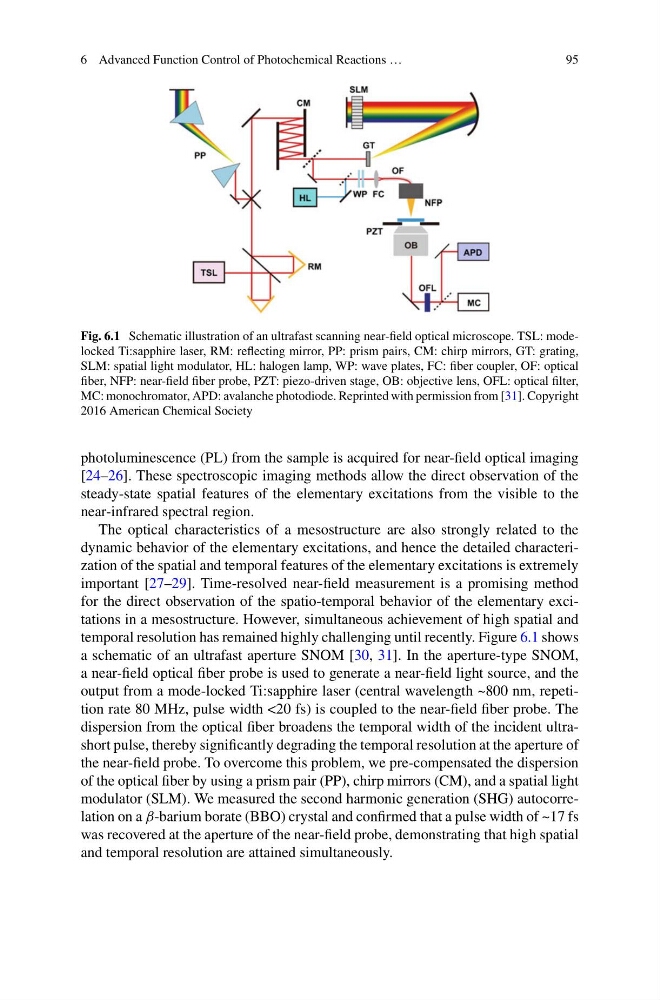
Fig. 6.1 Schematic illustration of an ultrafast scanning near-field optical microscope. TSL: modelocked Ti:sapphire laser, RM: reflecting mirror, PP: prism pairs, CM: chirp mirrors, GT: grating,
SLM: spatial light modulator, HL: halogen lamp, WP: wave plates, FC: fiber coupler, OF: optical
fiber, NFP: near-field fiber probe, PZT: piezo-driven stage, OB: objective lens, OFL: optical filter,
MC: monochromator, APD: avalanche photodiode. Reprinted with permission from [31]. Copyright
2016 American Chemical Society
photoluminescence (PL) from the sample is acquired for near-field optical imaging
[24–26]. These spectroscopic imaging methods allow the direct observation of the
steady-state spatial features of the elementary excitations from the visible to the
near-infrared spectral region.
The optical characteristics of a mesostructure are also strongly related to the
dynamic behavior of the elementary excitations, and hence the detailed characterization of the spatial and temporal features of the elementary excitations is extremely
important [27–29]. Time-resolved near-field measurement is a promising method
for the direct observation of the spatio-temporal behavior of the elementary excitations in a mesostructure. However, simultaneous achievement of high spatial and
temporal resolution has remained highly challenging until recently. Figure 6.1 shows
a schematic of an ultrafast aperture SNOM [30, 31]. In the aperture-type SNOM,
a near-field optical fiber probe is used to generate a near-field light source, and the
output from a mode-locked Ti:sapphire laser (central wavelength ~800 nm, repetition rate 80 MHz, pulse width <20 fs) is coupled to the near-field fiber probe. The
dispersion from the optical fiber broadens the temporal width of the incident ultrashort pulse, thereby significantly degrading the temporal resolution at the aperture of
the near-field probe. To overcome this problem, we pre-compensated the dispersion
of the optical fiber by using a prism pair (PP), chirp mirrors (CM), and a spatial light
modulator (SLM). We measured the second harmonic generation (SHG) autocorrelation on a β-barium borate (BBO) crystal and confirmed that a pulse width of ~17 fs
was recovered at the aperture of the near-field probe, demonstrating that high spatial
and temporal resolution are attained simultaneously.
95
Fig. 6.1 Schematic illustration of an ultrafast scanning near-field optical microscope. TSL: modelocked Ti:sapphire laser, RM: reflecting mirror, PP: prism pairs, CM: chirp mirrors, GT: grating,
SLM: spatial light modulator, HL: halogen lamp, WP: wave plates, FC: fiber coupler, OF: optical
fiber, NFP: near-field fiber probe, PZT: piezo-driven stage, OB: objective lens, OFL: optical filter,
MC: monochromator, APD: avalanche photodiode. Reprinted with permission from [31]. Copyright
2016 American Chemical Society
photoluminescence (PL) from the sample is acquired for near-field optical imaging
[24–26]. These spectroscopic imaging methods allow the direct observation of the
steady-state spatial features of the elementary excitations from the visible to the
near-infrared spectral region.
The optical characteristics of a mesostructure are also strongly related to the
dynamic behavior of the elementary excitations, and hence the detailed characterization of the spatial and temporal features of the elementary excitations is extremely
important [27–29]. Time-resolved near-field measurement is a promising method
for the direct observation of the spatio-temporal behavior of the elementary excitations in a mesostructure. However, simultaneous achievement of high spatial and
temporal resolution has remained highly challenging until recently. Figure 6.1 shows
a schematic of an ultrafast aperture SNOM [30, 31]. In the aperture-type SNOM,
a near-field optical fiber probe is used to generate a near-field light source, and the
output from a mode-locked Ti:sapphire laser (central wavelength ~800 nm, repetition rate 80 MHz, pulse width <20 fs) is coupled to the near-field fiber probe. The
dispersion from the optical fiber broadens the temporal width of the incident ultrashort pulse, thereby significantly degrading the temporal resolution at the aperture of
the near-field probe. To overcome this problem, we pre-compensated the dispersion
of the optical fiber by using a prism pair (PP), chirp mirrors (CM), and a spatial light
modulator (SLM). We measured the second harmonic generation (SHG) autocorrelation on a β-barium borate (BBO) crystal and confirmed that a pulse width of ~17 fs
was recovered at the aperture of the near-field probe, demonstrating that high spatial
and temporal resolution are attained simultaneously.