

4 Permutation Matrices Associated to Bent Functions
91
Correspondingly,
D 2 ˜
f (x) =
−2 ˜
f (x), if x 1 = 1,
0,
if x 1 = 0.
So,
D 2l+1 ˜
f (x) =
−2 ˜
f (x), if x 2l+2 = 1,
0,
otherwise,
D 2l+2 ˜
f (x) =
−2 ˜
f (x), if x 2l+1 = 1,
0,
otherwise,
for l = 0, 1, 2, . . . , n/2 − 1.
Notice that if we put the partial derivatives in order D 2 , D 1 , D 4 , D 3 and ignore
signs we get the binary numbers in the order 1, 2, 3, . . . , 15. This is identity
permutation and others come in the same natural way.
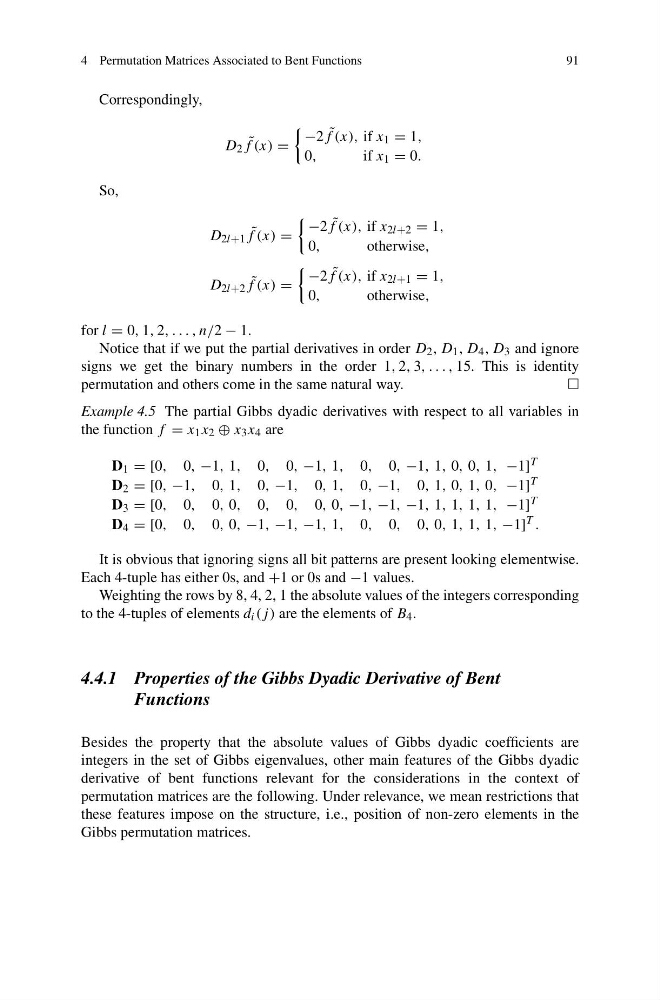
Example 4.5 The partial Gibbs dyadic derivatives with respect to all variables in
the function f = x 1 x 2 ⊕ x 3 x 4 are
D 1 = [0, 0, −1, 1, 0, 0, −1, 1, 0, 0, −1, 1, 0, 0, 1, −1] T
D 2 = [0, −1, 0, 1, 0, −1, 0, 1, 0, −1, 0, 1, 0, 1, 0, −1] T
D 3 = [0, 0, 0, 0, 0, 0, 0, 0, −1, −1, −1, 1, 1, 1, 1, −1] T
D 4 = [0, 0, 0, 0, −1, −1, −1, 1, 0, 0, 0, 0, 1, 1, 1, −1] T .
It is obvious that ignoring signs all bit patterns are present looking elementwise.
Each 4-tuple has either 0s, and +1 or 0s and −1 values.
Weighting the rows by 8, 4, 2, 1 the absolute values of the integers corresponding
to the 4-tuples of elements d i (j ) are the elements of B 4 .
4.4.1 Properties of the Gibbs Dyadic Derivative of Bent
Functions
Besides the property that the absolute values of Gibbs dyadic coefficients are
integers in the set of Gibbs eigenvalues, other main features of the Gibbs dyadic
derivative of bent functions relevant for the considerations in the context of
permutation matrices are the following. Under relevance, we mean restrictions that
these features impose on the structure, i.e., position of non-zero elements in the
Gibbs permutation matrices.
91
Correspondingly,
D 2 ˜
f (x) =
−2 ˜
f (x), if x 1 = 1,
0,
if x 1 = 0.
So,
D 2l+1 ˜
f (x) =
−2 ˜
f (x), if x 2l+2 = 1,
0,
otherwise,
D 2l+2 ˜
f (x) =
−2 ˜
f (x), if x 2l+1 = 1,
0,
otherwise,
for l = 0, 1, 2, . . . , n/2 − 1.
Notice that if we put the partial derivatives in order D 2 , D 1 , D 4 , D 3 and ignore
signs we get the binary numbers in the order 1, 2, 3, . . . , 15. This is identity
permutation and others come in the same natural way.
Example 4.5 The partial Gibbs dyadic derivatives with respect to all variables in
the function f = x 1 x 2 ⊕ x 3 x 4 are
D 1 = [0, 0, −1, 1, 0, 0, −1, 1, 0, 0, −1, 1, 0, 0, 1, −1] T
D 2 = [0, −1, 0, 1, 0, −1, 0, 1, 0, −1, 0, 1, 0, 1, 0, −1] T
D 3 = [0, 0, 0, 0, 0, 0, 0, 0, −1, −1, −1, 1, 1, 1, 1, −1] T
D 4 = [0, 0, 0, 0, −1, −1, −1, 1, 0, 0, 0, 0, 1, 1, 1, −1] T .
It is obvious that ignoring signs all bit patterns are present looking elementwise.
Each 4-tuple has either 0s, and +1 or 0s and −1 values.
Weighting the rows by 8, 4, 2, 1 the absolute values of the integers corresponding
to the 4-tuples of elements d i (j ) are the elements of B 4 .
4.4.1 Properties of the Gibbs Dyadic Derivative of Bent
Functions
Besides the property that the absolute values of Gibbs dyadic coefficients are
integers in the set of Gibbs eigenvalues, other main features of the Gibbs dyadic
derivative of bent functions relevant for the considerations in the context of
permutation matrices are the following. Under relevance, we mean restrictions that
these features impose on the structure, i.e., position of non-zero elements in the
Gibbs permutation matrices.