

90
R. S. Stankovi´ c et al.
and the Walsh spectrum is
S f = 4F = [4, 4, 4, −4, 4, 4, 4, −4, 4, 4, 4, −4, −4, −4, −4, 4]
T .
The Gibbs dyadic derivative of this function is
D f = [0, 2, 1, −3, 8, 10, 9, 11, 4, 6, 5, −7, −12, −14, −13, 15]
T .
The logic complement of f is specified by the function vector
F = [−1, −1, −1, 1, −1, −1, −1, 1, −1, −1, −1, 1, 1, 1, 1, −1]
T ,
whose Walsh spectrum is
S f = [−4, −4, −4, 4, −4, −4, −4, 4, −4, −4, −4, 4, 4, 4, 4, −4]
T ,
and the Gibbs dyadic derivative
D f = [0, −2, −1, 3, −8, −10, −9, 11, −4, −6, −5, 7, 12, 14, 13, −15]
T .
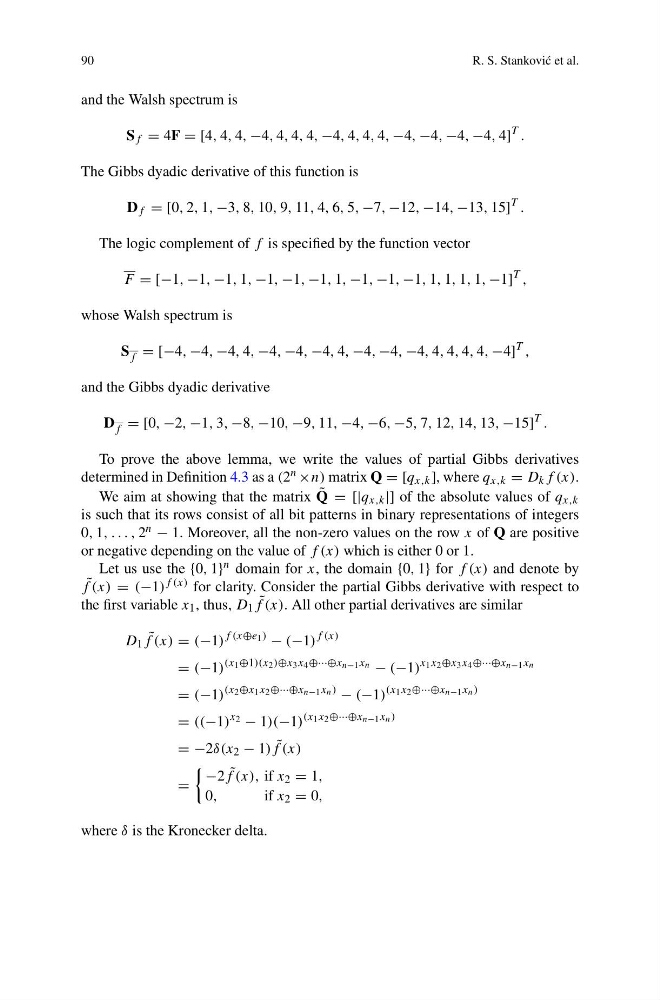
To prove the above lemma, we write the values of partial Gibbs derivatives
determined in Definition 4.3 as a (2 n ×n) matrix Q = [q x,k ], where q x,k = D k f (x).
We aim at showing that the matrix ˜
Q = [|q x,k |] of the absolute values of q x,k
is such that its rows consist of all bit patterns in binary representations of integers
0, 1, . . . , 2 n − 1. Moreover, all the non-zero values on the row x of Q are positive
or negative depending on the value of f (x) which is either 0 or 1.
Let us use the {0, 1} n domain for x, the domain {0, 1} for f (x) and denote by
˜
f (x) = (−1) f (x) for clarity. Consider the partial Gibbs derivative with respect to
the first variable x 1 , thus, D 1 ˜
f (x). All other partial derivatives are similar
D 1 ˜
f (x) = (−1)
f (x⊕e 1 )
− (−1)
f (x)
= (−1)
(x 1 ⊕1)(x 2 )⊕x 3 x 4 ⊕···⊕x n−1 x n − (−1)
x 1 x 2 ⊕x 3 x 4 ⊕···⊕x n−1 x n
= (−1)
(x 2 ⊕x 1 x 2 ⊕···⊕x n−1 x n )
− (−1)
(x 1 x 2 ⊕···⊕x n−1 x n )
= ((−1)
x 2 − 1)(−1)
(x 1 x 2 ⊕···⊕x n−1 x n )
= −2δ(x 2 − 1) ˜
f (x)
=
−2 ˜
f (x), if x 2 = 1,
0,
if x 2 = 0,
where δ is the Kronecker delta.
R. S. Stankovi´ c et al.
and the Walsh spectrum is
S f = 4F = [4, 4, 4, −4, 4, 4, 4, −4, 4, 4, 4, −4, −4, −4, −4, 4]
T .
The Gibbs dyadic derivative of this function is
D f = [0, 2, 1, −3, 8, 10, 9, 11, 4, 6, 5, −7, −12, −14, −13, 15]
T .
The logic complement of f is specified by the function vector
F = [−1, −1, −1, 1, −1, −1, −1, 1, −1, −1, −1, 1, 1, 1, 1, −1]
T ,
whose Walsh spectrum is
S f = [−4, −4, −4, 4, −4, −4, −4, 4, −4, −4, −4, 4, 4, 4, 4, −4]
T ,
and the Gibbs dyadic derivative
D f = [0, −2, −1, 3, −8, −10, −9, 11, −4, −6, −5, 7, 12, 14, 13, −15]
T .
To prove the above lemma, we write the values of partial Gibbs derivatives
determined in Definition 4.3 as a (2 n ×n) matrix Q = [q x,k ], where q x,k = D k f (x).
We aim at showing that the matrix ˜
Q = [|q x,k |] of the absolute values of q x,k
is such that its rows consist of all bit patterns in binary representations of integers
0, 1, . . . , 2 n − 1. Moreover, all the non-zero values on the row x of Q are positive
or negative depending on the value of f (x) which is either 0 or 1.
Let us use the {0, 1} n domain for x, the domain {0, 1} for f (x) and denote by
˜
f (x) = (−1) f (x) for clarity. Consider the partial Gibbs derivative with respect to
the first variable x 1 , thus, D 1 ˜
f (x). All other partial derivatives are similar
D 1 ˜
f (x) = (−1)
f (x⊕e 1 )
− (−1)
f (x)
= (−1)
(x 1 ⊕1)(x 2 )⊕x 3 x 4 ⊕···⊕x n−1 x n − (−1)
x 1 x 2 ⊕x 3 x 4 ⊕···⊕x n−1 x n
= (−1)
(x 2 ⊕x 1 x 2 ⊕···⊕x n−1 x n )
− (−1)
(x 1 x 2 ⊕···⊕x n−1 x n )
= ((−1)
x 2 − 1)(−1)
(x 1 x 2 ⊕···⊕x n−1 x n )
= −2δ(x 2 − 1) ˜
f (x)
=
−2 ˜
f (x), if x 2 = 1,
0,
if x 2 = 0,
where δ is the Kronecker delta.