

152
E. C. Ferraz et al.
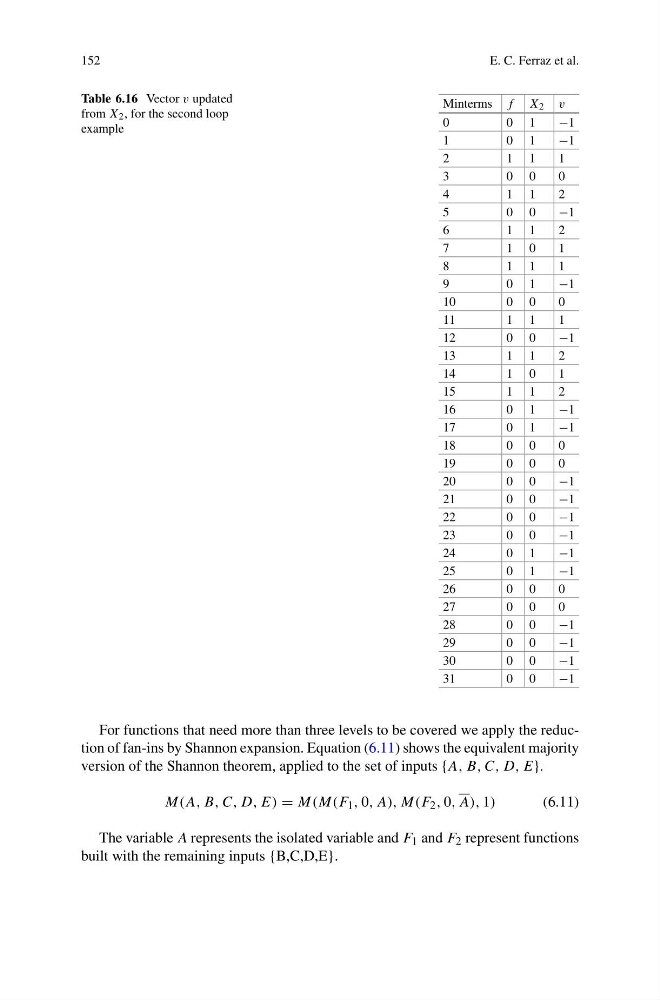
Table 6.16 Vector v updated
from X 2 , for the second loop
example
Minterms f X 2 v
0
0 1
−1
1
0 1
−1
2
1 1
1
3
0 0
0
4
1 1
2
5
0 0
−1
6
1 1
2
7
1 0
1
8
1 1
1
9
0 1
−1
10
0 0
0
11
1 1
1
12
0 0
−1
13
1 1
2
14
1 0
1
15
1 1
2
16
0 1
−1
17
0 1
−1
18
0 0
0
19
0 0
0
20
0 0
−1
21
0 0
−1
22
0 0
−1
23
0 0
−1
24
0 1
−1
25
0 1
−1
26
0 0
0
27
0 0
0
28
0 0
−1
29
0 0
−1
30
0 0
−1
31
0 0
−1
For functions that need more than three levels to be covered we apply the reduction of fan-ins by Shannon expansion. Equation (6.11) shows the equivalent majority
version of the Shannon theorem, applied to the set of inputs {A, B, C, D, E}.
M(A, B, C, D, E) = M(M(F 1 , 0, A), M(F 2 , 0, A), 1)
(6.11)
The variable A represents the isolated variable and F 1 and F 2 represent functions
built with the remaining inputs {B,C,D,E}.
E. C. Ferraz et al.
Table 6.16 Vector v updated
from X 2 , for the second loop
example
Minterms f X 2 v
0
0 1
−1
1
0 1
−1
2
1 1
1
3
0 0
0
4
1 1
2
5
0 0
−1
6
1 1
2
7
1 0
1
8
1 1
1
9
0 1
−1
10
0 0
0
11
1 1
1
12
0 0
−1
13
1 1
2
14
1 0
1
15
1 1
2
16
0 1
−1
17
0 1
−1
18
0 0
0
19
0 0
0
20
0 0
−1
21
0 0
−1
22
0 0
−1
23
0 0
−1
24
0 1
−1
25
0 1
−1
26
0 0
0
27
0 0
0
28
0 0
−1
29
0 0
−1
30
0 0
−1
31
0 0
−1
For functions that need more than three levels to be covered we apply the reduction of fan-ins by Shannon expansion. Equation (6.11) shows the equivalent majority
version of the Shannon theorem, applied to the set of inputs {A, B, C, D, E}.
M(A, B, C, D, E) = M(M(F 1 , 0, A), M(F 2 , 0, A), 1)
(6.11)
The variable A represents the isolated variable and F 1 and F 2 represent functions
built with the remaining inputs {B,C,D,E}.