

4 Permutation Matrices Associated to Bent Functions
103
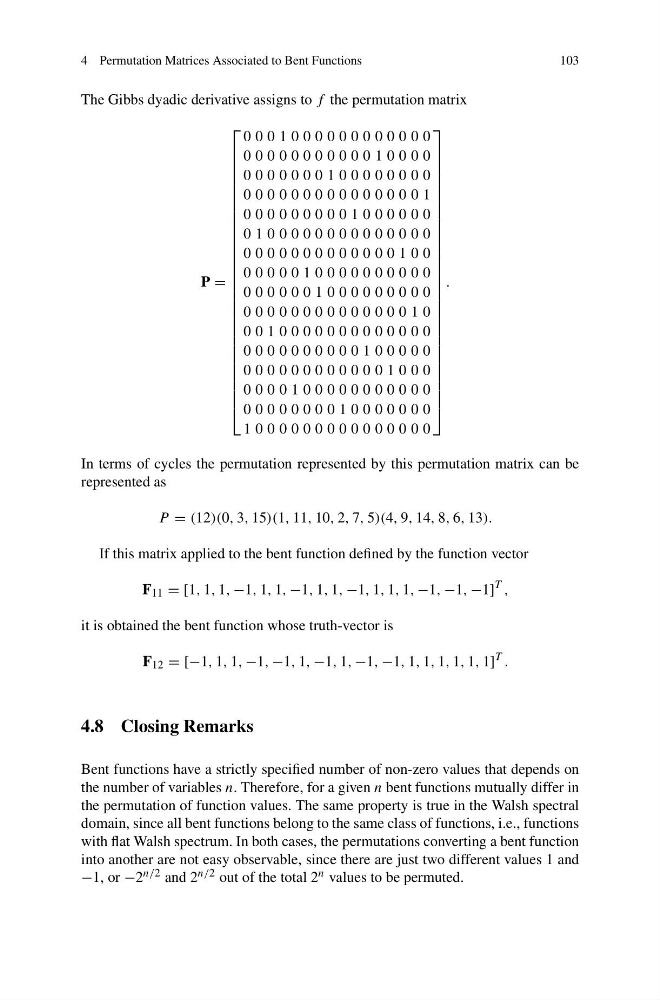
The Gibbs dyadic derivative assigns to f the permutation matrix
P =
⎡
⎢
⎢
⎢
⎢
⎢
⎢
⎢
⎢
⎢
⎢
⎢
⎢
⎢
⎢
⎢
⎢
⎢
⎢
⎢
⎢
⎢
⎢
⎢
⎢
⎢
⎢
⎢
⎢
⎣
0 0 0 1 0 0 0 0 0 0 0 0 0 0 0 0
0 0 0 0 0 0 0 0 0 0 0 1 0 0 0 0
0 0 0 0 0 0 0 1 0 0 0 0 0 0 0 0
0 0 0 0 0 0 0 0 0 0 0 0 0 0 0 1
0 0 0 0 0 0 0 0 0 1 0 0 0 0 0 0
0 1 0 0 0 0 0 0 0 0 0 0 0 0 0 0
0 0 0 0 0 0 0 0 0 0 0 0 0 1 0 0
0 0 0 0 0 1 0 0 0 0 0 0 0 0 0 0
0 0 0 0 0 0 1 0 0 0 0 0 0 0 0 0
0 0 0 0 0 0 0 0 0 0 0 0 0 0 1 0
0 0 1 0 0 0 0 0 0 0 0 0 0 0 0 0
0 0 0 0 0 0 0 0 0 0 1 0 0 0 0 0
0 0 0 0 0 0 0 0 0 0 0 0 1 0 0 0
0 0 0 0 1 0 0 0 0 0 0 0 0 0 0 0
0 0 0 0 0 0 0 0 1 0 0 0 0 0 0 0
1 0 0 0 0 0 0 0 0 0 0 0 0 0 0 0
⎤
⎥
⎥
⎥
⎥
⎥
⎥
⎥
⎥
⎥
⎥
⎥
⎥
⎥
⎥
⎥
⎥
⎥
⎥
⎥
⎥
⎥
⎥
⎥
⎥
⎥
⎥
⎥
⎥
⎦
.
In terms of cycles the permutation represented by this permutation matrix can be
represented as
P = (12)(0, 3, 15)(1, 11, 10, 2, 7, 5)(4, 9, 14, 8, 6, 13).
If this matrix applied to the bent function defined by the function vector
F 11 = [1, 1, 1, −1, 1, 1, −1, 1, 1, −1, 1, 1, 1, −1, −1, −1]
T ,
it is obtained the bent function whose truth-vector is
F 12 = [−1, 1, 1, −1, −1, 1, −1, 1, −1, −1, 1, 1, 1, 1, 1, 1]
T .
4.8 Closing Remarks
Bent functions have a strictly specified number of non-zero values that depends on
the number of variables n. Therefore, for a given n bent functions mutually differ in
the permutation of function values. The same property is true in the Walsh spectral
domain, since all bent functions belong to the same class of functions, i.e., functions
with flat Walsh spectrum. In both cases, the permutations converting a bent function
into another are not easy observable, since there are just two different values 1 and
−1, or −2 n/2 and 2 n/2 out of the total 2 n values to be permuted.
103
The Gibbs dyadic derivative assigns to f the permutation matrix
P =
⎡
⎢
⎢
⎢
⎢
⎢
⎢
⎢
⎢
⎢
⎢
⎢
⎢
⎢
⎢
⎢
⎢
⎢
⎢
⎢
⎢
⎢
⎢
⎢
⎢
⎢
⎢
⎢
⎢
⎣
0 0 0 1 0 0 0 0 0 0 0 0 0 0 0 0
0 0 0 0 0 0 0 0 0 0 0 1 0 0 0 0
0 0 0 0 0 0 0 1 0 0 0 0 0 0 0 0
0 0 0 0 0 0 0 0 0 0 0 0 0 0 0 1
0 0 0 0 0 0 0 0 0 1 0 0 0 0 0 0
0 1 0 0 0 0 0 0 0 0 0 0 0 0 0 0
0 0 0 0 0 0 0 0 0 0 0 0 0 1 0 0
0 0 0 0 0 1 0 0 0 0 0 0 0 0 0 0
0 0 0 0 0 0 1 0 0 0 0 0 0 0 0 0
0 0 0 0 0 0 0 0 0 0 0 0 0 0 1 0
0 0 1 0 0 0 0 0 0 0 0 0 0 0 0 0
0 0 0 0 0 0 0 0 0 0 1 0 0 0 0 0
0 0 0 0 0 0 0 0 0 0 0 0 1 0 0 0
0 0 0 0 1 0 0 0 0 0 0 0 0 0 0 0
0 0 0 0 0 0 0 0 1 0 0 0 0 0 0 0
1 0 0 0 0 0 0 0 0 0 0 0 0 0 0 0
⎤
⎥
⎥
⎥
⎥
⎥
⎥
⎥
⎥
⎥
⎥
⎥
⎥
⎥
⎥
⎥
⎥
⎥
⎥
⎥
⎥
⎥
⎥
⎥
⎥
⎥
⎥
⎥
⎥
⎦
.
In terms of cycles the permutation represented by this permutation matrix can be
represented as
P = (12)(0, 3, 15)(1, 11, 10, 2, 7, 5)(4, 9, 14, 8, 6, 13).
If this matrix applied to the bent function defined by the function vector
F 11 = [1, 1, 1, −1, 1, 1, −1, 1, 1, −1, 1, 1, 1, −1, −1, −1]
T ,
it is obtained the bent function whose truth-vector is
F 12 = [−1, 1, 1, −1, −1, 1, −1, 1, −1, −1, 1, 1, 1, 1, 1, 1]
T .
4.8 Closing Remarks
Bent functions have a strictly specified number of non-zero values that depends on
the number of variables n. Therefore, for a given n bent functions mutually differ in
the permutation of function values. The same property is true in the Walsh spectral
domain, since all bent functions belong to the same class of functions, i.e., functions
with flat Walsh spectrum. In both cases, the permutations converting a bent function
into another are not easy observable, since there are just two different values 1 and
−1, or −2 n/2 and 2 n/2 out of the total 2 n values to be permuted.