

76
Water for Energy and Fuel Production
equilibrium can be achieved at an oxygen-to-carbon ratio of 1 and a steam-to-carbon
ratio of 1.25 at 700°C temperature.
The advanced thermal recycling (ATR) process requires catalysts and supports
with high resistance to coking at high temperatures. Excess steam and/or oxygen helps
avoid coking. Also at high temperature, sulfur is less of a problem. The noble metal
catalysts (Pt, Rh, Ru) supported on ceria or zirconium or their mixtures work well.
In the recent years, applications of pervoskite oxides (ABO 3 ) for steam reforming of
higher hydrocarbons and various fuels have been extensively examined [135–142] (Sun
et al. 2001, pers. comm.). A group of six metal carbides has also shown a good success.
4.5.2.4 Glycerol
Glycerol has been a byproduct of a number of conversion processes, particularly
transesterification of used oil, algae, and crop oils (there are about 350 of them) to
produce diesel fuel [143–155] (Cheng et al., 2012, pers. comm.). This byproduct can
also be effectively utilized to produce hydrogen by steam reforming process. Steam
reforming of glycerol involves a complex set of reactions, numerous intermediates,
and hydrogen that is accompanied by several other products. The hydrogen yield
depends on the steam-to-glycerol ratio and follows the reactions:
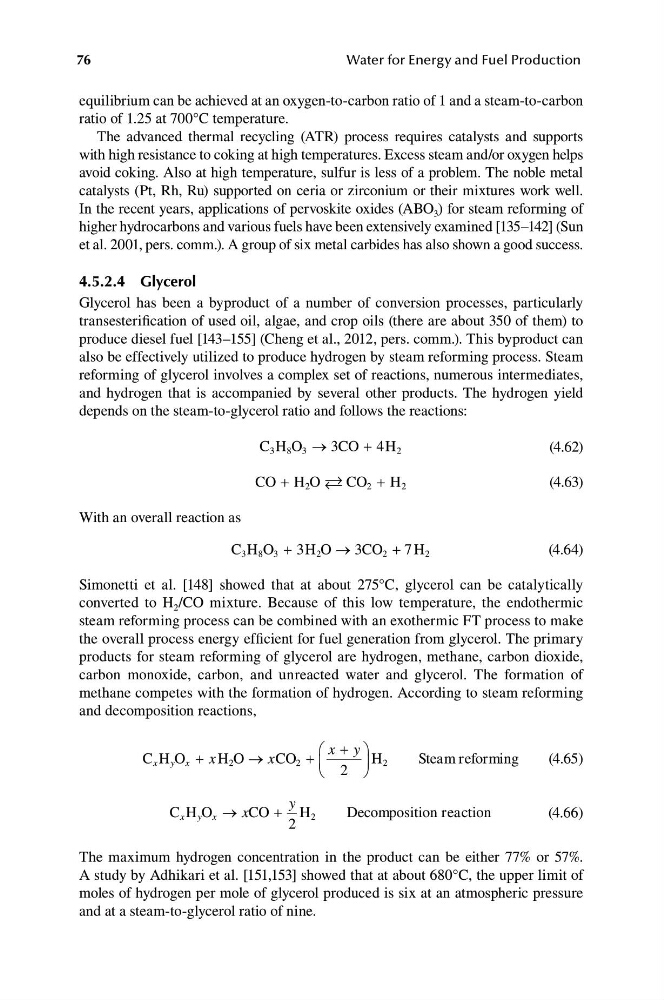
C 3 H 8 O 3 → 3CO + 4H 2
(4.62)
CO + H 2 O CO 2 + H 2
(4.63)
With an overall reaction as
C 3 H 8 O 3 + 3H 2 O → 3CO 2 + 7 H 2
(4.64)
Simonetti et al. [148] showed that at about 275°C, glycerol can be catalytically
converted to H 2 /CO mixture. Because of this low temperature, the endothermic
steam reforming process can be combined with an exothermic FT process to make
the overall process energy efficient for fuel generation from glycerol. The primary
products for steam reforming of glycerol are hydrogen, methane, carbon dioxide,
carbon monoxide, carbon, and unreacted water and glycerol. The formation of
methane competes with the formation of hydrogen. According to steam reforming
and decomposition reactions,
x + y
C x H y O x + x H 2 O → xCO 2 +
H 2
Steam reforming
(4.65)
2
y
C x H y O x → xCO + H 2
Decomposition reaction
(4.66)
2
The maximum hydrogen concentration in the product can be either 77% or 57%.
A study by Adhikari et al. [151,153] showed that at about 680°C, the upper limit of
moles of hydrogen per mole of glycerol produced is six at an atmospheric pressure
and at a steam-to-glycerol ratio of nine.
Water for Energy and Fuel Production
equilibrium can be achieved at an oxygen-to-carbon ratio of 1 and a steam-to-carbon
ratio of 1.25 at 700°C temperature.
The advanced thermal recycling (ATR) process requires catalysts and supports
with high resistance to coking at high temperatures. Excess steam and/or oxygen helps
avoid coking. Also at high temperature, sulfur is less of a problem. The noble metal
catalysts (Pt, Rh, Ru) supported on ceria or zirconium or their mixtures work well.
In the recent years, applications of pervoskite oxides (ABO 3 ) for steam reforming of
higher hydrocarbons and various fuels have been extensively examined [135–142] (Sun
et al. 2001, pers. comm.). A group of six metal carbides has also shown a good success.
4.5.2.4 Glycerol
Glycerol has been a byproduct of a number of conversion processes, particularly
transesterification of used oil, algae, and crop oils (there are about 350 of them) to
produce diesel fuel [143–155] (Cheng et al., 2012, pers. comm.). This byproduct can
also be effectively utilized to produce hydrogen by steam reforming process. Steam
reforming of glycerol involves a complex set of reactions, numerous intermediates,
and hydrogen that is accompanied by several other products. The hydrogen yield
depends on the steam-to-glycerol ratio and follows the reactions:
C 3 H 8 O 3 → 3CO + 4H 2
(4.62)
CO + H 2 O CO 2 + H 2
(4.63)
With an overall reaction as
C 3 H 8 O 3 + 3H 2 O → 3CO 2 + 7 H 2
(4.64)
Simonetti et al. [148] showed that at about 275°C, glycerol can be catalytically
converted to H 2 /CO mixture. Because of this low temperature, the endothermic
steam reforming process can be combined with an exothermic FT process to make
the overall process energy efficient for fuel generation from glycerol. The primary
products for steam reforming of glycerol are hydrogen, methane, carbon dioxide,
carbon monoxide, carbon, and unreacted water and glycerol. The formation of
methane competes with the formation of hydrogen. According to steam reforming
and decomposition reactions,
x + y
C x H y O x + x H 2 O → xCO 2 +
H 2
Steam reforming
(4.65)
2
y
C x H y O x → xCO + H 2
Decomposition reaction
(4.66)
2
The maximum hydrogen concentration in the product can be either 77% or 57%.
A study by Adhikari et al. [151,153] showed that at about 680°C, the upper limit of
moles of hydrogen per mole of glycerol produced is six at an atmospheric pressure
and at a steam-to-glycerol ratio of nine.