

75
Steam Gasification and Reforming Technologies
[134] examined a strategy in which a coal-derived methanol is used as a hydrogen
carrier. The steam reforming of methanol can generate hydrogen at the desired place.
4.5.2.3 liquid hydrocarbons
Besides methane, methanol, and ethanol, gasoline, diesel, and jet fuel can also be
important feedstock for the steam reforming to produce hydrogen [135–142] (Sun
et al. 2001, pers. comm.). These three types of fuels contain a variety of hydrocarbons and sulfur. While these components themselves can be important feedstock for
steam reforming, they are not as readily available on a large scale as various other
fuels. The technical problems associated with these hydrocarbons include (1) the
catalyst deactivation by sulfur in the feedstock and (2) the significant amount of
coke deposition on the catalyst that eventually results in its deactivation. Along with
steam reforming, in the recent years, catalytic partial oxidation of high hydrocarbons
using short contact time (milliseconds) and high temperatures (850°C–900°C) over
noble metal catalysts on porous monolithic ceramic supports have been examined
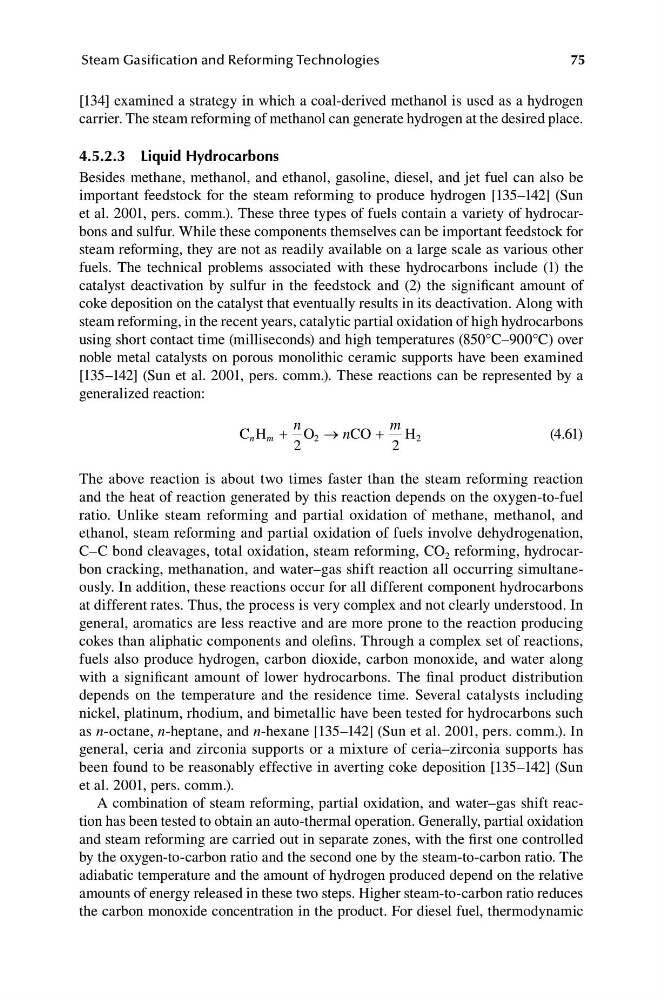
[135–142] (Sun et al. 2001, pers. comm.). These reactions can be represented by a
generalized reaction:
n
m
C n H m + O 2 → nCO + H
(
2
2
2
4.61)
The above reaction is about two times faster than the steam reforming reaction
and the heat of reaction generated by this reaction depends on the oxygen-to-fuel
ratio. Unlike steam reforming and partial oxidation of methane, methanol, and
ethanol, steam reforming and partial oxidation of fuels involve dehydrogenation,
C–C bond cleavages, total oxidation, steam reforming, CO 2 reforming, hydrocarbon cracking, methanation, and water–gas shift reaction all occurring simultaneously. In addition, these reactions occur for all different component hydrocarbons
at different rates. Thus, the process is very complex and not clearly understood. In
general, aromatics are less reactive and are more prone to the reaction producing
cokes than aliphatic components and olefins. Through a complex set of reactions,
fuels also produce hydrogen, carbon dioxide, carbon monoxide, and water along
with a significant amount of lower hydrocarbons. The final product distribution
depends on the temperature and the residence time. Several catalysts including
nickel, platinum, rhodium, and bimetallic have been tested for hydrocarbons such
as n-octane, n-heptane, and n-hexane [135–142] (Sun et al. 2001, pers. comm.). In
general, ceria and zirconia supports or a mixture of ceria–zirconia supports has
been found to be reasonably effective in averting coke deposition [135–142] (Sun
et al. 2001, pers. comm.).
A combination of steam reforming, partial oxidation, and water–gas shift reaction has been tested to obtain an auto-thermal operation. Generally, partial oxidation
and steam reforming are carried out in separate zones, with the first one controlled
by the oxygen-to-carbon ratio and the second one by the steam-to-carbon ratio. The
adiabatic temperature and the amount of hydrogen produced depend on the relative
amounts of energy released in these two steps. Higher steam-to-carbon ratio reduces
the carbon monoxide concentration in the product. For diesel fuel, thermodynamic
Steam Gasification and Reforming Technologies
[134] examined a strategy in which a coal-derived methanol is used as a hydrogen
carrier. The steam reforming of methanol can generate hydrogen at the desired place.
4.5.2.3 liquid hydrocarbons
Besides methane, methanol, and ethanol, gasoline, diesel, and jet fuel can also be
important feedstock for the steam reforming to produce hydrogen [135–142] (Sun
et al. 2001, pers. comm.). These three types of fuels contain a variety of hydrocarbons and sulfur. While these components themselves can be important feedstock for
steam reforming, they are not as readily available on a large scale as various other
fuels. The technical problems associated with these hydrocarbons include (1) the
catalyst deactivation by sulfur in the feedstock and (2) the significant amount of
coke deposition on the catalyst that eventually results in its deactivation. Along with
steam reforming, in the recent years, catalytic partial oxidation of high hydrocarbons
using short contact time (milliseconds) and high temperatures (850°C–900°C) over
noble metal catalysts on porous monolithic ceramic supports have been examined
[135–142] (Sun et al. 2001, pers. comm.). These reactions can be represented by a
generalized reaction:
n
m
C n H m + O 2 → nCO + H
(
2
2
2
4.61)
The above reaction is about two times faster than the steam reforming reaction
and the heat of reaction generated by this reaction depends on the oxygen-to-fuel
ratio. Unlike steam reforming and partial oxidation of methane, methanol, and
ethanol, steam reforming and partial oxidation of fuels involve dehydrogenation,
C–C bond cleavages, total oxidation, steam reforming, CO 2 reforming, hydrocarbon cracking, methanation, and water–gas shift reaction all occurring simultaneously. In addition, these reactions occur for all different component hydrocarbons
at different rates. Thus, the process is very complex and not clearly understood. In
general, aromatics are less reactive and are more prone to the reaction producing
cokes than aliphatic components and olefins. Through a complex set of reactions,
fuels also produce hydrogen, carbon dioxide, carbon monoxide, and water along
with a significant amount of lower hydrocarbons. The final product distribution
depends on the temperature and the residence time. Several catalysts including
nickel, platinum, rhodium, and bimetallic have been tested for hydrocarbons such
as n-octane, n-heptane, and n-hexane [135–142] (Sun et al. 2001, pers. comm.). In
general, ceria and zirconia supports or a mixture of ceria–zirconia supports has
been found to be reasonably effective in averting coke deposition [135–142] (Sun
et al. 2001, pers. comm.).
A combination of steam reforming, partial oxidation, and water–gas shift reaction has been tested to obtain an auto-thermal operation. Generally, partial oxidation
and steam reforming are carried out in separate zones, with the first one controlled
by the oxygen-to-carbon ratio and the second one by the steam-to-carbon ratio. The
adiabatic temperature and the amount of hydrogen produced depend on the relative
amounts of energy released in these two steps. Higher steam-to-carbon ratio reduces
the carbon monoxide concentration in the product. For diesel fuel, thermodynamic