

Yield of hydrogen (vol%)
50
45
40
35
30
25
20
15
10
600
1100
1200
Supercritical fluid extraction
Conventional pyrolysis
Steam gasification
700
800
900
1000
Temperature (K)
64
Water for Energy and Fuel Production
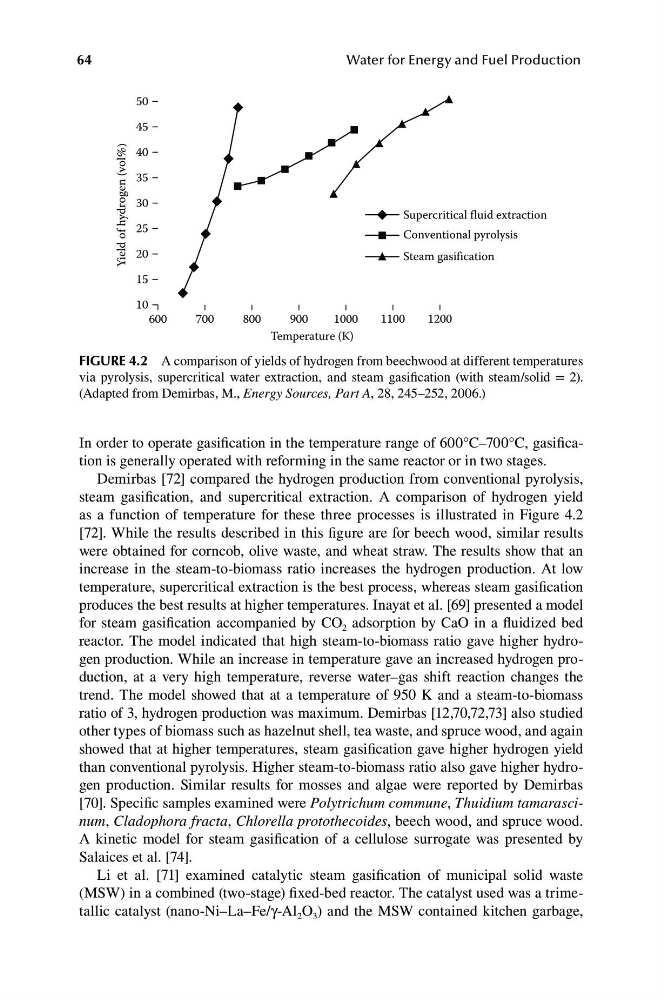
FiGUre 4.2 A comparison of yields of hydrogen from beechwood at different temperatures
via pyrolysis, supercritical water extraction, and steam gasification (with steam/solid = 2).
(Adapted from Demirbas, M., Energy Sources, Part A, 28, 245–252, 2006.)
In order to operate gasification in the temperature range of 600°C–700°C, gasification is generally operated with reforming in the same reactor or in two stages.
Demirbas [72] compared the hydrogen production from conventional pyrolysis,
steam gasification, and supercritical extraction. A comparison of hydrogen yield
as a function of temperature for these three processes is illustrated in Figure 4.2
[72]. While the results described in this figure are for beech wood, similar results
were obtained for corncob, olive waste, and wheat straw. The results show that an
increase in the steam-to-biomass ratio increases the hydrogen production. At low
temperature, supercritical extraction is the best process, whereas steam gasification
produces the best results at higher temperatures. Inayat et al. [69] presented a model
for steam gasification accompanied by CO 2 adsorption by CaO in a fluidized bed
reactor. The model indicated that high steam-to-biomass ratio gave higher hydrogen production. While an increase in temperature gave an increased hydrogen production, at a very high temperature, reverse water–gas shift reaction changes the
trend. The model showed that at a temperature of 950 K and a steam-to-biomass
ratio of 3, hydrogen production was maximum. Demirbas [12,70,72,73] also studied
other types of biomass such as hazelnut shell, tea waste, and spruce wood, and again
showed that at higher temperatures, steam gasification gave higher hydrogen yield
than conventional pyrolysis. Higher steam-to-biomass ratio also gave higher hydrogen production. Similar results for mosses and algae were reported by Demirbas
[70]. Specific samples examined were Polytrichum commune, Thuidium tamarascinum, Cladophora fracta, Chlorella protothecoides, beech wood, and spruce wood.
A kinetic model for steam gasification of a cellulose surrogate was presented by
Salaices et al. [74].
Li et al. [71] examined catalytic steam gasification of municipal solid waste
(MSW) in a combined (two-stage) fixed-bed reactor. The catalyst used was a trimetallic catalyst (nano-Ni–La–Fe/γ-Al 2 O 3 ) and the MSW contained kitchen garbage,
50
45
40
35
30
25
20
15
10
600
1100
1200
Supercritical fluid extraction
Conventional pyrolysis
Steam gasification
700
800
900
1000
Temperature (K)
64
Water for Energy and Fuel Production
FiGUre 4.2 A comparison of yields of hydrogen from beechwood at different temperatures
via pyrolysis, supercritical water extraction, and steam gasification (with steam/solid = 2).
(Adapted from Demirbas, M., Energy Sources, Part A, 28, 245–252, 2006.)
In order to operate gasification in the temperature range of 600°C–700°C, gasification is generally operated with reforming in the same reactor or in two stages.
Demirbas [72] compared the hydrogen production from conventional pyrolysis,
steam gasification, and supercritical extraction. A comparison of hydrogen yield
as a function of temperature for these three processes is illustrated in Figure 4.2
[72]. While the results described in this figure are for beech wood, similar results
were obtained for corncob, olive waste, and wheat straw. The results show that an
increase in the steam-to-biomass ratio increases the hydrogen production. At low
temperature, supercritical extraction is the best process, whereas steam gasification
produces the best results at higher temperatures. Inayat et al. [69] presented a model
for steam gasification accompanied by CO 2 adsorption by CaO in a fluidized bed
reactor. The model indicated that high steam-to-biomass ratio gave higher hydrogen production. While an increase in temperature gave an increased hydrogen production, at a very high temperature, reverse water–gas shift reaction changes the
trend. The model showed that at a temperature of 950 K and a steam-to-biomass
ratio of 3, hydrogen production was maximum. Demirbas [12,70,72,73] also studied
other types of biomass such as hazelnut shell, tea waste, and spruce wood, and again
showed that at higher temperatures, steam gasification gave higher hydrogen yield
than conventional pyrolysis. Higher steam-to-biomass ratio also gave higher hydrogen production. Similar results for mosses and algae were reported by Demirbas
[70]. Specific samples examined were Polytrichum commune, Thuidium tamarascinum, Cladophora fracta, Chlorella protothecoides, beech wood, and spruce wood.
A kinetic model for steam gasification of a cellulose surrogate was presented by
Salaices et al. [74].
Li et al. [71] examined catalytic steam gasification of municipal solid waste
(MSW) in a combined (two-stage) fixed-bed reactor. The catalyst used was a trimetallic catalyst (nano-Ni–La–Fe/γ-Al 2 O 3 ) and the MSW contained kitchen garbage,