

63
Steam Gasification and Reforming Technologies
electricity with high efficiency or provide a feedstock for various chemical and fuel
productions. Steam gasification also (1) provides gases with high heating value,
(2) reduces the diluting effect of nitrogen from air, and (3) eliminates the need for
expensive oxygen separation plant. Catalytic gasification in a fluidized bed allows
(1) lower temperature, (2) a variety of particle sizes, and (3) a variety of feedstock.
A serious issue in the broad implementation of steam gasification is the generation of
unwanted materials such as tars, particles, nitrogen compounds, and alkali metals. Tar is
a mixture of one- to five-ring aromatic hydrocarbons that can plug the reactor. Its removal
is essential, which can be done either in the gasifier or by hot gas cleaning after the gasification process. Within the gasifier, tar can be reduced by choosing the appropriate operating parameters, inserting additive catalyst, or changing the gasifier design so that it cannot
plug t he r eactor. T he r emoval o f t ar t hermally r equires t he o peration o f t he g asifier a t a
temperature above 1000°C. The prevention of ash agglomeration however requires the
gasifier at a temperature below 700°C. Ash frequently contains various oxides of Ca, K,
Mg, P, Si, Na, and S that can agglomerate, deposit on the surface, and contribute to erosion and corrosion of the gasifier. Alkali metals can also react with silica to form silicates
or with sulfur to form alkali sulfates, both of which are sticky and can cause sintering and
defluidization [28,41–49,53–56,69–74] (Encinar et al., 2010, pers. comm.). Reforming
tar using a Ni catalyst is an effective method for removing tar. The coke deposition in
a reforming reaction can be reduced using excess steam. Catalytic steam gasification
of biomass is a complete network of heterogeneous reactions [28,41–49,53–56,69–74]
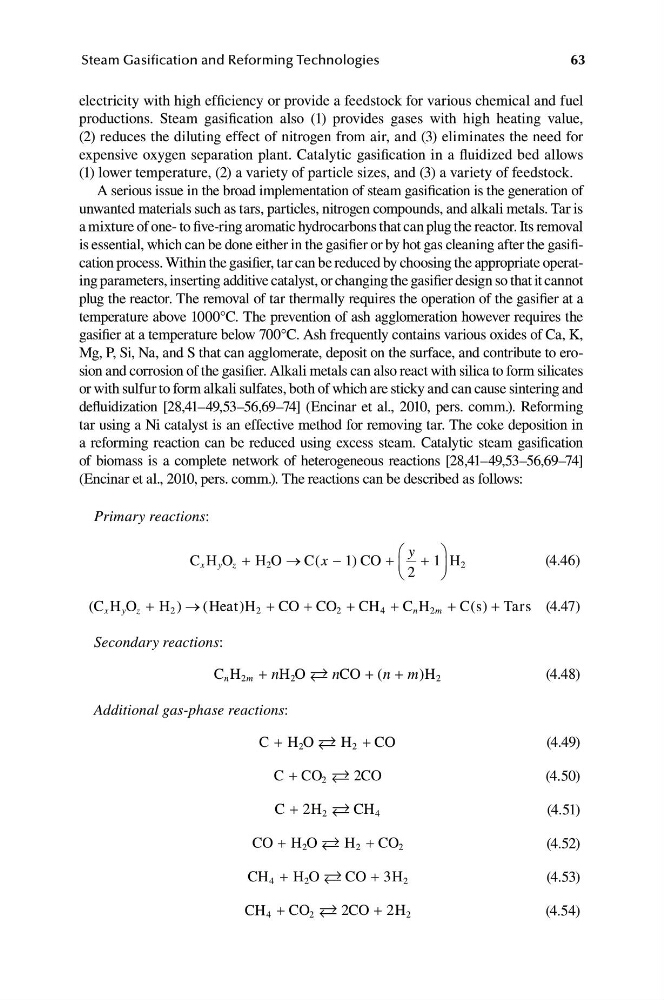
(Encinar et al., 2010, pers. comm.). The reactions can be described as follows:
Primary reactions:
y
C x H y O z + H 2 O → C(x − 1) CO + + 1 H
(4.46)
2
2
(C x H y O z + H 2 ) → (Heat)H 2 + CO + CO 2 + CH 4 + C n H 2m + C(s) + Tars (4.47)
Secondary reactions:
C n H 2m + nH 2 O nCO + (n + m)H 2
(4.48)
Additional gas-phase reactions:
C + H 2 O H 2 + CO
(4.49)
C + CO 2 2CO
(4.50)
C + 2H 2 CH 4
(4.51)
CO + H 2 O H 2 + CO 2
(4.52)
CH 4 + H 2 O CO + 3H 2
(4.53)
CH 4 + CO 2 2CO + 2H 2
(4.54)
Steam Gasification and Reforming Technologies
electricity with high efficiency or provide a feedstock for various chemical and fuel
productions. Steam gasification also (1) provides gases with high heating value,
(2) reduces the diluting effect of nitrogen from air, and (3) eliminates the need for
expensive oxygen separation plant. Catalytic gasification in a fluidized bed allows
(1) lower temperature, (2) a variety of particle sizes, and (3) a variety of feedstock.
A serious issue in the broad implementation of steam gasification is the generation of
unwanted materials such as tars, particles, nitrogen compounds, and alkali metals. Tar is
a mixture of one- to five-ring aromatic hydrocarbons that can plug the reactor. Its removal
is essential, which can be done either in the gasifier or by hot gas cleaning after the gasification process. Within the gasifier, tar can be reduced by choosing the appropriate operating parameters, inserting additive catalyst, or changing the gasifier design so that it cannot
plug t he r eactor. T he r emoval o f t ar t hermally r equires t he o peration o f t he g asifier a t a
temperature above 1000°C. The prevention of ash agglomeration however requires the
gasifier at a temperature below 700°C. Ash frequently contains various oxides of Ca, K,
Mg, P, Si, Na, and S that can agglomerate, deposit on the surface, and contribute to erosion and corrosion of the gasifier. Alkali metals can also react with silica to form silicates
or with sulfur to form alkali sulfates, both of which are sticky and can cause sintering and
defluidization [28,41–49,53–56,69–74] (Encinar et al., 2010, pers. comm.). Reforming
tar using a Ni catalyst is an effective method for removing tar. The coke deposition in
a reforming reaction can be reduced using excess steam. Catalytic steam gasification
of biomass is a complete network of heterogeneous reactions [28,41–49,53–56,69–74]
(Encinar et al., 2010, pers. comm.). The reactions can be described as follows:
Primary reactions:
y
C x H y O z + H 2 O → C(x − 1) CO + + 1 H
(4.46)
2
2
(C x H y O z + H 2 ) → (Heat)H 2 + CO + CO 2 + CH 4 + C n H 2m + C(s) + Tars (4.47)
Secondary reactions:
C n H 2m + nH 2 O nCO + (n + m)H 2
(4.48)
Additional gas-phase reactions:
C + H 2 O H 2 + CO
(4.49)
C + CO 2 2CO
(4.50)
C + 2H 2 CH 4
(4.51)
CO + H 2 O H 2 + CO 2
(4.52)
CH 4 + H 2 O CO + 3H 2
(4.53)
CH 4 + CO 2 2CO + 2H 2
(4.54)