

363
Power and Energy Directly from Water
GHG emissions, the creation and operation of dams have some environmental effects
such as changing ecosystems and displacing people and wildlife, and these issues
need to be considered in the development of the new hydroelectricity projects. There
are numerous methods for obtaining hydroelectricity. These are briefly described in
Sections 13.2.1 through 13.2.3 and in Section 13.2.6 [1–13].
13.2.1 ConvenTionAl dAmS
Most hydroelectric power comes from the potential energy of dammed water driving
a water turbine and generator [1–13]. The power extracted from the water depends on
the height of the dam and volume of waterfall. The potential energy is proportional
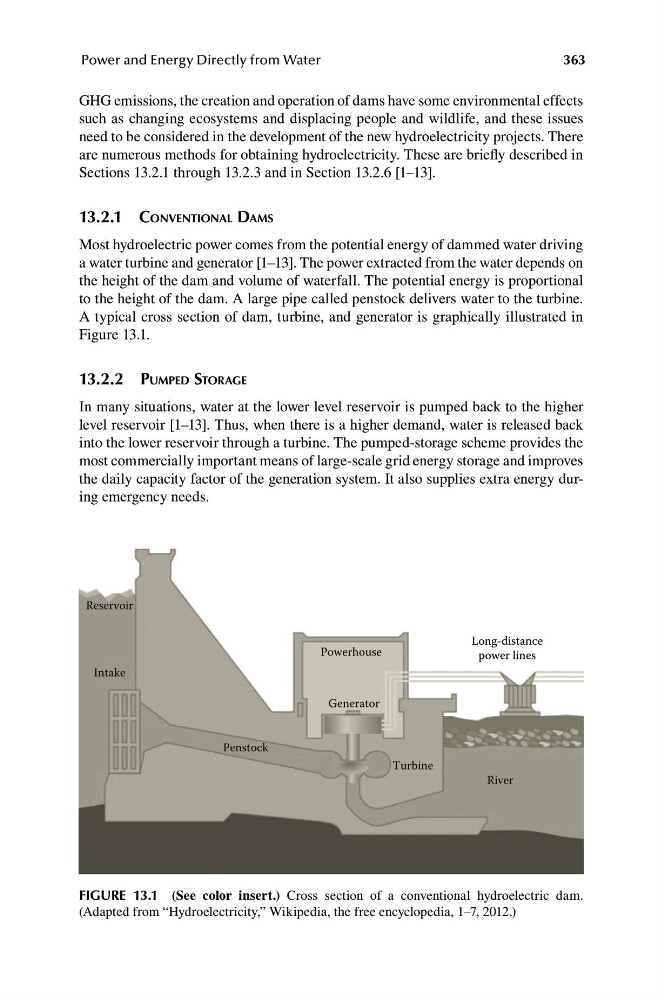
to the height of the dam. A large pipe called penstock delivers water to the turbine.
A typical cross section of dam, turbine, and generator is graphically illustrated in
Figure 13.1.
13.2.2 PumPed STorAge
In many situations, water at the lower level reservoir is pumped back to the higher
level reservoir [1–13]. Thus, when there is a higher demand, water is released back
into the lower reservoir through a turbine. The pumped-storage scheme provides the
most commercially important means of large-scale grid energy storage and improves
the daily capacity factor of the generation system. It also supplies extra energy during emergency needs.
Powerhouse
Long-distance
power lines
Generator
Turbine
River
Penstock
Intake
Reservoir
FiGUre 13.1 (See color insert.) Cross section of a conventional hydroelectric dam.
(Adapted from “Hydroelectricity,” Wikipedia, the free encyclopedia, 1–7, 2012.)
Power and Energy Directly from Water
GHG emissions, the creation and operation of dams have some environmental effects
such as changing ecosystems and displacing people and wildlife, and these issues
need to be considered in the development of the new hydroelectricity projects. There
are numerous methods for obtaining hydroelectricity. These are briefly described in
Sections 13.2.1 through 13.2.3 and in Section 13.2.6 [1–13].
13.2.1 ConvenTionAl dAmS
Most hydroelectric power comes from the potential energy of dammed water driving
a water turbine and generator [1–13]. The power extracted from the water depends on
the height of the dam and volume of waterfall. The potential energy is proportional
to the height of the dam. A large pipe called penstock delivers water to the turbine.
A typical cross section of dam, turbine, and generator is graphically illustrated in
Figure 13.1.
13.2.2 PumPed STorAge
In many situations, water at the lower level reservoir is pumped back to the higher
level reservoir [1–13]. Thus, when there is a higher demand, water is released back
into the lower reservoir through a turbine. The pumped-storage scheme provides the
most commercially important means of large-scale grid energy storage and improves
the daily capacity factor of the generation system. It also supplies extra energy during emergency needs.
Powerhouse
Long-distance
power lines
Generator
Turbine
River
Penstock
Intake
Reservoir
FiGUre 13.1 (See color insert.) Cross section of a conventional hydroelectric dam.
(Adapted from “Hydroelectricity,” Wikipedia, the free encyclopedia, 1–7, 2012.)