

Solar
thermolysis
Solar
thermochemical
cycle
Concentrated
solar energy
Decarbonization
H 2 O splitting
Fossil fuels
(NG, oil, coal)
Solar fuels (hydrogen, syngas)
Optional CO 2 /C
sequestration
Solar
electricity
+
electrolysis
H 2 O
Solar
cracking
Solar
gasification
Solar
reforming
296
Water for Energy and Fuel Production
also be carried with the use of solar energy. In electrochemical processes, solar
electricity made from photovoltaic or concentrating solar thermal systems can be
used for electrolytic process. In photochemical/photobiological processes, direct use
of solar photon energy carries out photochemical and photobiological processes.
Finally, in thermochemical processes, solar heat at high temperature supports endothermic thermochemical water dissociation reactions. While thermochemical route
offers some intriguing thermodynamic advantages over other options, in general,
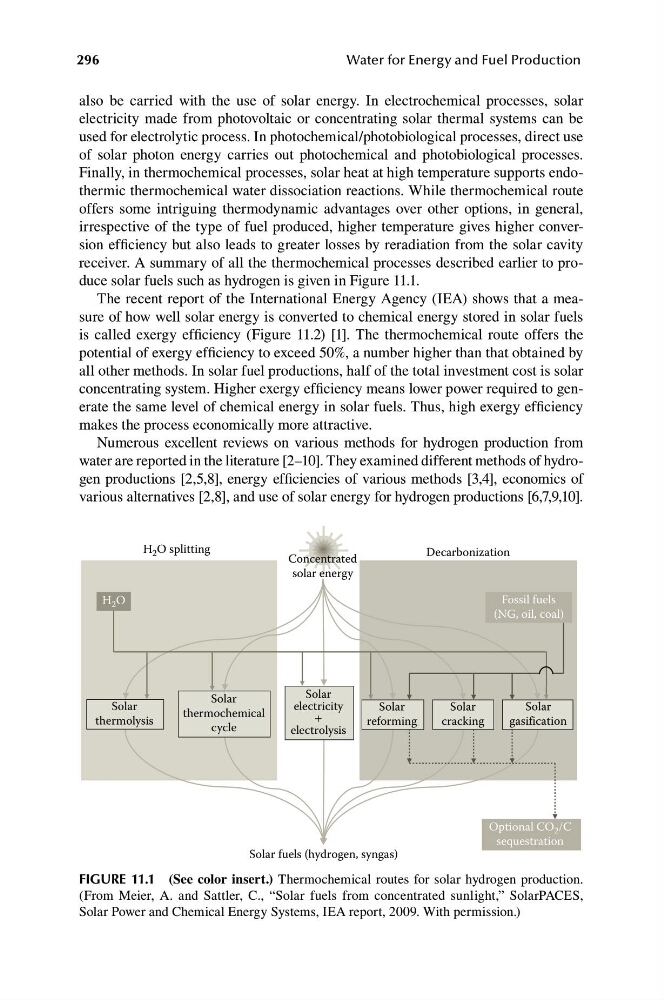
irrespective of the type of fuel produced, higher temperature gives higher conversion efficiency but also leads to greater losses by reradiation from the solar cavity
receiver. A summary of all the thermochemical processes described earlier to produce solar fuels such as hydrogen is given in Figure 11.1.
The recent report of the International Energy Agency (IEA) shows that a measure of how well solar energy is converted to chemical energy stored in solar fuels
is called exergy efficiency (Figure 11.2) [1]. The thermochemical route offers the
potential of exergy efficiency to exceed 50%, a number higher than that obtained by
all other methods. In solar fuel productions, half of the total investment cost is solar
concentrating system. Higher exergy efficiency means lower power required to generate the same level of chemical energy in solar fuels. Thus, high exergy efficiency
makes the process economically more attractive.
Numerous excellent reviews on various methods for hydrogen production from
water are reported in the literature [2–10]. They examined different methods of hydrogen productions [2,5,8], energy efficiencies of various methods [3,4], economics of
various alternatives [2,8], and use of solar energy for hydrogen productions [6,7,9,10].
FiGUre 11.1 (See color insert.) Thermochemical routes for solar hydrogen production.
(From Meier, A. and Sattler, C., “Solar fuels from concentrated sunlight,” SolarPACES,
Solar Power and Chemical Energy Systems, IEA report, 2009. With permission.)
thermolysis
Solar
thermochemical
cycle
Concentrated
solar energy
Decarbonization
H 2 O splitting
Fossil fuels
(NG, oil, coal)
Solar fuels (hydrogen, syngas)
Optional CO 2 /C
sequestration
Solar
electricity
+
electrolysis
H 2 O
Solar
cracking
Solar
gasification
Solar
reforming
296
Water for Energy and Fuel Production
also be carried with the use of solar energy. In electrochemical processes, solar
electricity made from photovoltaic or concentrating solar thermal systems can be
used for electrolytic process. In photochemical/photobiological processes, direct use
of solar photon energy carries out photochemical and photobiological processes.
Finally, in thermochemical processes, solar heat at high temperature supports endothermic thermochemical water dissociation reactions. While thermochemical route
offers some intriguing thermodynamic advantages over other options, in general,
irrespective of the type of fuel produced, higher temperature gives higher conversion efficiency but also leads to greater losses by reradiation from the solar cavity
receiver. A summary of all the thermochemical processes described earlier to produce solar fuels such as hydrogen is given in Figure 11.1.
The recent report of the International Energy Agency (IEA) shows that a measure of how well solar energy is converted to chemical energy stored in solar fuels
is called exergy efficiency (Figure 11.2) [1]. The thermochemical route offers the
potential of exergy efficiency to exceed 50%, a number higher than that obtained by
all other methods. In solar fuel productions, half of the total investment cost is solar
concentrating system. Higher exergy efficiency means lower power required to generate the same level of chemical energy in solar fuels. Thus, high exergy efficiency
makes the process economically more attractive.
Numerous excellent reviews on various methods for hydrogen production from
water are reported in the literature [2–10]. They examined different methods of hydrogen productions [2,5,8], energy efficiencies of various methods [3,4], economics of
various alternatives [2,8], and use of solar energy for hydrogen productions [6,7,9,10].
FiGUre 11.1 (See color insert.) Thermochemical routes for solar hydrogen production.
(From Meier, A. and Sattler, C., “Solar fuels from concentrated sunlight,” SolarPACES,
Solar Power and Chemical Energy Systems, IEA report, 2009. With permission.)