

272
Water for Energy and Fuel Production
All the studies described earlier indicate that near-critical conditions, complex carbonaceous materials tend to decompose into a mixture of liquids and gases. The amount
of each phase depends on the nature of feedstock, pressure, and reaction time. The use
of a suitable catalyst increases both liquid and gas yields. An increase in temperature
generally produces more gas. In a case of a mixture, the synergistic effects between the
decompositions of two components depend on the nature of the components.
10.6 GasiFiCatiOn in sCW
While steam gasification occurs at low pressure and high temperature, in recent
years gasification of biomass in a pressurized water environment (called hydrothermal gasification) has gained significant support [83,84,119–153] (Antal and xu, 2012,
pers. comm.; Boukis, 2012, pers. comm.; Kruse, 2012, pers. comm.; Veriansyah
et al., 2012, pers. comm.). The hydrothermal gasification can be divided into three
regions depending on the range of temperature. Osada et al. [119] identified region 1
as the one with a temperature range of 500°C–700°C—a region in which biomass is
decomposed in SCW in the presence of either activated carbon to avoid the formation of char or an alkali catalyst to facilitate water–gas shift reaction. In this region,
very little solids remained and the main product of the gasification is hydrogen.
In region 2 of SCW, where the temperature range is 374°C–500°C, biomass hydrolyzes and metal catalyst facilitates gasification. Here once again, the main product
is hydrogen with some carbon dioxide, carbon monoxide, and methane. The third
region was described in Chapter 5. Near the critical conditions, methane would be
a preferential gas in the absence of a catalyst. However, at high temperature and/
or in the presence of a suitable catalyst, hydrogen can be formed by reforming and
water–gas shift reactions. The nature of the product will depend on the nature of the
feedstock, temperature, pressure, feed concentration, residence time, and the nature
of the catalyst (if any). The reported studies for SCW gasification of complex and
simple materials are briefly described here.
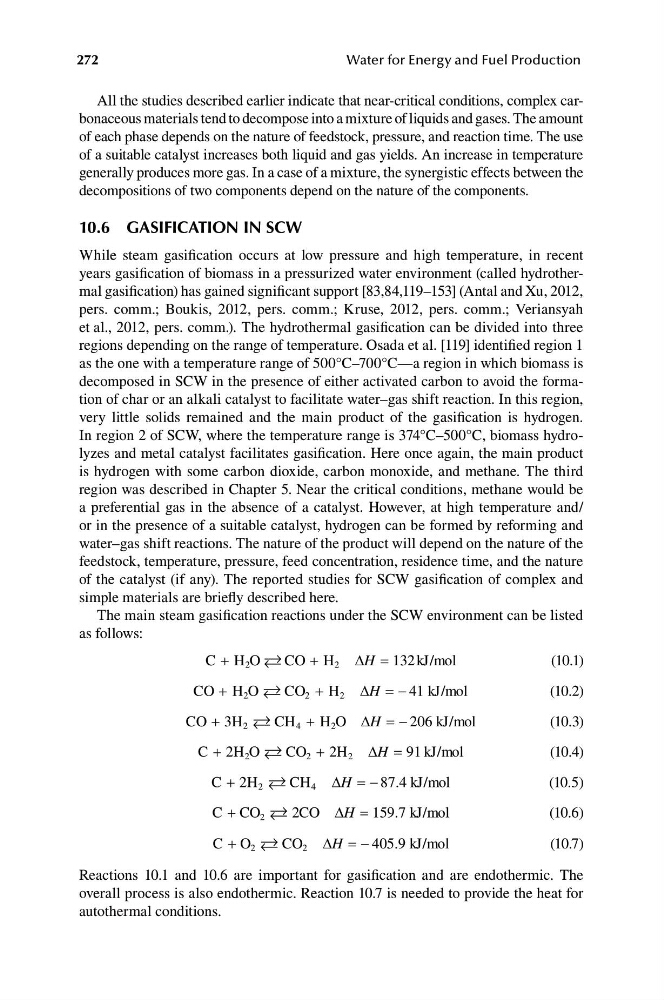
The main steam gasification reactions under the SCW environment can be listed
as follows:
C + H 2 O CO + H 2 ∆H = 132 kJ/mol
(10.1)
CO + H 2 O CO 2 + H 2 ∆H = − 41 kJ/mol
(10.2)
CO + 3H 2 CH 4 + H 2 O ∆H = − 206 kJ/mol
(10.3)
C + 2H 2 O CO 2 + 2H 2 ∆H = 91 kJ/mol
(10.4)
C + 2H 2 CH 4 ∆H = − 87.4 kJ/mol
(10.5)
C + CO 2 2CO ∆H = 159.7 kJ/mol
(10.6)
C + O 2 CO 2 ∆H = − 405.9 kJ/mol
(10.7)
Reactions 10.1 and 10.6 are important for gasification and are endothermic. The
overall process is also endothermic. Reaction 10.7 is needed to provide the heat for
autothermal conditions.
Water for Energy and Fuel Production
All the studies described earlier indicate that near-critical conditions, complex carbonaceous materials tend to decompose into a mixture of liquids and gases. The amount
of each phase depends on the nature of feedstock, pressure, and reaction time. The use
of a suitable catalyst increases both liquid and gas yields. An increase in temperature
generally produces more gas. In a case of a mixture, the synergistic effects between the
decompositions of two components depend on the nature of the components.
10.6 GasiFiCatiOn in sCW
While steam gasification occurs at low pressure and high temperature, in recent
years gasification of biomass in a pressurized water environment (called hydrothermal gasification) has gained significant support [83,84,119–153] (Antal and xu, 2012,
pers. comm.; Boukis, 2012, pers. comm.; Kruse, 2012, pers. comm.; Veriansyah
et al., 2012, pers. comm.). The hydrothermal gasification can be divided into three
regions depending on the range of temperature. Osada et al. [119] identified region 1
as the one with a temperature range of 500°C–700°C—a region in which biomass is
decomposed in SCW in the presence of either activated carbon to avoid the formation of char or an alkali catalyst to facilitate water–gas shift reaction. In this region,
very little solids remained and the main product of the gasification is hydrogen.
In region 2 of SCW, where the temperature range is 374°C–500°C, biomass hydrolyzes and metal catalyst facilitates gasification. Here once again, the main product
is hydrogen with some carbon dioxide, carbon monoxide, and methane. The third
region was described in Chapter 5. Near the critical conditions, methane would be
a preferential gas in the absence of a catalyst. However, at high temperature and/
or in the presence of a suitable catalyst, hydrogen can be formed by reforming and
water–gas shift reactions. The nature of the product will depend on the nature of the
feedstock, temperature, pressure, feed concentration, residence time, and the nature
of the catalyst (if any). The reported studies for SCW gasification of complex and
simple materials are briefly described here.
The main steam gasification reactions under the SCW environment can be listed
as follows:
C + H 2 O CO + H 2 ∆H = 132 kJ/mol
(10.1)
CO + H 2 O CO 2 + H 2 ∆H = − 41 kJ/mol
(10.2)
CO + 3H 2 CH 4 + H 2 O ∆H = − 206 kJ/mol
(10.3)
C + 2H 2 O CO 2 + 2H 2 ∆H = 91 kJ/mol
(10.4)
C + 2H 2 CH 4 ∆H = − 87.4 kJ/mol
(10.5)
C + CO 2 2CO ∆H = 159.7 kJ/mol
(10.6)
C + O 2 CO 2 ∆H = − 405.9 kJ/mol
(10.7)
Reactions 10.1 and 10.6 are important for gasification and are endothermic. The
overall process is also endothermic. Reaction 10.7 is needed to provide the heat for
autothermal conditions.