

271
Fuel Production by Supercritical Water
13% light oil, 24% vacuum gas oil, 21% carbon dioxide and 1% soot, and 8% heavy oil.
The process was proven in a test plant of size 1 bbl/day.
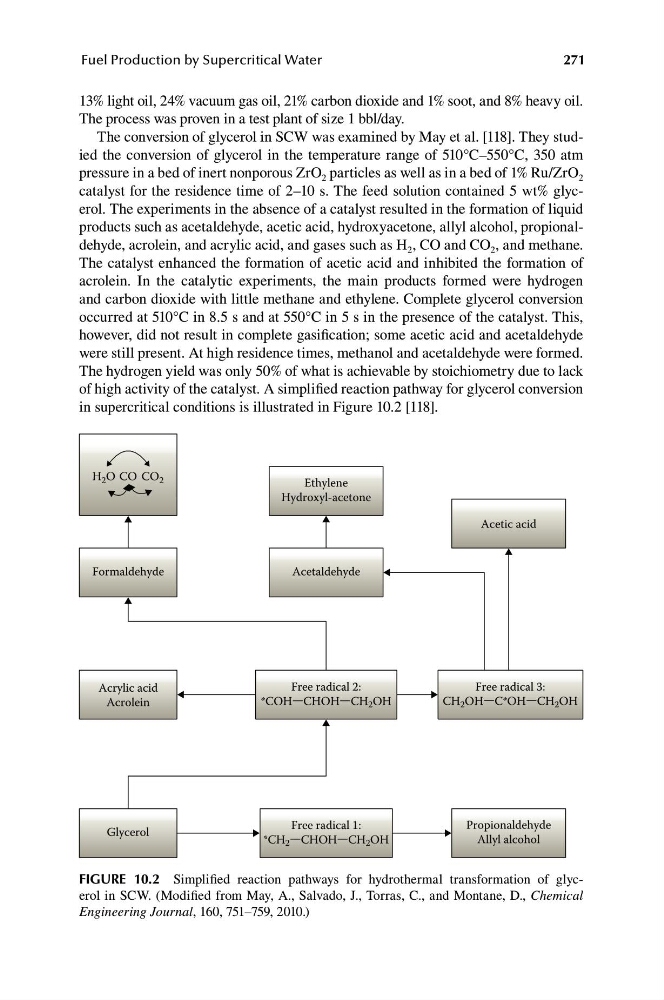
The conversion of glycerol in SCW was examined by May et al. [118]. They studied the conversion of glycerol in the temperature range of 510°C–550°C, 350 atm
pressure in a bed of inert nonporous ZrO 2 particles as well as in a bed of 1% Ru/ZrO 2
catalyst for the residence time of 2–10 s. The feed solution contained 5 wt% glycerol. The experiments in the absence of a catalyst resulted in the formation of liquid
products such as acetaldehyde, acetic acid, hydroxyacetone, allyl alcohol, propionaldehyde, acrolein, and acrylic acid, and gases such as H 2 , CO and CO 2 , and methane.
The catalyst enhanced the formation of acetic acid and inhibited the formation of
acrolein. In the catalytic experiments, the main products formed were hydrogen
and carbon dioxide with little methane and ethylene. Complete glycerol conversion
occurred at 510°C in 8.5 s and at 550°C in 5 s in the presence of the catalyst. This,
however, did not result in complete gasification; some acetic acid and acetaldehyde
were still present. At high residence times, methanol and acetaldehyde were formed.
The hydrogen yield was only 50% of what is achievable by stoichiometry due to lack
of high activity of the catalyst. A simplified reaction pathway for glycerol conversion
in supercritical conditions is illustrated in Figure 10.2 [118].
H 2 O
CO 2
CO
Ethylene
Hydroxyl-acetone
Acetaldehyde
Formaldehyde
Acetic acid
Acrylic acid
Acrolein
Free radical 3:
CH 2 OH—C*OH—CH 2 OH
Free radical 1:
*CH 2 —CHOH—CH 2 OH
Glycerol
Propionaldehyde
Allyl alcohol
Free radical 2:
*COH—CHOH—CH 2 OH
FiGUre 10.2 Simplified reaction pathways for hydrothermal transformation of glycerol in SCW. (Modified from May, A., Salvado, J., Torras, C., and Montane, D., Chemical
Engineering Journal, 160, 751–759, 2010.)