

264
Water for Energy and Fuel Production
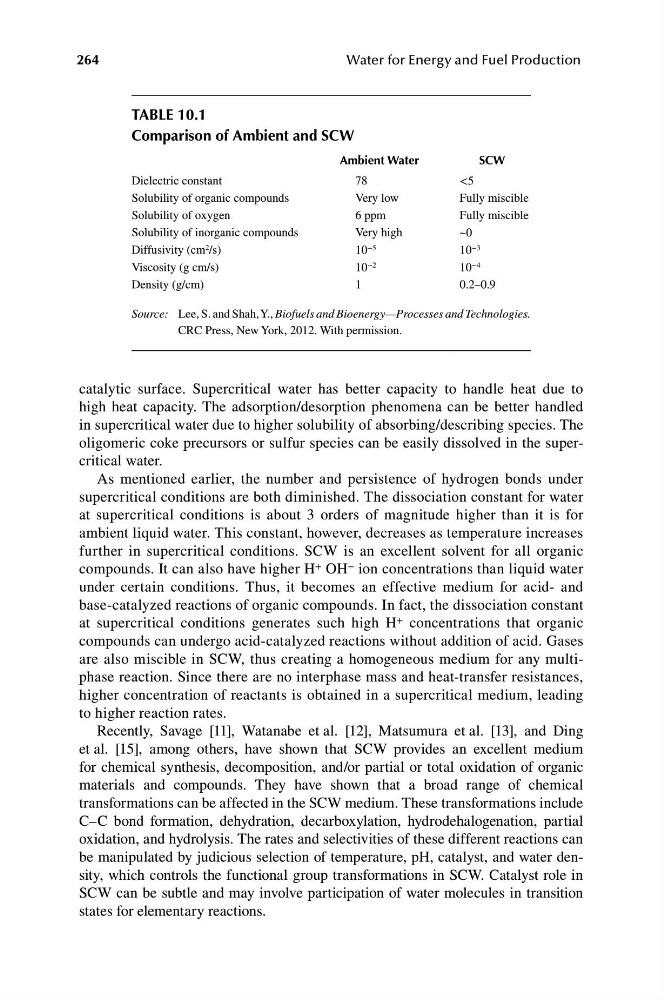
taBle 10.1
Comparison of ambient and sCW
ambient Water
sCW
Dielectric constant
78
<5
Solubility of organic compounds
Very low
Fully miscible
Solubility of oxygen
6 ppm
Fully miscible
Solubility of inorganic compounds
Very high
~0
Diffusivity (cm 2 /s)
10 −5
10 −3
Viscosity (g cm/s)
10 −2
10 −4
Density (g/cm)
1
0.2–0.9
Source: Lee, S. and Shah, Y., Biofuels and Bioenergy—Processes and Technologies.
CRC Press, New York, 2012. With permission.
catalytic surface. Supercritical water has better capacity to handle heat due to
high heat capacity. The adsorption/desorption phenomena can be better handled
in supercritical water due to higher solubility of absorbing/describing species. The
oligomeric coke precursors or sulfur species can be easily dissolved in the supercritical water.
As mentioned earlier, the number and persistence of hydrogen bonds under
supercritical conditions are both diminished. The dissociation constant for water
at supercritical conditions is about 3 orders of magnitude higher than it is for
ambient liquid water. This constant, however, decreases as temperature increases
further in supercritical conditions. SCW is an excellent solvent for all organic
compounds. It can also have higher H + OH − ion concentrations than liquid water
under certain conditions. Thus, it becomes an effective medium for acid- and
base-catalyzed reactions of organic compounds. In fact, the dissociation constant
at supercritical conditions generates such high H + concentrations that organic
compounds can undergo acid-catalyzed reactions without addition of acid. Gases
are also miscible in SCW, thus creating a homogeneous medium for any multiphase reaction. Since there are no interphase mass and heat-transfer resistances,
higher concentration of reactants is obtained in a supercritical medium, leading
to higher reaction rates.
Recently, Savage [11], Watanabe et al. [12], Matsumura et al. [13], and Ding
et al. [15], among others, have shown that SCW provides an excellent medium
for chemical synthesis, decomposition, and/or partial or total oxidation of organic
materials and compounds. They have shown that a broad range of chemical
transformations can be affected in the SCW medium. These transformations include
C–C bond formation, dehydration, decarboxylation, hydrodehalogenation, partial
oxidation, and hydrolysis. The rates and selectivities of these different reactions can
be manipulated by judicious selection of temperature, pH, catalyst, and water density, which controls the functional group transformations in SCW. Catalyst role in
SCW can be subtle and may involve participation of water molecules in transition
states for elementary reactions.
Water for Energy and Fuel Production
taBle 10.1
Comparison of ambient and sCW
ambient Water
sCW
Dielectric constant
78
<5
Solubility of organic compounds
Very low
Fully miscible
Solubility of oxygen
6 ppm
Fully miscible
Solubility of inorganic compounds
Very high
~0
Diffusivity (cm 2 /s)
10 −5
10 −3
Viscosity (g cm/s)
10 −2
10 −4
Density (g/cm)
1
0.2–0.9
Source: Lee, S. and Shah, Y., Biofuels and Bioenergy—Processes and Technologies.
CRC Press, New York, 2012. With permission.
catalytic surface. Supercritical water has better capacity to handle heat due to
high heat capacity. The adsorption/desorption phenomena can be better handled
in supercritical water due to higher solubility of absorbing/describing species. The
oligomeric coke precursors or sulfur species can be easily dissolved in the supercritical water.
As mentioned earlier, the number and persistence of hydrogen bonds under
supercritical conditions are both diminished. The dissociation constant for water
at supercritical conditions is about 3 orders of magnitude higher than it is for
ambient liquid water. This constant, however, decreases as temperature increases
further in supercritical conditions. SCW is an excellent solvent for all organic
compounds. It can also have higher H + OH − ion concentrations than liquid water
under certain conditions. Thus, it becomes an effective medium for acid- and
base-catalyzed reactions of organic compounds. In fact, the dissociation constant
at supercritical conditions generates such high H + concentrations that organic
compounds can undergo acid-catalyzed reactions without addition of acid. Gases
are also miscible in SCW, thus creating a homogeneous medium for any multiphase reaction. Since there are no interphase mass and heat-transfer resistances,
higher concentration of reactants is obtained in a supercritical medium, leading
to higher reaction rates.
Recently, Savage [11], Watanabe et al. [12], Matsumura et al. [13], and Ding
et al. [15], among others, have shown that SCW provides an excellent medium
for chemical synthesis, decomposition, and/or partial or total oxidation of organic
materials and compounds. They have shown that a broad range of chemical
transformations can be affected in the SCW medium. These transformations include
C–C bond formation, dehydration, decarboxylation, hydrodehalogenation, partial
oxidation, and hydrolysis. The rates and selectivities of these different reactions can
be manipulated by judicious selection of temperature, pH, catalyst, and water density, which controls the functional group transformations in SCW. Catalyst role in
SCW can be subtle and may involve participation of water molecules in transition
states for elementary reactions.