

40
Pressure (MPa)
35
30
25
20
15
10
5
(Supercritical fluid)
(Liquid)
(Vapor)
400
500
600
700
Catalytic
gasification
Liquefaction
High-temperature
gasification
0 0
100
200
300
Temperature (°C)
263
Fuel Production by Supercritical Water
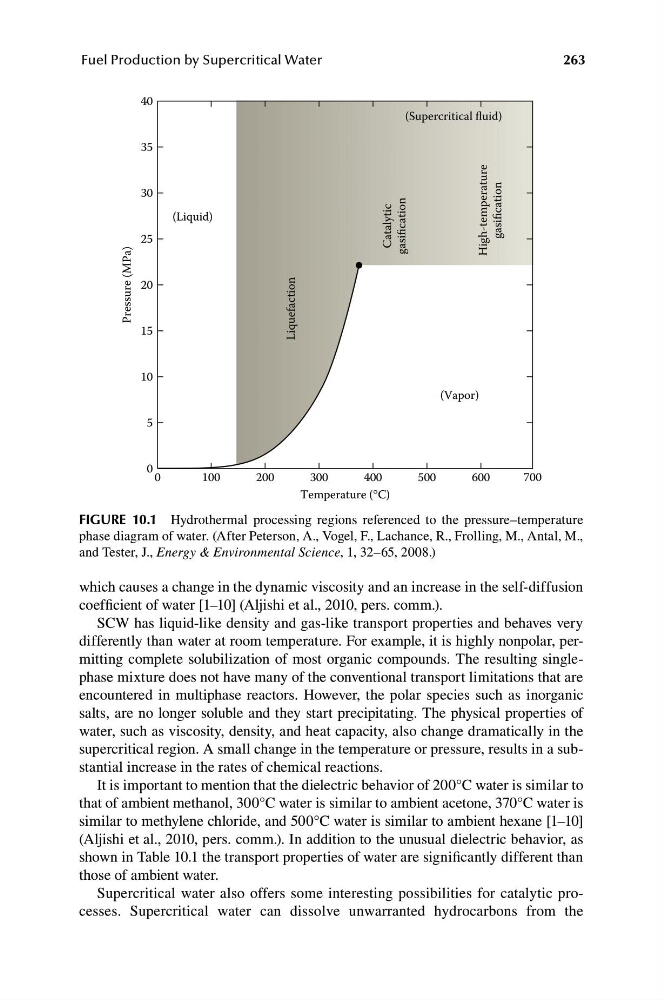
FiGUre 10.1 Hydrothermal processing regions referenced to the pressure–temperature
phase diagram of water. (After Peterson, A., Vogel, F., Lachance, R., Frolling, M., Antal, M.,
and Tester, J., Energy & Environmental Science, 1, 32–65, 2008.)
which causes a change in the dynamic viscosity and an increase in the self-diffusion
coefficient of water [1–10] (Aljishi et a l., 2010, pers. comm.).
SCW has liquid-like density and gas-like transport properties and behaves very
differently than water at room temperature. For example, it is highly nonpolar, permitting complete solubilization of most organic compounds. The resulting singlephase mixture does not have many of the conventional transport limitations that are
encountered in multiphase reactors. However, the polar species such as inorganic
salts, are no longer soluble and they start precipitating. The physical properties of
water, such as viscosity, density, and heat capacity, also change dramatically in the
supercritical region. A small change in the temperature or pressure, results in a substantial increase in the rates of chemical reactions.
It is important to mention that the dielectric behavior of 200°C water is similar to
that of ambient methanol, 300°C water is similar to ambient acetone, 370°C water is
similar to methylene chloride, and 500°C water is similar to ambient hexane [1–10]
(Aljishi et a l., 2010, pers. comm.). In addition to the unusual dielectric behavior, as
shown in Table 10.1 the transport properties of water are significantly different than
those of ambient water.
Supercritical water also offers some interesting possibilities for catalytic processes. Supercritical water can dissolve unwarranted hydrocarbons from the
Pressure (MPa)
35
30
25
20
15
10
5
(Supercritical fluid)
(Liquid)
(Vapor)
400
500
600
700
Catalytic
gasification
Liquefaction
High-temperature
gasification
0 0
100
200
300
Temperature (°C)
263
Fuel Production by Supercritical Water
FiGUre 10.1 Hydrothermal processing regions referenced to the pressure–temperature
phase diagram of water. (After Peterson, A., Vogel, F., Lachance, R., Frolling, M., Antal, M.,
and Tester, J., Energy & Environmental Science, 1, 32–65, 2008.)
which causes a change in the dynamic viscosity and an increase in the self-diffusion
coefficient of water [1–10] (Aljishi et a l., 2010, pers. comm.).
SCW has liquid-like density and gas-like transport properties and behaves very
differently than water at room temperature. For example, it is highly nonpolar, permitting complete solubilization of most organic compounds. The resulting singlephase mixture does not have many of the conventional transport limitations that are
encountered in multiphase reactors. However, the polar species such as inorganic
salts, are no longer soluble and they start precipitating. The physical properties of
water, such as viscosity, density, and heat capacity, also change dramatically in the
supercritical region. A small change in the temperature or pressure, results in a substantial increase in the rates of chemical reactions.
It is important to mention that the dielectric behavior of 200°C water is similar to
that of ambient methanol, 300°C water is similar to ambient acetone, 370°C water is
similar to methylene chloride, and 500°C water is similar to ambient hexane [1–10]
(Aljishi et a l., 2010, pers. comm.). In addition to the unusual dielectric behavior, as
shown in Table 10.1 the transport properties of water are significantly different than
those of ambient water.
Supercritical water also offers some interesting possibilities for catalytic processes. Supercritical water can dissolve unwarranted hydrocarbons from the