

Hydrolysis and Fermentation Technologies for Alcohols
235
Today, there are two types of ethanol depending on the source of feedstock: grain
ethanol [8–10] and cellulosic ethanol [11,12]. Grain ethanol is made from starch or
sugar feedstock such as corn, wheat, barley, rice, and sugarcane, while cellulosic
ethanol is produced from lignocellulosic materials. The process for cellulosic ethanol is much more complex than that for grain ethanol due to the complexity of the
feedstock in the former case. Here, we describe the processes for both types of ethanol in detail.
9.2 Grain (COrn) ethanOl
Grain ethanol suffers from the fact that the feedstock has food value, and the use
of corn, wheat, and so on for the purpose of fuel may become challenging in times
of drought or when the corn is in short supply. The need for food is always higher
than that for fuel, and these competitive usages for corn may make the price of
corn too high for an economical ethanol process. The advantages of grain ethanol
are that the starting feedstock is starch (or sugar) and it only requires hydrolysis
and fermentation steps and not the pretreatment step as it is required in cellulosic
ethanol.
Ethanol production facilities for corn (grain) ethanol are classified into two broad
categories: wet milling [2,13–15] and dry milling operations [2,16,17]. As the terms
indicate, in dry milling operation, the entire corn kernel is pulverized into flour
called “corn meal,” and it is then mixed with water and processed for hydrolysis and
fermentation. Dry mills are usually smaller in size and are built primarily to manufacture ethanol only. The remaining stillage from ethanol purification undergoes
a different process treatment to produce highly nutritious animal feedstock (often
called dried distillers grains [DDGs]). In 2008, a total of 86% of corn ethanol was
produced by this method in about 150 dry milling plants [17].
Wet milling processes are called “corn refineries,” which along with ethanol also
produce high-value coproducts such as high-fructose corn syrup, dextrose, cornstarch, DDG, and Splenda. They are larger and have more capital and operating
costs. While the wet milling process is more versatile and produces many co- and
byproducts, it is less efficient than the dry milling process. Thermal energy and
electricity are the main types of energy used in both dry and wet milling processes.
Dry milling uses natural gas in several parts of the process such as generating steam
for mash cooking, distillation, and evaporation. In many new ethanol plants, the
use of combined heat and power (CHP) has been very popular due to its increased
production efficiencies and expanded fuel capabilities. A CHP system improves the
efficiency by 10%–30% more than 50% efficiency obtained in conventional operations [2].
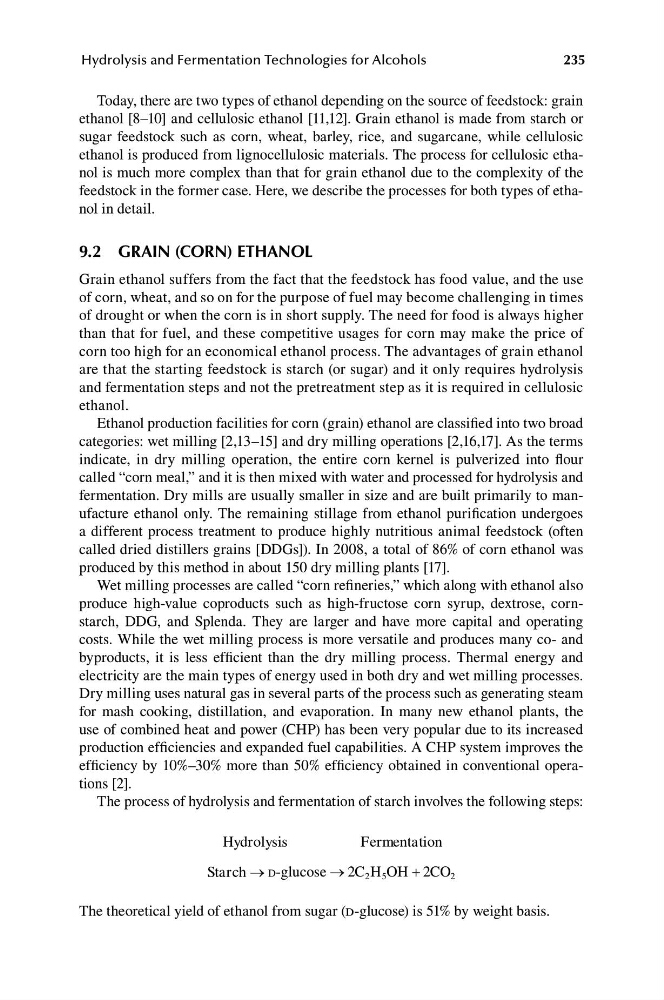
The process of hydrolysis and fermentation of starch involves the following steps:
Hydrolysis
Fermentation
Starch → D-glucose → 2C H OH
2 5
+ 2CO 2
The theoretical yield of ethanol from sugar (d-glucose) is 51% by weight basis.
235
Today, there are two types of ethanol depending on the source of feedstock: grain
ethanol [8–10] and cellulosic ethanol [11,12]. Grain ethanol is made from starch or
sugar feedstock such as corn, wheat, barley, rice, and sugarcane, while cellulosic
ethanol is produced from lignocellulosic materials. The process for cellulosic ethanol is much more complex than that for grain ethanol due to the complexity of the
feedstock in the former case. Here, we describe the processes for both types of ethanol in detail.
9.2 Grain (COrn) ethanOl
Grain ethanol suffers from the fact that the feedstock has food value, and the use
of corn, wheat, and so on for the purpose of fuel may become challenging in times
of drought or when the corn is in short supply. The need for food is always higher
than that for fuel, and these competitive usages for corn may make the price of
corn too high for an economical ethanol process. The advantages of grain ethanol
are that the starting feedstock is starch (or sugar) and it only requires hydrolysis
and fermentation steps and not the pretreatment step as it is required in cellulosic
ethanol.
Ethanol production facilities for corn (grain) ethanol are classified into two broad
categories: wet milling [2,13–15] and dry milling operations [2,16,17]. As the terms
indicate, in dry milling operation, the entire corn kernel is pulverized into flour
called “corn meal,” and it is then mixed with water and processed for hydrolysis and
fermentation. Dry mills are usually smaller in size and are built primarily to manufacture ethanol only. The remaining stillage from ethanol purification undergoes
a different process treatment to produce highly nutritious animal feedstock (often
called dried distillers grains [DDGs]). In 2008, a total of 86% of corn ethanol was
produced by this method in about 150 dry milling plants [17].
Wet milling processes are called “corn refineries,” which along with ethanol also
produce high-value coproducts such as high-fructose corn syrup, dextrose, cornstarch, DDG, and Splenda. They are larger and have more capital and operating
costs. While the wet milling process is more versatile and produces many co- and
byproducts, it is less efficient than the dry milling process. Thermal energy and
electricity are the main types of energy used in both dry and wet milling processes.
Dry milling uses natural gas in several parts of the process such as generating steam
for mash cooking, distillation, and evaporation. In many new ethanol plants, the
use of combined heat and power (CHP) has been very popular due to its increased
production efficiencies and expanded fuel capabilities. A CHP system improves the
efficiency by 10%–30% more than 50% efficiency obtained in conventional operations [2].
The process of hydrolysis and fermentation of starch involves the following steps:
Hydrolysis
Fermentation
Starch → D-glucose → 2C H OH
2 5
+ 2CO 2
The theoretical yield of ethanol from sugar (d-glucose) is 51% by weight basis.