

10.5%
34.9%
39.4%
15.2%
Feed and residual
Food, seed, and industrial
Corn ethanol
Export
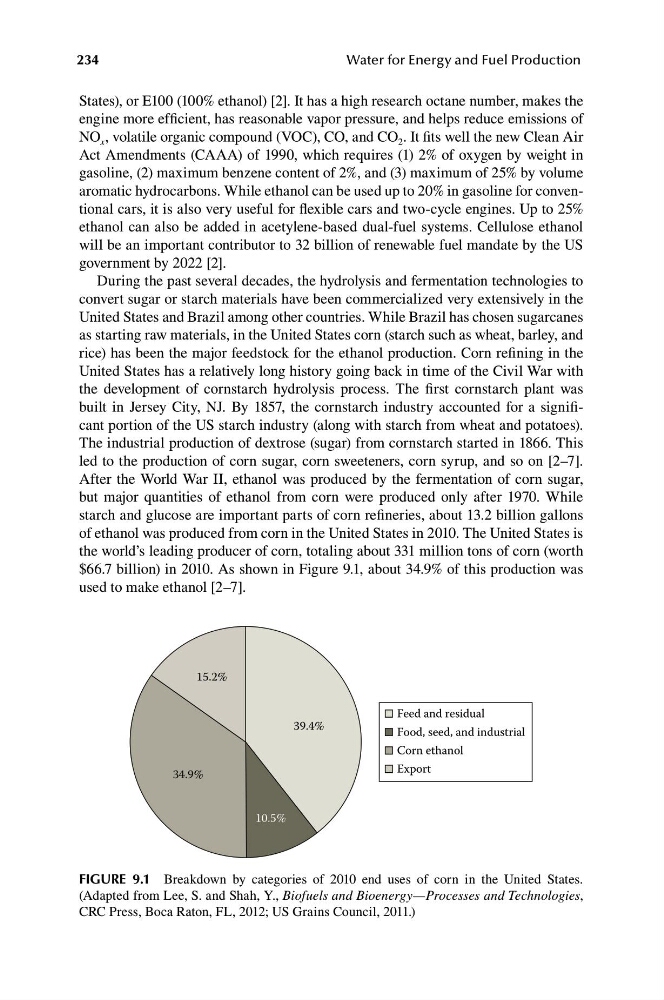
FiGUre 9.1 Breakdown by categories of 2010 end uses of corn in the United States.
(Adapted from Lee, S. and Shah, Y., Biofuels and Bioenergy—Processes and Technologies,
CRC Press, Boca Raton, FL, 2012; US Grains Council, 2011.)
234
Water for Energy and Fuel Production
States), or E100 (100% ethanol) [2]. It has a high research octane number, makes the
engine more efficient, has reasonable vapor pressure, and helps reduce emissions of
NO x , volatile organic compound (VOC), CO, and CO 2 . It fits well the new Clean Air
Act Amendments (CAAA) of 1990, which requires (1) 2% of oxygen by weight in
gasoline, (2) maximum benzene content of 2%, and (3) maximum of 25% by volume
aromatic hydrocarbons. While ethanol can be used up to 20% in gasoline for conventional cars, it is also very useful for flexible cars and two-cycle engines. Up to 25%
ethanol can also be added in acetylene-based dual-fuel systems. Cellulose ethanol
will be an important contributor to 32 billion of renewable fuel mandate by the US
government by 2022 [2].
During the past several decades, the hydrolysis and fermentation technologies to
convert sugar or starch materials have been commercialized very extensively in the
United States and Brazil among other countries. While Brazil has chosen sugarcanes
as starting raw materials, in the United States corn (starch such as wheat, barley, and
rice) has been the major feedstock for the ethanol production. Corn refining in the
United States has a relatively long history going back in time of the Civil War with
the development of cornstarch hydrolysis process. The first cornstarch plant was
built in Jersey City, NJ. By 1857, the cornstarch industry accounted for a significant portion of the US starch industry (along with starch from wheat and potatoes).
The industrial production of dextrose (sugar) from cornstarch started in 1866. This
led to the production of corn sugar, corn sweeteners, corn syrup, and so on [2–7].
After the World War II, ethanol was produced by the fermentation of corn sugar,
but major quantities of ethanol from corn were produced only after 1970. While
starch and glucose are important parts of corn refineries, about 13.2 billion gallons
of ethanol was produced from corn in the United States in 2010. The United States is
the world’s leading producer of corn, totaling about 331 million tons of corn (worth
$66.7 billion) in 2010. As shown in Figure 9.1, about 34.9% of this production was
used to make ethanol [2–7].
34.9%
39.4%
15.2%
Feed and residual
Food, seed, and industrial
Corn ethanol
Export
FiGUre 9.1 Breakdown by categories of 2010 end uses of corn in the United States.
(Adapted from Lee, S. and Shah, Y., Biofuels and Bioenergy—Processes and Technologies,
CRC Press, Boca Raton, FL, 2012; US Grains Council, 2011.)
234
Water for Energy and Fuel Production
States), or E100 (100% ethanol) [2]. It has a high research octane number, makes the
engine more efficient, has reasonable vapor pressure, and helps reduce emissions of
NO x , volatile organic compound (VOC), CO, and CO 2 . It fits well the new Clean Air
Act Amendments (CAAA) of 1990, which requires (1) 2% of oxygen by weight in
gasoline, (2) maximum benzene content of 2%, and (3) maximum of 25% by volume
aromatic hydrocarbons. While ethanol can be used up to 20% in gasoline for conventional cars, it is also very useful for flexible cars and two-cycle engines. Up to 25%
ethanol can also be added in acetylene-based dual-fuel systems. Cellulose ethanol
will be an important contributor to 32 billion of renewable fuel mandate by the US
government by 2022 [2].
During the past several decades, the hydrolysis and fermentation technologies to
convert sugar or starch materials have been commercialized very extensively in the
United States and Brazil among other countries. While Brazil has chosen sugarcanes
as starting raw materials, in the United States corn (starch such as wheat, barley, and
rice) has been the major feedstock for the ethanol production. Corn refining in the
United States has a relatively long history going back in time of the Civil War with
the development of cornstarch hydrolysis process. The first cornstarch plant was
built in Jersey City, NJ. By 1857, the cornstarch industry accounted for a significant portion of the US starch industry (along with starch from wheat and potatoes).
The industrial production of dextrose (sugar) from cornstarch started in 1866. This
led to the production of corn sugar, corn sweeteners, corn syrup, and so on [2–7].
After the World War II, ethanol was produced by the fermentation of corn sugar,
but major quantities of ethanol from corn were produced only after 1970. While
starch and glucose are important parts of corn refineries, about 13.2 billion gallons
of ethanol was produced from corn in the United States in 2010. The United States is
the world’s leading producer of corn, totaling about 331 million tons of corn (worth
$66.7 billion) in 2010. As shown in Figure 9.1, about 34.9% of this production was
used to make ethanol [2–7].