

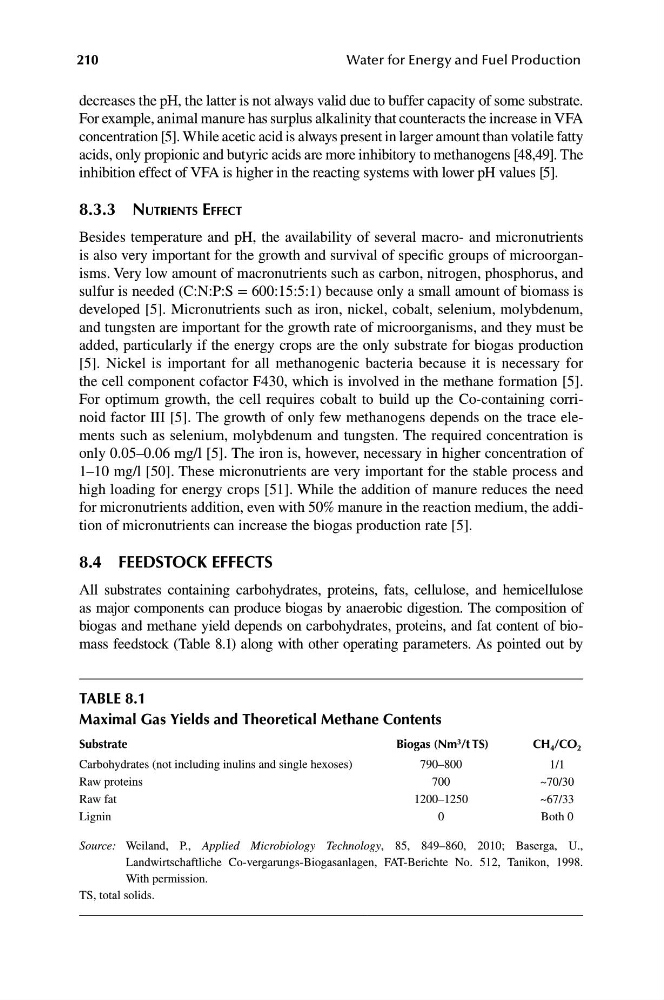
taBle 8.1
maximal Gas yields and theoretical methane Contents
substrate
Biogas (nm 3 /t ts)
Ch 4 /CO 2
Carbohydrates (not including inulins and single hexoses)
790–800
1/1
Raw proteins
700
~70/30
Raw fat
1200–1250
~67/33
Lignin
0
Both 0
Source: Weiland, P., Applied Microbiology Technology, 85, 849–860, 2010; Baserga, U.,
Landwirtschaftliche Co-vergarungs-Biogasanlagen, FAT-Berichte No. 512, Tanikon, 1998.
With permission.
TS, total solids.
210
Water for Energy and Fuel Production
decreases the pH, the latter is not always valid due to buffer capacity of some substrate.
For example, animal manure has surplus alkalinity that counteracts the increase in VFA
concentration [5]. While acetic acid is always present in larger amount than volatile fatty
acids, only propionic and butyric acids are more inhibitory to methanogens [48,49]. The
inhibition effect of VFA is higher in the reacting systems with lower pH values [5].
8.3.3 nuTrienTS eFFeCT
Besides temperature and pH, the availability of several macro- and micronutrients
is also very important for the growth and survival of specific groups of microorganisms. Very low amount of macronutrients such as carbon, nitrogen, phosphorus, and
sulfur is needed (C:N:P:S = 600:15:5:1) because only a small amount of biomass is
developed [5]. Micronutrients such as iron, nickel, cobalt, selenium, molybdenum,
and tungsten are important for the growth rate of microorganisms, and they must be
added, particularly if the energy crops are the only substrate for biogas production
[5]. Nickel is important for all methanogenic bacteria because it is necessary for
the cell component cofactor F430, which is involved in the methane formation [5].
For optimum growth, the cell requires cobalt to build up the Co-containing corrinoid factor III [5]. The growth of only few methanogens depends on the trace elements such as selenium, molybdenum and tungsten. The required concentration is
only 0.05–0.06 mg/l [5]. The iron is, however, necessary in higher concentration of
1–10 mg/l [50]. These micronutrients are very important for the stable process and
high loading for energy crops [51]. While the addition of manure reduces the need
for micronutrients addition, even with 50% manure in the reaction medium, the addition of micronutrients can increase the biogas production rate [5].
8.4 FeedstOCK eFFeCts
All substrates containing carbohydrates, proteins, fats, cellulose, and hemicellulose
as major components can produce biogas by anaerobic digestion. The composition of
biogas and methane yield depends on carbohydrates, proteins, and fat content of biomass feedstock (Table 8.1) along with other operating parameters. As pointed out by