

Aqueous-Phase Reforming and BioForming Process
173
[4,32,48,58,59,65,68–86]. Furthermore, the introduction of bifunctional metal basic
catalysts allows for the coupling of secondary alcohols in the presence of hydrogen.
More condensation reactions are also driven for ketones in the presence of hydrogen
[32]. C–C coupling can also be enhanced by ketonization of carboxylic acid [4].
The complete hydrogenations of monofunctional groups can also produce alcohols.
The alcohols can then be converted to gasoline using methanol-to-gasoline (MTG)
technology of Mobil Oil Co. that uses H-ZSM-5 catalyst [4,32,48,58,59,65,68–86].
Alcohols can also be dehydrated to produce olefins.
Kunkes et al. [10,30,83] designed a process of converting monofunctional group
to pentanol and hexanol and converting these alcohols to C 6
+ gasoline by H-ZSM-5
catalyst at 673 K. In a two-step process, alcohols can also be dehydrated by acidic
niobia catalyst to form olefins that can be coupled over H-ZSM-5 to form branched
olefins centered around C 12 [1–6,16]. Less branched and more complex diesel fuel
can also be created by using a mixed system of catalysts CuMg 10 Al 7 O x , Pd/CeZrO x ,
and CeZrO x to achieve ketonization and aldol condensation of biomass-derived
monofunctional groups as shown in Figure 6.5 [4]. All of these strategies closely
follow the details outlined in an excellent review by Alonso et al. [4] and they were
the starting points for the development of a complete Virent’s BioForming process
described in Section 6.7 [60–63,66,67,87–89].
6.7 Virent’s BiOFOrminG PrOCess
While the original work of Dumesic et al. [1–6,16] focused on the generation of
hydrogen, syngas, alkanes, and monofunctional groups from the biomass-derived
carbohydrates such as alcohols, glycerols, ketones, aldehydes, furans, and other polyols [1–6,16], more recently Virent Inc. (Madison, WI) developed a more complete
BioForming process that integrates APR with proven catalytic upgrading technologies to generate hydrocarbons for direct use as a biofuel or as blending components for
conventional liquid fuels such as gasoline, diesel, and jet fuels [60–63,66,67,87–89].
This process has been recently described by Blommel and Cortright [15]. Here, we
briefly summarize their description of the process [15,60–63,66,67,87–89].
The overall objective of the Virent’s bioforming process is to develop a continuous process of converting a wide variety of feedstock into various synthetic liquid
fuels, fuel additives, and some useful chemicals. Blommel and Cortright [15] point
out that for this process, based on the stoichiometry of the overall conversions of
xylose and sucrose to C 6
+ hydrocarbons, carbon dioxide, and water by the following
set of reactions,
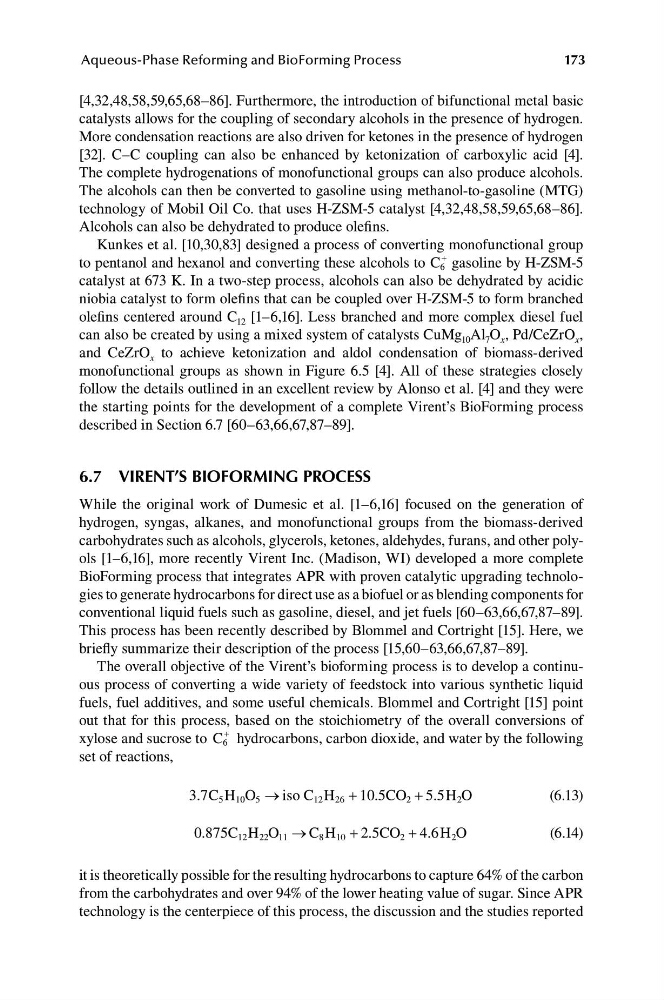
3 7 C H O → iso C H + 10 5
. CO
.
+ 5 5
. H O
(6.13)
5 10 5
12 26
2
2
0 875 C H O → C H + 2 5
. CO
.
+ 4 6
. H O
(6.14)
12 22 11
8 10
2
2
it is theoretically possible for the resulting hydrocarbons to capture 64% of the carbon
from the carbohydrates and over 94% of the lower heating value of sugar. Since APR
technology is the centerpiece of this process, the discussion and the studies reported
173
[4,32,48,58,59,65,68–86]. Furthermore, the introduction of bifunctional metal basic
catalysts allows for the coupling of secondary alcohols in the presence of hydrogen.
More condensation reactions are also driven for ketones in the presence of hydrogen
[32]. C–C coupling can also be enhanced by ketonization of carboxylic acid [4].
The complete hydrogenations of monofunctional groups can also produce alcohols.
The alcohols can then be converted to gasoline using methanol-to-gasoline (MTG)
technology of Mobil Oil Co. that uses H-ZSM-5 catalyst [4,32,48,58,59,65,68–86].
Alcohols can also be dehydrated to produce olefins.
Kunkes et al. [10,30,83] designed a process of converting monofunctional group
to pentanol and hexanol and converting these alcohols to C 6
+ gasoline by H-ZSM-5
catalyst at 673 K. In a two-step process, alcohols can also be dehydrated by acidic
niobia catalyst to form olefins that can be coupled over H-ZSM-5 to form branched
olefins centered around C 12 [1–6,16]. Less branched and more complex diesel fuel
can also be created by using a mixed system of catalysts CuMg 10 Al 7 O x , Pd/CeZrO x ,
and CeZrO x to achieve ketonization and aldol condensation of biomass-derived
monofunctional groups as shown in Figure 6.5 [4]. All of these strategies closely
follow the details outlined in an excellent review by Alonso et al. [4] and they were
the starting points for the development of a complete Virent’s BioForming process
described in Section 6.7 [60–63,66,67,87–89].
6.7 Virent’s BiOFOrminG PrOCess
While the original work of Dumesic et al. [1–6,16] focused on the generation of
hydrogen, syngas, alkanes, and monofunctional groups from the biomass-derived
carbohydrates such as alcohols, glycerols, ketones, aldehydes, furans, and other polyols [1–6,16], more recently Virent Inc. (Madison, WI) developed a more complete
BioForming process that integrates APR with proven catalytic upgrading technologies to generate hydrocarbons for direct use as a biofuel or as blending components for
conventional liquid fuels such as gasoline, diesel, and jet fuels [60–63,66,67,87–89].
This process has been recently described by Blommel and Cortright [15]. Here, we
briefly summarize their description of the process [15,60–63,66,67,87–89].
The overall objective of the Virent’s bioforming process is to develop a continuous process of converting a wide variety of feedstock into various synthetic liquid
fuels, fuel additives, and some useful chemicals. Blommel and Cortright [15] point
out that for this process, based on the stoichiometry of the overall conversions of
xylose and sucrose to C 6
+ hydrocarbons, carbon dioxide, and water by the following
set of reactions,
3 7 C H O → iso C H + 10 5
. CO
.
+ 5 5
. H O
(6.13)
5 10 5
12 26
2
2
0 875 C H O → C H + 2 5
. CO
.
+ 4 6
. H O
(6.14)
12 22 11
8 10
2
2
it is theoretically possible for the resulting hydrocarbons to capture 64% of the carbon
from the carbohydrates and over 94% of the lower heating value of sugar. Since APR
technology is the centerpiece of this process, the discussion and the studies reported