

172
Water for Energy and Fuel Production
C–C scission, low rates of C–H scission, and low rates of methanation
and F–T reactions. Low CO level can be obtained by operating the reactor
with low partial pressures of hydrogen and carbon dioxide. In the recent
years, the use of microchannel reactors has been found to have positive
effects on the APR process [9,31].
6.6 PrOdUCtiOn OF synGas and mOnOFUnCtiOnal
GrOUPs and their UPGradinG
6.6.1 SyngAS
Besides hydrogen and alkanes, reforming has also been used to produce syngas from
glycerol feedstock [34–36,44,47,51–57,65]. This once again requires the selective
breakage of C–C bonds. This can be achieved with Pt catalyst in the temperature
range of 498–548 K but at lower pressure. Under these conditions, Pt surface is covered by CO molecules, which hinder gas-phase reaction. Pt/Ru or Pt/Re was identified as alloys that bind CO less strongly on the surface, thus mitigating the reaction
inhibition in the presence of products. These catalysts will produce syngas by the
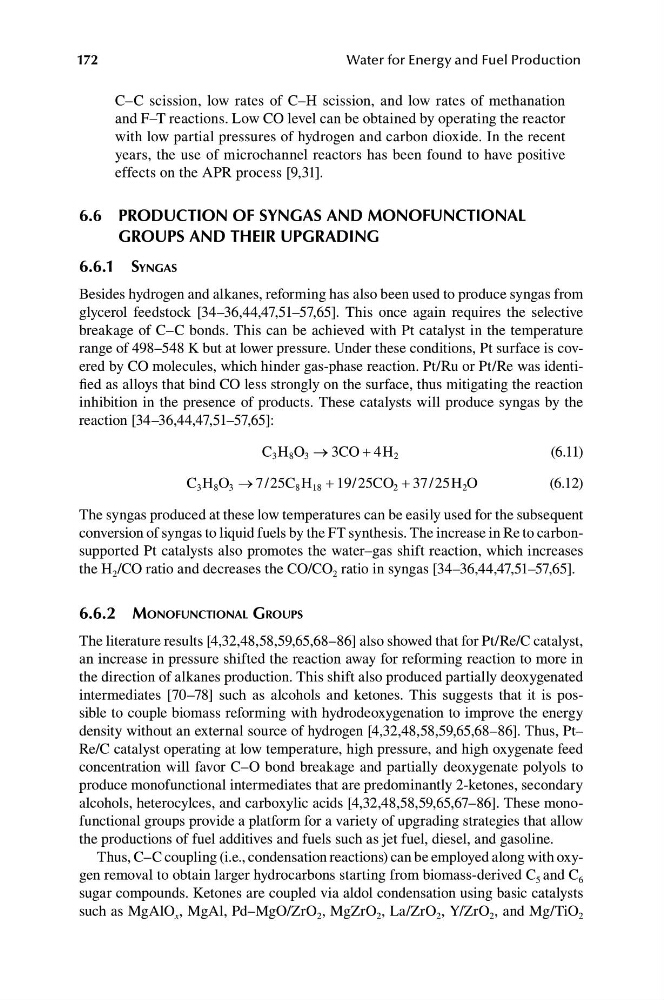
reaction [34–36,44,47,51–57,65]:
C H O
8 3 → 3CO + 4H
(6.11)
3
2
C H O 3 → 7 25 C H 18 + 19 25 CO + 37 25 H O
3 8
/
8
/
2
/
2
(6.12)
The syngas produced at these low temperatures can be easily used for the subsequent
conversion of syngas to liquid fuels by the FT synthesis. The increase in Re to carbonsupported Pt catalysts also promotes the water–gas shift reaction, which increases
the H 2 /CO ratio and decreases the CO/CO 2 ratio in syngas [34–36,44,47,51–57,65].
6.6.2 monoFunCTionAl grouPS
The literature results [4,32,48,58,59,65,68–86] also showed that for Pt/Re/C catalyst,
an increase in pressure shifted the reaction away for reforming reaction to more in
the direction of alkanes production. This shift also produced partially deoxygenated
intermediates [70–78] such as alcohols and ketones. This suggests that it is possible to couple biomass reforming with hydrodeoxygenation to improve the energy
density without an external source of hydrogen [4,32,48,58,59,65,68–86]. Thus, Pt–
Re/C catalyst operating at low temperature, high pressure, and high oxygenate feed
concentration will favor C–O bond breakage and partially deoxygenate polyols to
produce monofunctional intermediates that are predominantly 2-ketones, secondary
alcohols, heterocylces, and carboxylic acids [4,32,48,58,59,65,67–86]. These monofunctional groups provide a platform for a variety of upgrading strategies that allow
the productions of fuel additives and fuels such as jet fuel, diesel, and gasoline.
Thus, C–C coupling (i.e., condensation reactions) can be employed along with oxygen removal to obtain larger hydrocarbons starting from biomass-derived C 5 and C 6
sugar compounds. Ketones are coupled via aldol condensation using basic catalysts
such as MgAlO x , MgAl, Pd–MgO/ZrO 2 , MgZrO 2 , La/ZrO 2 , Y/ZrO 2 , and Mg/TiO 2
Water for Energy and Fuel Production
C–C scission, low rates of C–H scission, and low rates of methanation
and F–T reactions. Low CO level can be obtained by operating the reactor
with low partial pressures of hydrogen and carbon dioxide. In the recent
years, the use of microchannel reactors has been found to have positive
effects on the APR process [9,31].
6.6 PrOdUCtiOn OF synGas and mOnOFUnCtiOnal
GrOUPs and their UPGradinG
6.6.1 SyngAS
Besides hydrogen and alkanes, reforming has also been used to produce syngas from
glycerol feedstock [34–36,44,47,51–57,65]. This once again requires the selective
breakage of C–C bonds. This can be achieved with Pt catalyst in the temperature
range of 498–548 K but at lower pressure. Under these conditions, Pt surface is covered by CO molecules, which hinder gas-phase reaction. Pt/Ru or Pt/Re was identified as alloys that bind CO less strongly on the surface, thus mitigating the reaction
inhibition in the presence of products. These catalysts will produce syngas by the
reaction [34–36,44,47,51–57,65]:
C H O
8 3 → 3CO + 4H
(6.11)
3
2
C H O 3 → 7 25 C H 18 + 19 25 CO + 37 25 H O
3 8
/
8
/
2
/
2
(6.12)
The syngas produced at these low temperatures can be easily used for the subsequent
conversion of syngas to liquid fuels by the FT synthesis. The increase in Re to carbonsupported Pt catalysts also promotes the water–gas shift reaction, which increases
the H 2 /CO ratio and decreases the CO/CO 2 ratio in syngas [34–36,44,47,51–57,65].
6.6.2 monoFunCTionAl grouPS
The literature results [4,32,48,58,59,65,68–86] also showed that for Pt/Re/C catalyst,
an increase in pressure shifted the reaction away for reforming reaction to more in
the direction of alkanes production. This shift also produced partially deoxygenated
intermediates [70–78] such as alcohols and ketones. This suggests that it is possible to couple biomass reforming with hydrodeoxygenation to improve the energy
density without an external source of hydrogen [4,32,48,58,59,65,68–86]. Thus, Pt–
Re/C catalyst operating at low temperature, high pressure, and high oxygenate feed
concentration will favor C–O bond breakage and partially deoxygenate polyols to
produce monofunctional intermediates that are predominantly 2-ketones, secondary
alcohols, heterocylces, and carboxylic acids [4,32,48,58,59,65,67–86]. These monofunctional groups provide a platform for a variety of upgrading strategies that allow
the productions of fuel additives and fuels such as jet fuel, diesel, and gasoline.
Thus, C–C coupling (i.e., condensation reactions) can be employed along with oxygen removal to obtain larger hydrocarbons starting from biomass-derived C 5 and C 6
sugar compounds. Ketones are coupled via aldol condensation using basic catalysts
such as MgAlO x , MgAl, Pd–MgO/ZrO 2 , MgZrO 2 , La/ZrO 2 , Y/ZrO 2 , and Mg/TiO 2