

−10
1000
800
600
400
200
0
Density (kg/m 3
)
K w
Density
Dielectric constant
80
60
−12
Dielectric constant
−14
log
10 K
w
40
−16
20
0
−18
0
100
200
300
400
500
Temperature (°C)
115
Hydrothermal Processes in Subcritical Water
To understand hydrothermal operation in sub- and supercritical regions, it is important
to illustrate the behavior of various properties of water under these conditions. We will
mainly focus on the water properties in the subcritical conditions. The properties of water
under supercritical conditions are illustrated in Chapter 10. Interphase transport resistances can be considerably reduced at higher water temperatures. The water properties
will vary considerably with temperature to facilitate various types of organic reactions
and also the separations of products from byproducts. When feedstock contain inorganics such as sulfates, nitrates, and phosphates, hydrothermal operation can facilitate
the recovery and recycling of these chemicals in their ionic forms for eventual use as
fertilizers. Also, in hydrothermal operations, product streams are completely sterilized
with respect to any possible pathogens including biotoxins, bacteria, and viruses. For
temperatures greater than about 250°C and the contact time of few seconds, proteins are
destructively hydrolyzed so that even prions would be destroyed [5,16].
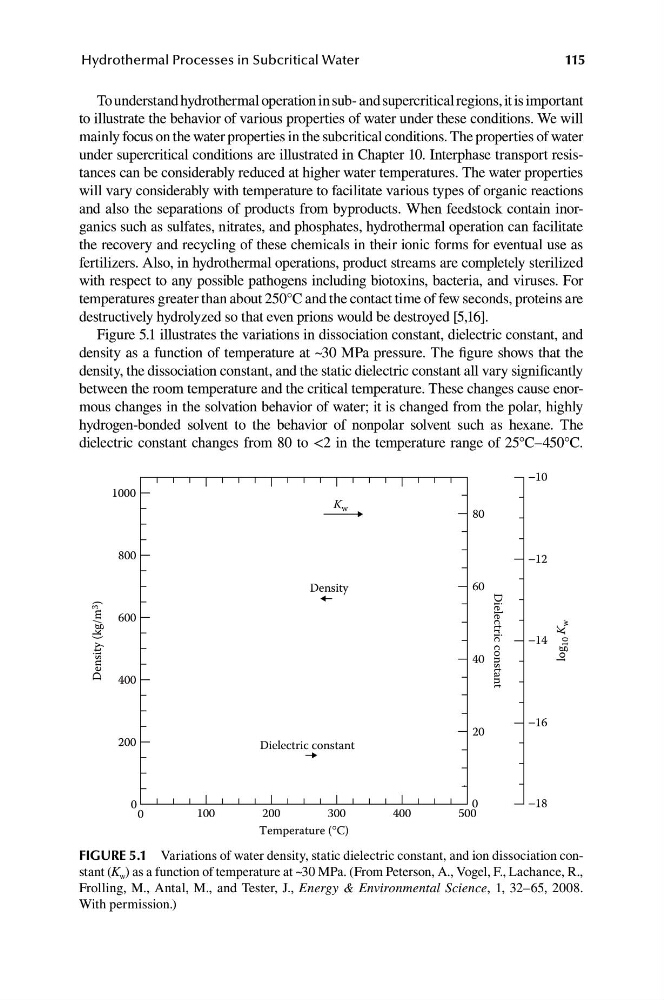
Figure 5.1 illustrates the variations in dissociation constant, dielectric constant, and
density as a function of temperature at ~30 MPa pressure. The figure shows that the
density, the dissociation constant, and the static dielectric constant all vary significantly
between the room temperature and the critical temperature. These changes cause enormous changes in the solvation behavior of water; it is changed from the polar, highly
hydrogen-bonded solvent to the behavior of nonpolar solvent such as hexane. The
dielectric constant changes from 80 to <2 in the temperature range of 25°C–450°C.
FiGUre 5.1 Variations of water density, static dielectric constant, and ion dissociation constant (K w ) as a function of temperature at ~30 MPa. (From Peterson, A., Vogel, F., Lachance, R.,
Frolling, M., Antal, M., and Tester, J., Energy & Environmental Science, 1, 32–65, 2008.
With permission.)