

4.1 The Heisenberg Group (CCR)
51
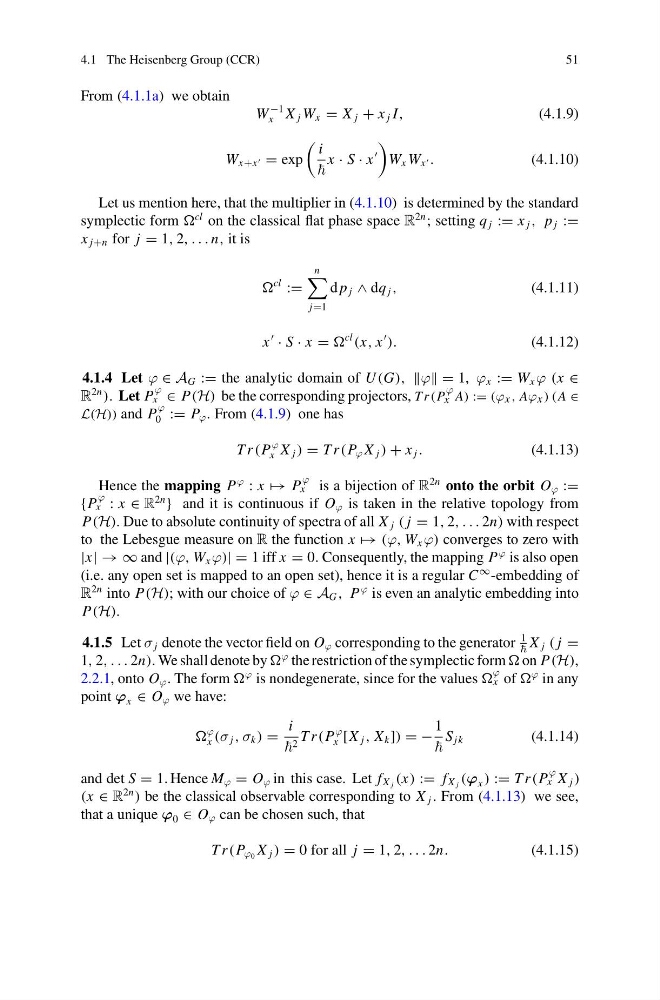
From (4.1.1a) we obtain
W
−1
x X j W x = X j + x j I,
(4.1.9)
W x+x = exp
i
x · S · x
W x W x .
(4.1.10)
Let us mention here, that the multiplier in (4.1.10) is determined by the standard
symplectic form
cl on the classical flat phase space R
2n ; setting q j := x j , p j :=
x j+n for j = 1, 2, . . . n, it is
cl
:=
n
j=1
d p j ∧ dq j ,
(4.1.11)
x
· S · x =
cl
(x, x
).
(4.1.12)
4.1.4 Let ϕ ∈ A G := the analytic domain of U (G), ϕ = 1, ϕ x := W x ϕ (x ∈
R
2n
). Let P
ϕ
x ∈ P(H) be the corresponding projectors, T r(P
ϕ
x A) := (ϕ x , Aϕ x ) (A ∈
L(H)) and P
ϕ
0 := P ϕ . From (4.1.9) one has
T r(P
ϕ
x X j ) = T r(P ϕ X j ) + x j .
(4.1.13)
Hence the mapping P
ϕ
: x → P
ϕ
x is a bijection of R
2n onto the orbit O ϕ :=
{P
ϕ
x : x ∈ R
2n
} and it is continuous if O ϕ is taken in the relative topology from
P(H). Due to absolute continuity of spectra of all X j ( j = 1, 2, . . . 2n) with respect
to the Lebesgue measure on R the function x → (ϕ, W x ϕ) converges to zero with
|x| → ∞ and |(ϕ, W x ϕ)| = 1 iff x = 0. Consequently, the mapping P
ϕ is also open
(i.e. any open set is mapped to an open set), hence it is a regular C
∞ -embedding of
R
2n into P(H); with our choice of ϕ ∈ A G , P
ϕ is even an analytic embedding into
P(H).
4.1.5 Let σ j denote the vector field on O ϕ corresponding to the generator
1
X j ( j =
1, 2, . . . 2n). We shall denote by
ϕ the restriction of the symplectic form on P(H),
2.2.1, onto O ϕ . The form
ϕ is nondegenerate, since for the values
ϕ
x of
ϕ in any
point ϕ x ∈ O ϕ we have:
ϕ
x (σ j , σ k ) =
i
2 T r(P
ϕ
x [X j , X k ]) = −
1
S jk
(4.1.14)
and det S = 1. Hence M ϕ = O ϕ in this case. Let f X j (x) := f X j (ϕ x ) := T r(P
ϕ
x X j )
(x ∈ R
2n
) be the classical observable corresponding to X j . From (4.1.13) we see,
that a unique ϕ 0 ∈ O ϕ can be chosen such, that
T r(P ϕ 0 X j ) = 0 for all j = 1, 2, . . . 2n.
(4.1.15)
51
From (4.1.1a) we obtain
W
−1
x X j W x = X j + x j I,
(4.1.9)
W x+x = exp
i
x · S · x
W x W x .
(4.1.10)
Let us mention here, that the multiplier in (4.1.10) is determined by the standard
symplectic form
cl on the classical flat phase space R
2n ; setting q j := x j , p j :=
x j+n for j = 1, 2, . . . n, it is
cl
:=
n
j=1
d p j ∧ dq j ,
(4.1.11)
x
· S · x =
cl
(x, x
).
(4.1.12)
4.1.4 Let ϕ ∈ A G := the analytic domain of U (G), ϕ = 1, ϕ x := W x ϕ (x ∈
R
2n
). Let P
ϕ
x ∈ P(H) be the corresponding projectors, T r(P
ϕ
x A) := (ϕ x , Aϕ x ) (A ∈
L(H)) and P
ϕ
0 := P ϕ . From (4.1.9) one has
T r(P
ϕ
x X j ) = T r(P ϕ X j ) + x j .
(4.1.13)
Hence the mapping P
ϕ
: x → P
ϕ
x is a bijection of R
2n onto the orbit O ϕ :=
{P
ϕ
x : x ∈ R
2n
} and it is continuous if O ϕ is taken in the relative topology from
P(H). Due to absolute continuity of spectra of all X j ( j = 1, 2, . . . 2n) with respect
to the Lebesgue measure on R the function x → (ϕ, W x ϕ) converges to zero with
|x| → ∞ and |(ϕ, W x ϕ)| = 1 iff x = 0. Consequently, the mapping P
ϕ is also open
(i.e. any open set is mapped to an open set), hence it is a regular C
∞ -embedding of
R
2n into P(H); with our choice of ϕ ∈ A G , P
ϕ is even an analytic embedding into
P(H).
4.1.5 Let σ j denote the vector field on O ϕ corresponding to the generator
1
X j ( j =
1, 2, . . . 2n). We shall denote by
ϕ the restriction of the symplectic form on P(H),
2.2.1, onto O ϕ . The form
ϕ is nondegenerate, since for the values
ϕ
x of
ϕ in any
point ϕ x ∈ O ϕ we have:
ϕ
x (σ j , σ k ) =
i
2 T r(P
ϕ
x [X j , X k ]) = −
1
S jk
(4.1.14)
and det S = 1. Hence M ϕ = O ϕ in this case. Let f X j (x) := f X j (ϕ x ) := T r(P
ϕ
x X j )
(x ∈ R
2n
) be the classical observable corresponding to X j . From (4.1.13) we see,
that a unique ϕ 0 ∈ O ϕ can be chosen such, that
T r(P ϕ 0 X j ) = 0 for all j = 1, 2, . . . 2n.
(4.1.15)