

212
7 Some Models of “Quantum Measurement”
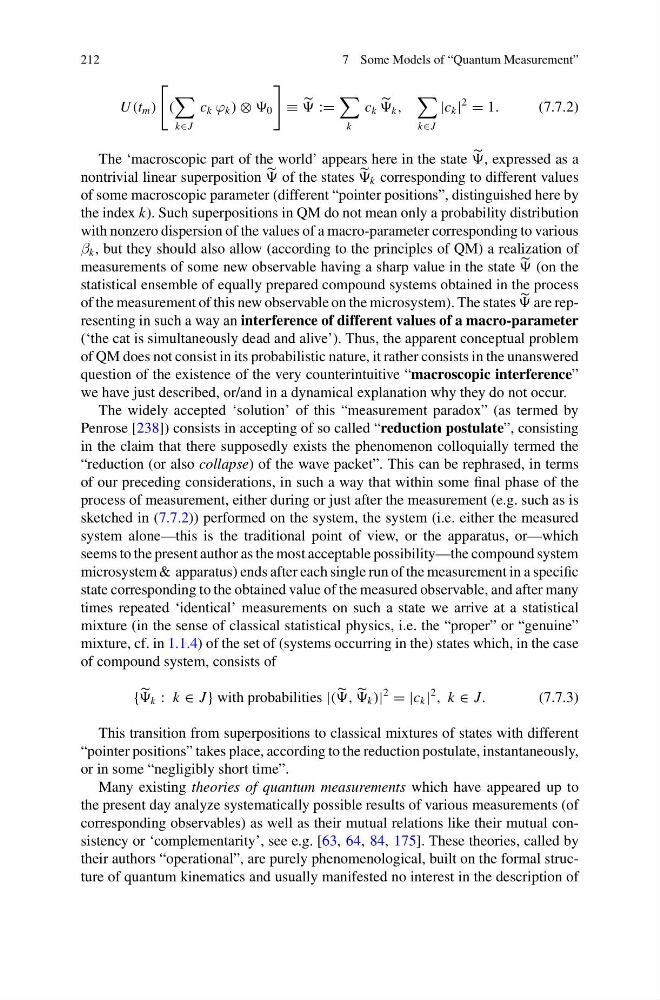
U (t m )
(
k∈J
c k ϕ k ) ⊗ 0
≡
:=
k
c k
k ,
k∈J
|c k |
2
= 1.
(7.7.2)
The ‘macroscopic part of the world’ appears here in the state
, expressed as a
nontrivial linear superposition
of the states
k corresponding to different values
of some macroscopic parameter (different “pointer positions”, distinguished here by
the index k). Such superpositions in QM do not mean only a probability distribution
with nonzero dispersion of the values of a macro-parameter corresponding to various
β k , but they should also allow (according to the principles of QM) a realization of
measurements of some new observable having a sharp value in the state
(on the
statistical ensemble of equally prepared compound systems obtained in the process
of the measurement of this new observable on the microsystem). The states
are representing in such a way an interference of different values of a macro-parameter
(‘the cat is simultaneously dead and alive’). Thus, the apparent conceptual problem
of QM does not consist in its probabilistic nature, it rather consists in the unanswered
question of the existence of the very counterintuitive “macroscopic interference”
we have just described, or/and in a dynamical explanation why they do not occur.
The widely accepted ‘solution’ of this “measurement paradox” (as termed by
Penrose [238]) consists in accepting of so called “reduction postulate”, consisting
in the claim that there supposedly exists the phenomenon colloquially termed the
“reduction (or also collapse) of the wave packet”. This can be rephrased, in terms
of our preceding considerations, in such a way that within some final phase of the
process of measurement, either during or just after the measurement (e.g. such as is
sketched in (7.7.2)) performed on the system, the system (i.e. either the measured
system alone—this is the traditional point of view, or the apparatus, or—which
seems to the present author as the most acceptable possibility—the compound system
microsystem & apparatus) ends after each single run of the measurement in a specific
state corresponding to the obtained value of the measured observable, and after many
times repeated ‘identical’ measurements on such a state we arrive at a statistical
mixture (in the sense of classical statistical physics, i.e. the “proper” or “genuine”
mixture, cf. in 1.1.4) of the set of (systems occurring in the) states which, in the case
of compound system, consists of
{
k : k ∈ J } with probabilities |(
,
k )|
2
= |c k |
2
, k ∈ J.
(7.7.3)
This transition from superpositions to classical mixtures of states with different
“pointer positions” takes place, according to the reduction postulate, instantaneously,
or in some “negligibly short time”.
Many existing theories of quantum measurements which have appeared up to
the present day analyze systematically possible results of various measurements (of
corresponding observables) as well as their mutual relations like their mutual consistency or ‘complementarity’, see e.g. [63, 64, 84, 175]. These theories, called by
their authors “operational”, are purely phenomenological, built on the formal structure of quantum kinematics and usually manifested no interest in the description of
7 Some Models of “Quantum Measurement”
U (t m )
(
k∈J
c k ϕ k ) ⊗ 0
≡
:=
k
c k
k ,
k∈J
|c k |
2
= 1.
(7.7.2)
The ‘macroscopic part of the world’ appears here in the state
, expressed as a
nontrivial linear superposition
of the states
k corresponding to different values
of some macroscopic parameter (different “pointer positions”, distinguished here by
the index k). Such superpositions in QM do not mean only a probability distribution
with nonzero dispersion of the values of a macro-parameter corresponding to various
β k , but they should also allow (according to the principles of QM) a realization of
measurements of some new observable having a sharp value in the state
(on the
statistical ensemble of equally prepared compound systems obtained in the process
of the measurement of this new observable on the microsystem). The states
are representing in such a way an interference of different values of a macro-parameter
(‘the cat is simultaneously dead and alive’). Thus, the apparent conceptual problem
of QM does not consist in its probabilistic nature, it rather consists in the unanswered
question of the existence of the very counterintuitive “macroscopic interference”
we have just described, or/and in a dynamical explanation why they do not occur.
The widely accepted ‘solution’ of this “measurement paradox” (as termed by
Penrose [238]) consists in accepting of so called “reduction postulate”, consisting
in the claim that there supposedly exists the phenomenon colloquially termed the
“reduction (or also collapse) of the wave packet”. This can be rephrased, in terms
of our preceding considerations, in such a way that within some final phase of the
process of measurement, either during or just after the measurement (e.g. such as is
sketched in (7.7.2)) performed on the system, the system (i.e. either the measured
system alone—this is the traditional point of view, or the apparatus, or—which
seems to the present author as the most acceptable possibility—the compound system
microsystem & apparatus) ends after each single run of the measurement in a specific
state corresponding to the obtained value of the measured observable, and after many
times repeated ‘identical’ measurements on such a state we arrive at a statistical
mixture (in the sense of classical statistical physics, i.e. the “proper” or “genuine”
mixture, cf. in 1.1.4) of the set of (systems occurring in the) states which, in the case
of compound system, consists of
{
k : k ∈ J } with probabilities |(
,
k )|
2
= |c k |
2
, k ∈ J.
(7.7.3)
This transition from superpositions to classical mixtures of states with different
“pointer positions” takes place, according to the reduction postulate, instantaneously,
or in some “negligibly short time”.
Many existing theories of quantum measurements which have appeared up to
the present day analyze systematically possible results of various measurements (of
corresponding observables) as well as their mutual relations like their mutual consistency or ‘complementarity’, see e.g. [63, 64, 84, 175]. These theories, called by
their authors “operational”, are purely phenomenological, built on the formal structure of quantum kinematics and usually manifested no interest in the description of