

7.7 On the “Measurement Problem” in QM
211
intuition provided by the ‘everyday life’, whose formal reflection is contained in the
mathematical models of classical physics.
One of the prominent results of the history of observations and measurements
mentioned above is that QM is considered an irreducibly statistical theory; i.e.,
that the probabilistic results of the measurements with nonzero dispersions are not
necessarily due to the presence of some statistical ensembles of systems in various
states, as they are in the classical statistical physics, but that it is impossible to find any
fully dispersionfree states even when considering individual (micro)systems. This is
now (starting from 1920’s) acceptable and included in a logically consistent manner
into the description of our world. The resulting picture of the world is, however, not
without problems, since its integral part is a class of counterintuitive phenomena
encountered in QM. These are, pictorially expressed, the problems of the type of the
well known “Schrödinger’s cat paradox”, which is just a popular representation of
the “measurement problem” to be discussed further (the cat can be regarded here
also as a measuring device).
We are measuring with some macroscopic apparatuses which belong to the same
world as microsystems do, but seem to be correctly described by a theory that is very
different from QM. Is QM a universal theory, or is there some borderline between
the two differently behaving parts of the world? If so, it should be explained in the
theory where that borderline is located. But the apparatuses are composite of many
microsystems and (as far as the present author knows) no new aspect of microsystems
was discovered which could effectively distinguish between them and macrosystems.
Thus, let us regard the apparatuses as some quantum-mechanical systems. Then any
measuring process should look as follows
15 :
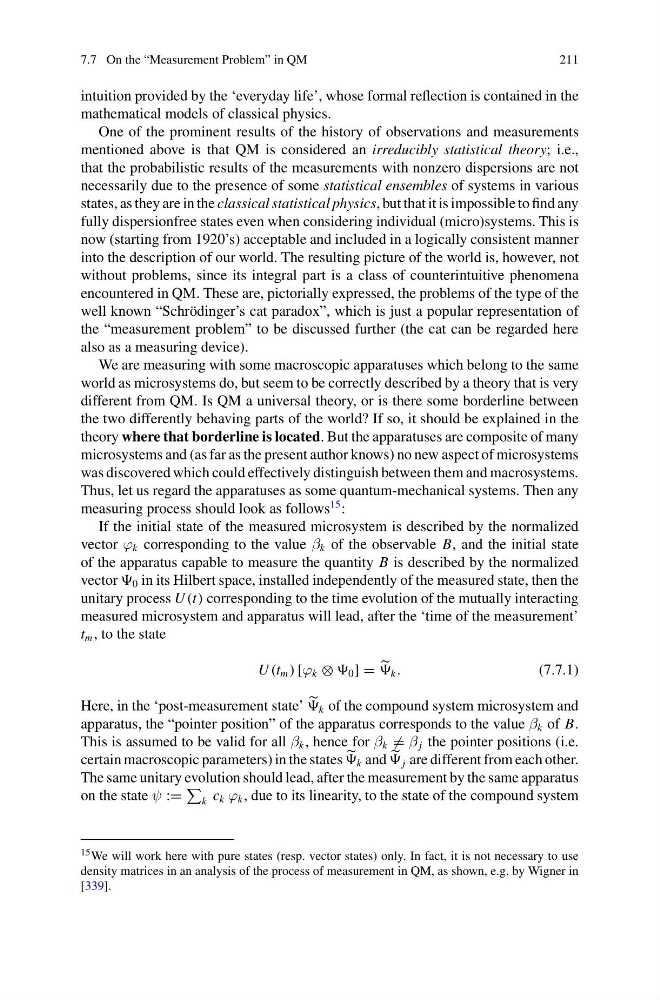
If the initial state of the measured microsystem is described by the normalized
vector ϕ k corresponding to the value β k of the observable B, and the initial state
of the apparatus capable to measure the quantity B is described by the normalized
vector 0 in its Hilbert space, installed independently of the measured state, then the
unitary process U (t) corresponding to the time evolution of the mutually interacting
measured microsystem and apparatus will lead, after the ‘time of the measurement’
t m , to the state
U (t m ) [ϕ k ⊗ 0 ] =
k .
(7.7.1)
Here, in the ‘post-measurement state’
k of the compound system microsystem and
apparatus, the “pointer position” of the apparatus corresponds to the value β k of B.
This is assumed to be valid for all β k , hence for β k = β j the pointer positions (i.e.
certain macroscopic parameters) in the states
k and
j are different from each other.
The same unitary evolution should lead, after the measurement by the same apparatus
on the state ψ :=
k c k ϕ k , due to its linearity, to the state of the compound system
15 We will work here with pure states (resp. vector states) only. In fact, it is not necessary to use
density matrices in an analysis of the process of measurement in QM, as shown, e.g. by Wigner in
[339].
211
intuition provided by the ‘everyday life’, whose formal reflection is contained in the
mathematical models of classical physics.
One of the prominent results of the history of observations and measurements
mentioned above is that QM is considered an irreducibly statistical theory; i.e.,
that the probabilistic results of the measurements with nonzero dispersions are not
necessarily due to the presence of some statistical ensembles of systems in various
states, as they are in the classical statistical physics, but that it is impossible to find any
fully dispersionfree states even when considering individual (micro)systems. This is
now (starting from 1920’s) acceptable and included in a logically consistent manner
into the description of our world. The resulting picture of the world is, however, not
without problems, since its integral part is a class of counterintuitive phenomena
encountered in QM. These are, pictorially expressed, the problems of the type of the
well known “Schrödinger’s cat paradox”, which is just a popular representation of
the “measurement problem” to be discussed further (the cat can be regarded here
also as a measuring device).
We are measuring with some macroscopic apparatuses which belong to the same
world as microsystems do, but seem to be correctly described by a theory that is very
different from QM. Is QM a universal theory, or is there some borderline between
the two differently behaving parts of the world? If so, it should be explained in the
theory where that borderline is located. But the apparatuses are composite of many
microsystems and (as far as the present author knows) no new aspect of microsystems
was discovered which could effectively distinguish between them and macrosystems.
Thus, let us regard the apparatuses as some quantum-mechanical systems. Then any
measuring process should look as follows
15 :
If the initial state of the measured microsystem is described by the normalized
vector ϕ k corresponding to the value β k of the observable B, and the initial state
of the apparatus capable to measure the quantity B is described by the normalized
vector 0 in its Hilbert space, installed independently of the measured state, then the
unitary process U (t) corresponding to the time evolution of the mutually interacting
measured microsystem and apparatus will lead, after the ‘time of the measurement’
t m , to the state
U (t m ) [ϕ k ⊗ 0 ] =
k .
(7.7.1)
Here, in the ‘post-measurement state’
k of the compound system microsystem and
apparatus, the “pointer position” of the apparatus corresponds to the value β k of B.
This is assumed to be valid for all β k , hence for β k = β j the pointer positions (i.e.
certain macroscopic parameters) in the states
k and
j are different from each other.
The same unitary evolution should lead, after the measurement by the same apparatus
on the state ψ :=
k c k ϕ k , due to its linearity, to the state of the compound system
15 We will work here with pure states (resp. vector states) only. In fact, it is not necessary to use
density matrices in an analysis of the process of measurement in QM, as shown, e.g. by Wigner in
[339].