

7.5 The X-Y Chain as a Measuring Device
199
0 :=
j≤−1
| + j ⊗
k≥0
| − k.
(7.5.15)
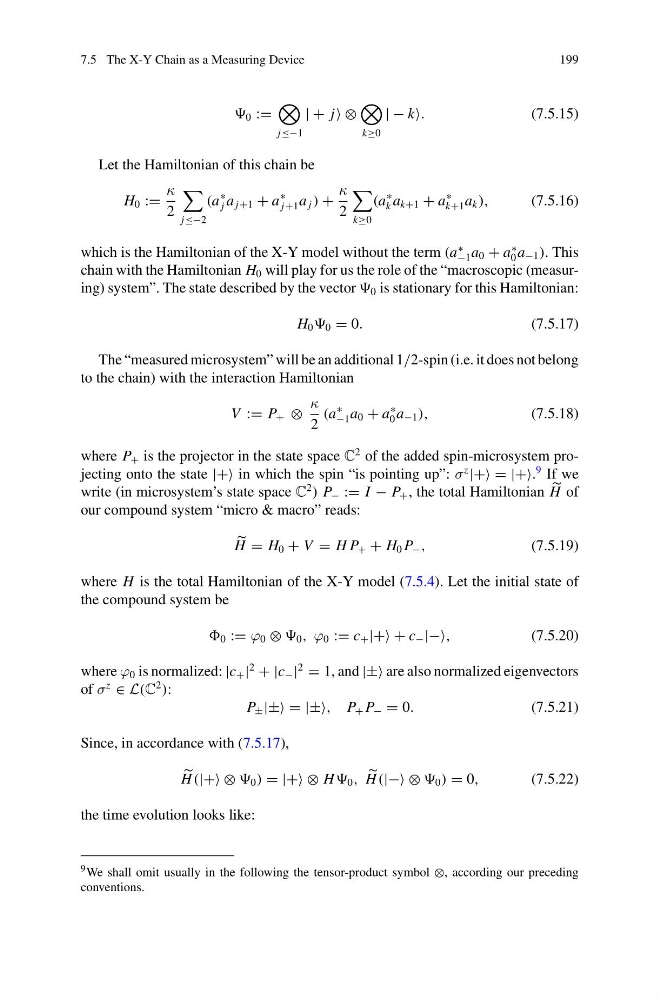
Let the Hamiltonian of this chain be
H 0 :=
κ
2
j≤−2
(a
∗
j a j+1 + a
∗
j+1 a j ) +
κ
2
k≥0
(a
∗
k a k+1 + a
∗
k+1 a k ),
(7.5.16)
which is the Hamiltonian of the X-Y model without the term (a
∗
−1 a 0 + a
∗
0 a −1 ). This
chain with the Hamiltonian H 0 will play for us the role of the “macroscopic (measuring) system”. The state described by the vector 0 is stationary for this Hamiltonian:
H 0 0 = 0.
(7.5.17)
The “measured microsystem” will be an additional 1/2-spin (i.e. it does not belong
to the chain) with the interaction Hamiltonian
V := P + ⊗
κ
2
(a
∗
−1 a 0 + a
∗
0 a −1 ),
(7.5.18)
where P + is the projector in the state space C
2 of the added spin-microsystem projecting onto the state |++ in which the spin “is pointing up”: σ
z
|++ = |++.
9 If we
write (in microsystem’s state space C
2 ) P − := I − P + , the total Hamiltonian
H of
our compound system “micro & macro” reads:
H = H 0 + V = H P + + H 0 P − ,
(7.5.19)
where H is the total Hamiltonian of the X-Y model (7.5.4). Let the initial state of
the compound system be
0 := ϕ 0 ⊗ 0 , ϕ 0 := c + |++ + c − |−−,
(7.5.20)
where ϕ 0 is normalized: |c + |
2
+ |c − |
2
= 1, and |±± are also normalized eigenvectors
of σ
z
∈ L(C
2
):
P ± |±± = |±±, P + P − = 0.
(7.5.21)
Since, in accordance with (7.5.17),
H (|++ ⊗ 0 ) = |+ ⊗ H 0 ,
H (|−− ⊗ 0 ) = 0,
(7.5.22)
the time evolution looks like:
9 We shall omit usually in the following the tensor-product symbol ⊗, according our preceding
conventions.
199
0 :=
j≤−1
| + j ⊗
k≥0
| − k.
(7.5.15)
Let the Hamiltonian of this chain be
H 0 :=
κ
2
j≤−2
(a
∗
j a j+1 + a
∗
j+1 a j ) +
κ
2
k≥0
(a
∗
k a k+1 + a
∗
k+1 a k ),
(7.5.16)
which is the Hamiltonian of the X-Y model without the term (a
∗
−1 a 0 + a
∗
0 a −1 ). This
chain with the Hamiltonian H 0 will play for us the role of the “macroscopic (measuring) system”. The state described by the vector 0 is stationary for this Hamiltonian:
H 0 0 = 0.
(7.5.17)
The “measured microsystem” will be an additional 1/2-spin (i.e. it does not belong
to the chain) with the interaction Hamiltonian
V := P + ⊗
κ
2
(a
∗
−1 a 0 + a
∗
0 a −1 ),
(7.5.18)
where P + is the projector in the state space C
2 of the added spin-microsystem projecting onto the state |++ in which the spin “is pointing up”: σ
z
|++ = |++.
9 If we
write (in microsystem’s state space C
2 ) P − := I − P + , the total Hamiltonian
H of
our compound system “micro & macro” reads:
H = H 0 + V = H P + + H 0 P − ,
(7.5.19)
where H is the total Hamiltonian of the X-Y model (7.5.4). Let the initial state of
the compound system be
0 := ϕ 0 ⊗ 0 , ϕ 0 := c + |++ + c − |−−,
(7.5.20)
where ϕ 0 is normalized: |c + |
2
+ |c − |
2
= 1, and |±± are also normalized eigenvectors
of σ
z
∈ L(C
2
):
P ± |±± = |±±, P + P − = 0.
(7.5.21)
Since, in accordance with (7.5.17),
H (|++ ⊗ 0 ) = |+ ⊗ H 0 ,
H (|−− ⊗ 0 ) = 0,
(7.5.22)
the time evolution looks like:
9 We shall omit usually in the following the tensor-product symbol ⊗, according our preceding
conventions.