

7.4 Particle Detection—A “Nonideal” Measurement
185
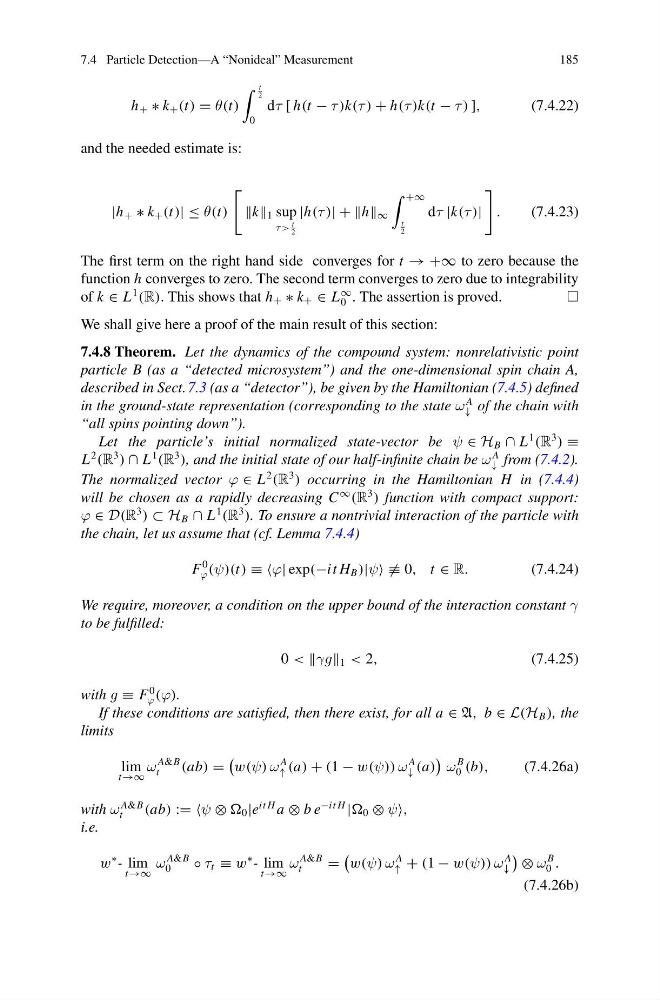
h + ∗ k + (t) = θ(t)
t
2
0
dτ [ h(t − τ )k(τ ) + h(τ )k(t − τ ) ],
(7.4.22)
and the needed estimate is:
|h + ∗ k + (t)| ≤ θ(t)
k 1 sup
τ >
t
2
|h(τ )| + +h ∞
+∞
t
2
dτ |k(τ )|
.
(7.4.23)
The first term on the right hand side converges for t → +∞ to zero because the
function h converges to zero. The second term converges to zero due to integrability
of k ∈ L
1
(R). This shows that h + ∗ k + ∈ L
∞
0 . The assertion is proved.
We shall give here a proof of the main result of this section:
7.4.8 Theorem. Let the dynamics of the compound system: nonrelativistic point
particle B (as a “detected microsystem”) and the one-dimensional spin chain A,
described in Sect. 7.3 (as a “detector”), be given by the Hamiltonian (7.4.5) defined
in the ground-state representation (corresponding to the state ω
A
↓ of the chain with
“all spins pointing down”).
Let the particle’s initial normalized state-vector be ψ ∈ H B ∩ L
1
(R
3
) ≡
L
2
(R
3
) ∩ L
1
(R
3
), and the initial state of our half-infinite chain be ω
A
↓ from (7.4.2).
The normalized vector ϕ ∈ L
2
(R
3
) occurring in the Hamiltonian H in (7.4.4)
will be chosen as a rapidly decreasing C
∞
(R
3
) function with compact support:
ϕ ∈ D(R
3
) ⊂ H B ∩ L
1
(R
3
). To ensure a nontrivial interaction of the particle with
the chain, let us assume that (cf. Lemma 7.4.4)
F
0
ϕ (ψ)(t) ≡ ≡ϕ| exp(−it H B )|ψ ≡ 0, t ∈ R.
(7.4.24)
We require, moreover, a condition on the upper bound of the interaction constant γ
to be fulfilled:
0 < γg 1 < 2,
(7.4.25)
with g ≡ F
0
ϕ (ϕ).
If these conditions are satisfied, then there exist, for all a ∈ A, b ∈ L(H B ), the
limits
lim
t→∞
ω
A&B
t
(ab) =
w(ψ) ω
A
↑ (a) + (1 − w(ψ)) ω
A
↓ (a)
ω
B
0 (b),
(7.4.26a)
with ω
A&B
t
(ab) := =ψ ⊗ 0 |e
it H a ⊗ b e
−it H
| 0 ⊗ ψ,
i.e.
w
∗ - lim
t→∞
ω
A&B
0
◦ τ t ≡ w
∗ - lim
t→∞
ω
A&B
t
=
w(ψ) ω
A
↑ + (1 − w(ψ)) ω
A
↓
⊗ ω
B
0 .
(7.4.26b)
185
h + ∗ k + (t) = θ(t)
t
2
0
dτ [ h(t − τ )k(τ ) + h(τ )k(t − τ ) ],
(7.4.22)
and the needed estimate is:
|h + ∗ k + (t)| ≤ θ(t)
k 1 sup
τ >
t
2
|h(τ )| + +h ∞
+∞
t
2
dτ |k(τ )|
.
(7.4.23)
The first term on the right hand side converges for t → +∞ to zero because the
function h converges to zero. The second term converges to zero due to integrability
of k ∈ L
1
(R). This shows that h + ∗ k + ∈ L
∞
0 . The assertion is proved.
We shall give here a proof of the main result of this section:
7.4.8 Theorem. Let the dynamics of the compound system: nonrelativistic point
particle B (as a “detected microsystem”) and the one-dimensional spin chain A,
described in Sect. 7.3 (as a “detector”), be given by the Hamiltonian (7.4.5) defined
in the ground-state representation (corresponding to the state ω
A
↓ of the chain with
“all spins pointing down”).
Let the particle’s initial normalized state-vector be ψ ∈ H B ∩ L
1
(R
3
) ≡
L
2
(R
3
) ∩ L
1
(R
3
), and the initial state of our half-infinite chain be ω
A
↓ from (7.4.2).
The normalized vector ϕ ∈ L
2
(R
3
) occurring in the Hamiltonian H in (7.4.4)
will be chosen as a rapidly decreasing C
∞
(R
3
) function with compact support:
ϕ ∈ D(R
3
) ⊂ H B ∩ L
1
(R
3
). To ensure a nontrivial interaction of the particle with
the chain, let us assume that (cf. Lemma 7.4.4)
F
0
ϕ (ψ)(t) ≡ ≡ϕ| exp(−it H B )|ψ ≡ 0, t ∈ R.
(7.4.24)
We require, moreover, a condition on the upper bound of the interaction constant γ
to be fulfilled:
0 < γg 1 < 2,
(7.4.25)
with g ≡ F
0
ϕ (ϕ).
If these conditions are satisfied, then there exist, for all a ∈ A, b ∈ L(H B ), the
limits
lim
t→∞
ω
A&B
t
(ab) =
w(ψ) ω
A
↑ (a) + (1 − w(ψ)) ω
A
↓ (a)
ω
B
0 (b),
(7.4.26a)
with ω
A&B
t
(ab) := =ψ ⊗ 0 |e
it H a ⊗ b e
−it H
| 0 ⊗ ψ,
i.e.
w
∗ - lim
t→∞
ω
A&B
0
◦ τ t ≡ w
∗ - lim
t→∞
ω
A&B
t
=
w(ψ) ω
A
↑ + (1 − w(ψ)) ω
A
↓
⊗ ω
B
0 .
(7.4.26b)