

184
7 Some Models of “Quantum Measurement”
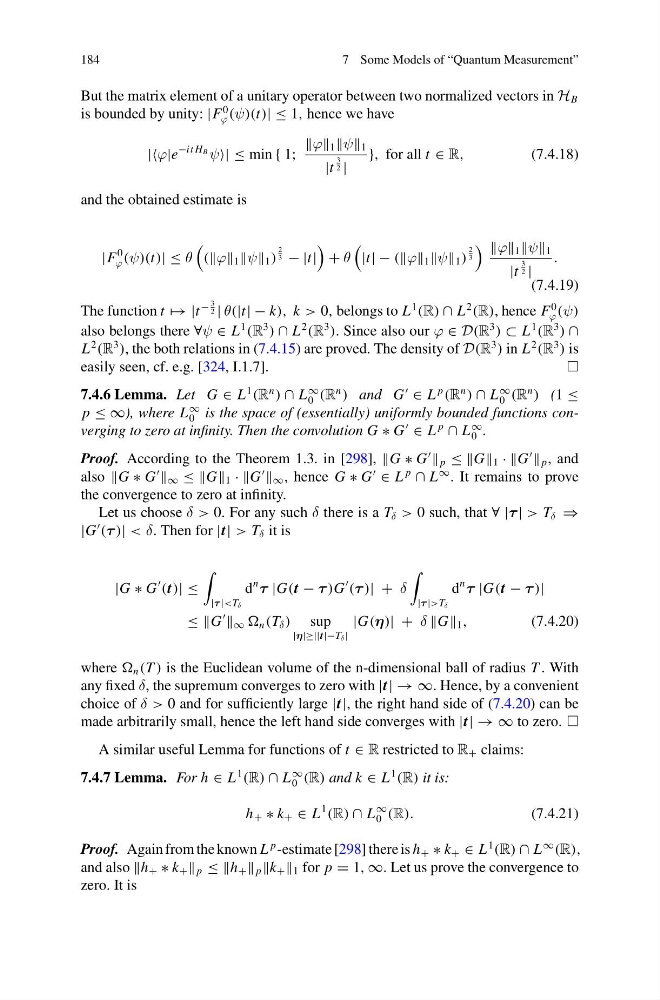
But the matrix element of a unitary operator between two normalized vectors in H B
is bounded by unity: |F
0
ϕ (ψ)(t)| ≤ 1, hence we have
||ϕ|e
−it H B ψ ≤ min { 1;
ϕ 1 ψ 1
|t
3
2 |
}, for all t ∈ R,
(7.4.18)
and the obtained estimate is
|F
0
ϕ (ψ)(t)| ≤ θ
(ϕ 1 ψ 1 )
2
3 − |t|
+ θ
|t| − (ϕ 1 ψ 1 )
2
3
ϕ 1 ψ 1
|t
3
2 |
.
(7.4.19)
The function t → |t
−
3
2 | θ(|t| − k), k > 0, belongs to L
1
(R) ∩ L
2
(R), hence F
0
ϕ (ψ)
also belongs there ∀ψ ∈ L
1
(R
3
) ∩ L
2
(R
3
). Since also our ϕ ∈ D(R
3
) ⊂ L
1
(R
3
) ∩
L
2
(R
3
), the both relations in (7.4.15) are proved. The density of D(R
3
) in L
2
(R
3
) is
easily seen, cf. e.g. [324, I.1.7].
7.4.6 Lemma. Let G ∈ L
1
(R
n
) ∩ L
∞
0 (R
n
) and G
∈ L
p
(R
n
) ∩ L
∞
0 (R
n
) (1 ≤
p ≤ ∞), where L
∞
0 is the space of (essentially) uniformly bounded functions converging to zero at infinity. Then the convolution G ∗ G
∈ L
p
∩ L
∞
0 .
Proof. According to the Theorem 1.3. in [298], G ∗ G
p ≤ ≤G 1 · ·G
p , and
also G ∗ G
∞ ≤ ≤G 1 · ·G
∞ , hence G ∗ G
∈ L
p
∩ L
∞ . It remains to prove
the convergence to zero at infinity.
Let us choose δ > 0. For any such δ there is a T δ > 0 such, that ∀ |τ | > T δ ⇒
|G
(τ )| < δ. Then for |t| > T δ it is
|G ∗ G
(t)| ≤
|τ |
n
τ |G(t − τ )G
(τ )| + δ
|τ |>T δ
d
n
τ |G(t − τ )|
≤ ≤G
∞ n (T δ ) sup
|η|≥||t|−T δ |
|G(η)| + δ G 1 ,
(7.4.20)
where n (T ) is the Euclidean volume of the n-dimensional ball of radius T . With
any fixed δ, the supremum converges to zero with |t| → ∞. Hence, by a convenient
choice of δ > 0 and for sufficiently large |t|, the right hand side of (7.4.20) can be
made arbitrarily small, hence the left hand side converges with |t| → ∞ to zero.
A similar useful Lemma for functions of t ∈ R restricted to R + claims:
7.4.7 Lemma. For h ∈ L
1
(R) ∩ L
∞
0 (R) and k ∈ L
1
(R) it is:
h + ∗ k + ∈ L
1
(R) ∩ L
∞
0 (R).
(7.4.21)
Proof. Again from the known L
p -estimate [298] there is h + ∗ k + ∈ L
1
(R) ∩ L
∞
(R),
and also h + ∗ k + p ≤ ≤h + p k + 1 for p = 1, ∞. Let us prove the convergence to
zero. It is
7 Some Models of “Quantum Measurement”
But the matrix element of a unitary operator between two normalized vectors in H B
is bounded by unity: |F
0
ϕ (ψ)(t)| ≤ 1, hence we have
||ϕ|e
−it H B ψ ≤ min { 1;
ϕ 1 ψ 1
|t
3
2 |
}, for all t ∈ R,
(7.4.18)
and the obtained estimate is
|F
0
ϕ (ψ)(t)| ≤ θ
(ϕ 1 ψ 1 )
2
3 − |t|
+ θ
|t| − (ϕ 1 ψ 1 )
2
3
ϕ 1 ψ 1
|t
3
2 |
.
(7.4.19)
The function t → |t
−
3
2 | θ(|t| − k), k > 0, belongs to L
1
(R) ∩ L
2
(R), hence F
0
ϕ (ψ)
also belongs there ∀ψ ∈ L
1
(R
3
) ∩ L
2
(R
3
). Since also our ϕ ∈ D(R
3
) ⊂ L
1
(R
3
) ∩
L
2
(R
3
), the both relations in (7.4.15) are proved. The density of D(R
3
) in L
2
(R
3
) is
easily seen, cf. e.g. [324, I.1.7].
7.4.6 Lemma. Let G ∈ L
1
(R
n
) ∩ L
∞
0 (R
n
) and G
∈ L
p
(R
n
) ∩ L
∞
0 (R
n
) (1 ≤
p ≤ ∞), where L
∞
0 is the space of (essentially) uniformly bounded functions converging to zero at infinity. Then the convolution G ∗ G
∈ L
p
∩ L
∞
0 .
Proof. According to the Theorem 1.3. in [298], G ∗ G
p ≤ ≤G 1 · ·G
p , and
also G ∗ G
∞ ≤ ≤G 1 · ·G
∞ , hence G ∗ G
∈ L
p
∩ L
∞ . It remains to prove
the convergence to zero at infinity.
Let us choose δ > 0. For any such δ there is a T δ > 0 such, that ∀ |τ | > T δ ⇒
|G
(τ )| < δ. Then for |t| > T δ it is
|G ∗ G
(t)| ≤
|τ |
n
τ |G(t − τ )G
(τ )| + δ
|τ |>T δ
d
n
τ |G(t − τ )|
≤ ≤G
∞ n (T δ ) sup
|η|≥||t|−T δ |
|G(η)| + δ G 1 ,
(7.4.20)
where n (T ) is the Euclidean volume of the n-dimensional ball of radius T . With
any fixed δ, the supremum converges to zero with |t| → ∞. Hence, by a convenient
choice of δ > 0 and for sufficiently large |t|, the right hand side of (7.4.20) can be
made arbitrarily small, hence the left hand side converges with |t| → ∞ to zero.
A similar useful Lemma for functions of t ∈ R restricted to R + claims:
7.4.7 Lemma. For h ∈ L
1
(R) ∩ L
∞
0 (R) and k ∈ L
1
(R) it is:
h + ∗ k + ∈ L
1
(R) ∩ L
∞
0 (R).
(7.4.21)
Proof. Again from the known L
p -estimate [298] there is h + ∗ k + ∈ L
1
(R) ∩ L
∞
(R),
and also h + ∗ k + p ≤ ≤h + p k + 1 for p = 1, ∞. Let us prove the convergence to
zero. It is