

7.3 Quantum Domino
175
J n (z) =
i
n
π
π
0
e
−iz cos α cos(nα)dα.
(7.3.22)
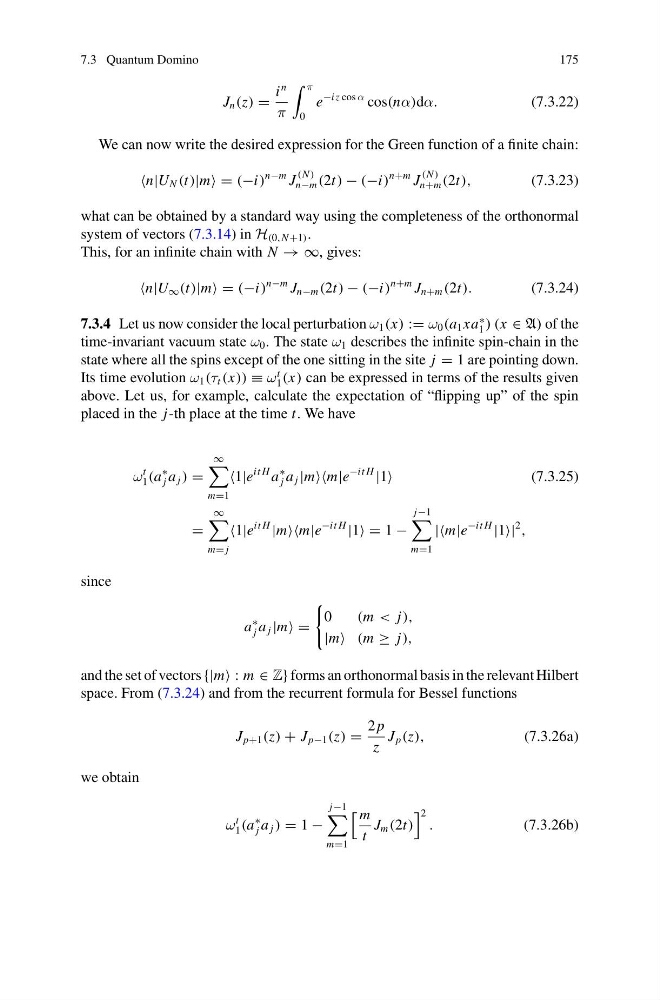
We can now write the desired expression for the Green function of a finite chain:
n|U N (t)|m = (−i)
n−m J
(N )
n−m (2t) − (−i)
n+m J
(N )
n+m (2t),
(7.3.23)
what can be obtained by a standard way using the completeness of the orthonormal
system of vectors (7.3.14) in H (0,N +1) .
This, for an infinite chain with N → ∞, gives:
n|U ∞ (t)|m = (−i)
n−m J n−m (2t) − (−i)
n+m J n+m (2t).
(7.3.24)
7.3.4 Let us now consider the local perturbation ω 1 (x) := ω 0 (a 1 xa
∗
1 ) (x ∈ A) of the
time-invariant vacuum state ω 0 . The state ω 1 describes the infinite spin-chain in the
state where all the spins except of the one sitting in the site j = 1 are pointing down.
Its time evolution ω 1 (τ t (x)) ≡ ω
t
1 (x) can be expressed in terms of the results given
above. Let us, for example, calculate the expectation of “flipping up” of the spin
placed in the j-th place at the time t. We have
ω
t
1 (a
∗
j a j ) =
∞
m=1
1|e
it H a
∗
j a j |mm|e
−it H
|1
(7.3.25)
=
∞
m= j
1|e
it H
|mm|e
−it H
|1 = 1 −
j−1
m=1
||m|e
−it H
|1|
2
,
since
a
∗
j a j |m =
0
(m < j),
|m (m ≥ j),
and the set of vectors {|m : m ∈ Z} forms an orthonormal basis in the relevant Hilbert
space. From (7.3.24) and from the recurrent formula for Bessel functions
J p+1 (z) + J p−1 (z) =
2 p
z
J p (z),
(7.3.26a)
we obtain
ω
t
1 (a
∗
j a j ) = 1 −
j−1
m=1
m
t
J m (2t)
2 .
(7.3.26b)
175
J n (z) =
i
n
π
π
0
e
−iz cos α cos(nα)dα.
(7.3.22)
We can now write the desired expression for the Green function of a finite chain:
n|U N (t)|m = (−i)
n−m J
(N )
n−m (2t) − (−i)
n+m J
(N )
n+m (2t),
(7.3.23)
what can be obtained by a standard way using the completeness of the orthonormal
system of vectors (7.3.14) in H (0,N +1) .
This, for an infinite chain with N → ∞, gives:
n|U ∞ (t)|m = (−i)
n−m J n−m (2t) − (−i)
n+m J n+m (2t).
(7.3.24)
7.3.4 Let us now consider the local perturbation ω 1 (x) := ω 0 (a 1 xa
∗
1 ) (x ∈ A) of the
time-invariant vacuum state ω 0 . The state ω 1 describes the infinite spin-chain in the
state where all the spins except of the one sitting in the site j = 1 are pointing down.
Its time evolution ω 1 (τ t (x)) ≡ ω
t
1 (x) can be expressed in terms of the results given
above. Let us, for example, calculate the expectation of “flipping up” of the spin
placed in the j-th place at the time t. We have
ω
t
1 (a
∗
j a j ) =
∞
m=1
1|e
it H a
∗
j a j |mm|e
−it H
|1
(7.3.25)
=
∞
m= j
1|e
it H
|mm|e
−it H
|1 = 1 −
j−1
m=1
||m|e
−it H
|1|
2
,
since
a
∗
j a j |m =
0
(m < j),
|m (m ≥ j),
and the set of vectors {|m : m ∈ Z} forms an orthonormal basis in the relevant Hilbert
space. From (7.3.24) and from the recurrent formula for Bessel functions
J p+1 (z) + J p−1 (z) =
2 p
z
J p (z),
(7.3.26a)
we obtain
ω
t
1 (a
∗
j a j ) = 1 −
j−1
m=1
m
t
J m (2t)
2 .
(7.3.26b)