

1.2 Quantum Mechanics
9
Here E A : B → E A (B), is the unique projector valued measure of A, or its spectral measure, characterizing any selfadjoint operator A, [37, B &C]. We shall define
also
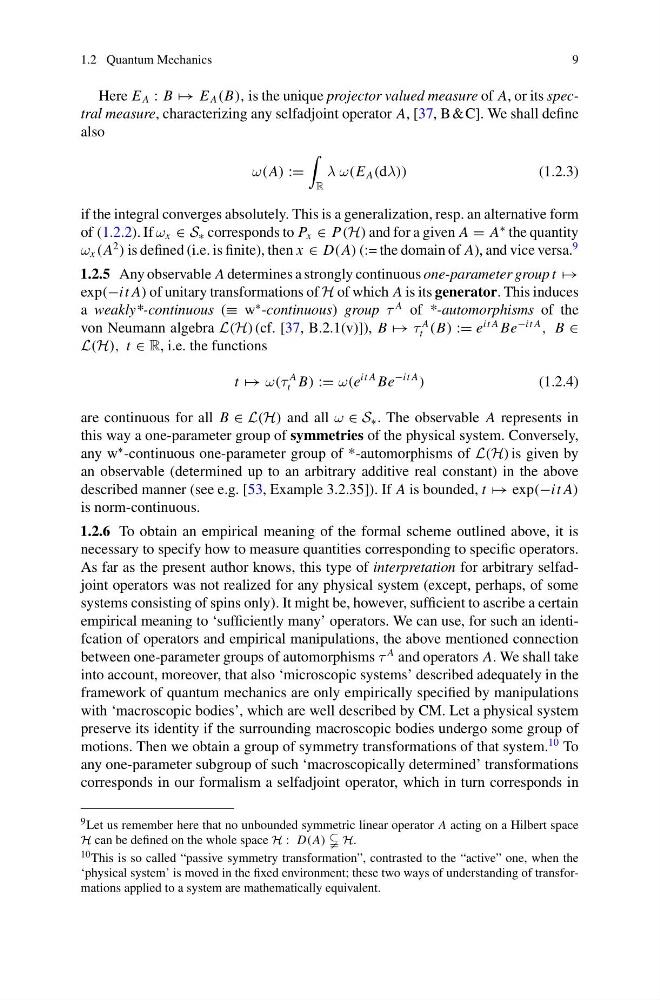
ω(A) :=
R
λ ω(E A (dλ))
(1.2.3)
if the integral converges absolutely. This is a generalization, resp. an alternative form
of (1.2.2). If ω x ∈ S ∗ corresponds to P x ∈ P(H) and for a given A = A
∗ the quantity
ω x (A
2
) is defined (i.e. is finite), then x ∈ D(A) (:= the domain of A), and vice versa.
9
1.2.5 Any observable A determines a strongly continuous one-parameter group t →
exp(−it A) of unitary transformations of H of which A is its generator. This induces
a weakly*-continuous (≡ w
∗ -continuous) group τ
A of *-automorphisms of the
von Neumann algebra L(H) (cf. [37, B.2.1(v)]), B → τ
A
t (B) := e
it A Be
−it A
, B ∈
L(H), t ∈ R, i.e. the functions
t → ω(τ
A
t B) := ω(e
it A Be
−it A
)
(1.2.4)
are continuous for all B ∈ L(H) and all ω ∈ S ∗ . The observable A represents in
this way a one-parameter group of symmetries of the physical system. Conversely,
any w
∗ -continuous one-parameter group of *-automorphisms of L(H) is given by
an observable (determined up to an arbitrary additive real constant) in the above
described manner (see e.g. [53, Example 3.2.35]). If A is bounded, t → exp(−it A)
is norm-continuous.
1.2.6 To obtain an empirical meaning of the formal scheme outlined above, it is
necessary to specify how to measure quantities corresponding to specific operators.
As far as the present author knows, this type of interpretation for arbitrary selfadjoint operators was not realized for any physical system (except, perhaps, of some
systems consisting of spins only). It might be, however, sufficient to ascribe a certain
empirical meaning to ‘sufficiently many’ operators. We can use, for such an identifcation of operators and empirical manipulations, the above mentioned connection
between one-parameter groups of automorphisms τ
A and operators A. We shall take
into account, moreover, that also ‘microscopic systems’ described adequately in the
framework of quantum mechanics are only empirically specified by manipulations
with ‘macroscopic bodies’, which are well described by CM. Let a physical system
preserve its identity if the surrounding macroscopic bodies undergo some group of
motions. Then we obtain a group of symmetry transformations of that system.
10 To
any one-parameter subgroup of such ‘macroscopically determined’ transformations
corresponds in our formalism a selfadjoint operator, which in turn corresponds in
9 Let us remember here that no unbounded symmetric linear operator A acting on a Hilbert space
H can be defined on the whole space H : D(A) H.
10 This is so called “passive symmetry transformation”, contrasted to the “active” one, when the
‘physical system’ is moved in the fixed environment; these two ways of understanding of transformations applied to a system are mathematically equivalent.
9
Here E A : B → E A (B), is the unique projector valued measure of A, or its spectral measure, characterizing any selfadjoint operator A, [37, B &C]. We shall define
also
ω(A) :=
R
λ ω(E A (dλ))
(1.2.3)
if the integral converges absolutely. This is a generalization, resp. an alternative form
of (1.2.2). If ω x ∈ S ∗ corresponds to P x ∈ P(H) and for a given A = A
∗ the quantity
ω x (A
2
) is defined (i.e. is finite), then x ∈ D(A) (:= the domain of A), and vice versa.
9
1.2.5 Any observable A determines a strongly continuous one-parameter group t →
exp(−it A) of unitary transformations of H of which A is its generator. This induces
a weakly*-continuous (≡ w
∗ -continuous) group τ
A of *-automorphisms of the
von Neumann algebra L(H) (cf. [37, B.2.1(v)]), B → τ
A
t (B) := e
it A Be
−it A
, B ∈
L(H), t ∈ R, i.e. the functions
t → ω(τ
A
t B) := ω(e
it A Be
−it A
)
(1.2.4)
are continuous for all B ∈ L(H) and all ω ∈ S ∗ . The observable A represents in
this way a one-parameter group of symmetries of the physical system. Conversely,
any w
∗ -continuous one-parameter group of *-automorphisms of L(H) is given by
an observable (determined up to an arbitrary additive real constant) in the above
described manner (see e.g. [53, Example 3.2.35]). If A is bounded, t → exp(−it A)
is norm-continuous.
1.2.6 To obtain an empirical meaning of the formal scheme outlined above, it is
necessary to specify how to measure quantities corresponding to specific operators.
As far as the present author knows, this type of interpretation for arbitrary selfadjoint operators was not realized for any physical system (except, perhaps, of some
systems consisting of spins only). It might be, however, sufficient to ascribe a certain
empirical meaning to ‘sufficiently many’ operators. We can use, for such an identifcation of operators and empirical manipulations, the above mentioned connection
between one-parameter groups of automorphisms τ
A and operators A. We shall take
into account, moreover, that also ‘microscopic systems’ described adequately in the
framework of quantum mechanics are only empirically specified by manipulations
with ‘macroscopic bodies’, which are well described by CM. Let a physical system
preserve its identity if the surrounding macroscopic bodies undergo some group of
motions. Then we obtain a group of symmetry transformations of that system.
10 To
any one-parameter subgroup of such ‘macroscopically determined’ transformations
corresponds in our formalism a selfadjoint operator, which in turn corresponds in
9 Let us remember here that no unbounded symmetric linear operator A acting on a Hilbert space
H can be defined on the whole space H : D(A) H.
10 This is so called “passive symmetry transformation”, contrasted to the “active” one, when the
‘physical system’ is moved in the fixed environment; these two ways of understanding of transformations applied to a system are mathematically equivalent.