

6.2 Spin Systems with Polynomial Local Hamiltonians Q N
127
f ξt (F) :=
∞
m=0
t
m
m!
{Q, f ξ }
(m)
(F), F ∈ supp E g , |t| ≤ κ 1 .
(6.2.37)
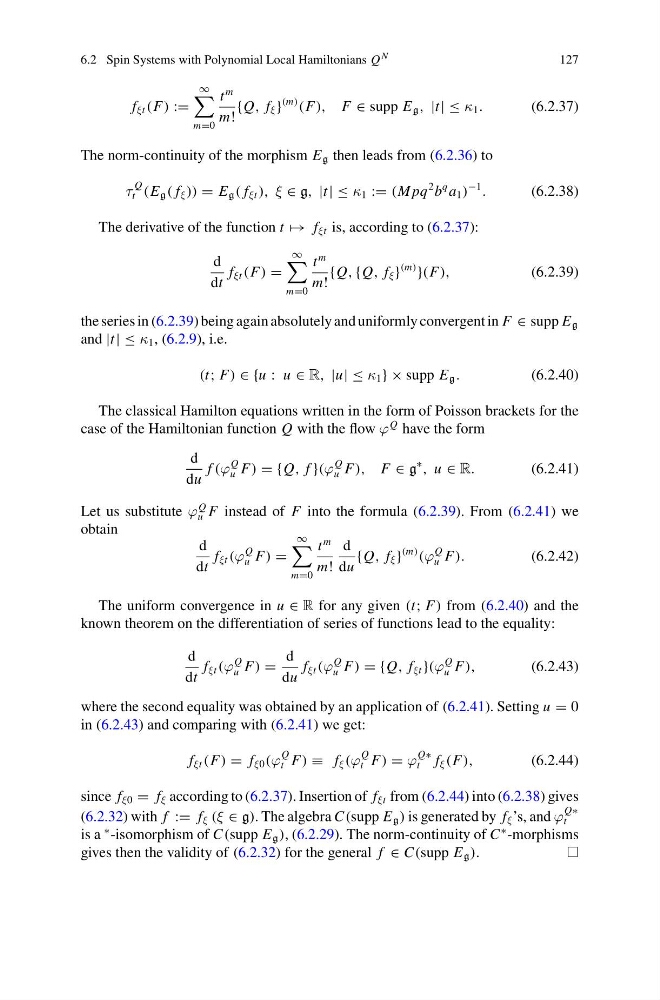
The norm-continuity of the morphism E g then leads from (6.2.36) to
τ
Q
t (E g ( f ξ )) = E g ( f ξt ), ξ ∈ g, |t| ≤ κ 1 := (Mpq
2 b
q a 1 )
−1
.
(6.2.38)
The derivative of the function t → f ξt is, according to (6.2.37):
d
dt
f ξt (F) =
∞
m=0
t
m
m!
{Q, {Q, f ξ }
(m)
}(F),
(6.2.39)
the series in (6.2.39) being again absolutely and uniformly convergent in F ∈ supp E g
and |t| ≤ κ 1 , (6.2.9), i.e.
(t; F) ∈ {u : u ∈ R, |u| ≤ κ 1 } × supp E g .
(6.2.40)
The classical Hamilton equations written in the form of Poisson brackets for the
case of the Hamiltonian function Q with the flow ϕ
Q have the form
d
du
f (ϕ
Q
u F) = {Q, f }(ϕ
Q
u F), F ∈ g
∗
, u ∈ R.
(6.2.41)
Let us substitute ϕ
Q
u F instead of F into the formula (6.2.39). From (6.2.41) we
obtain
d
dt
f ξt (ϕ
Q
u F) =
∞
m=0
t
m
m!
d
du
{Q, f ξ }
(m)
(ϕ
Q
u F).
(6.2.42)
The uniform convergence in u ∈ R for any given (t; F) from (6.2.40) and the
known theorem on the differentiation of series of functions lead to the equality:
d
dt
f ξt (ϕ
Q
u F) =
d
du
f ξt (ϕ
Q
u F) = {Q, f ξt }(ϕ
Q
u F),
(6.2.43)
where the second equality was obtained by an application of (6.2.41). Setting u = 0
in (6.2.43) and comparing with (6.2.41) we get:
f ξt (F) = f ξ0 (ϕ
Q
t F) ≡ f ξ (ϕ
Q
t F) = ϕ
Q∗
t f ξ (F),
(6.2.44)
since f ξ0 = f ξ according to (6.2.37). Insertion of f ξt from (6.2.44) into (6.2.38) gives
(6.2.32) with f := f ξ (ξ ∈ g). The algebra C(supp E g ) is generated by f ξ ’s, and ϕ
Q∗
t
is a
∗ -isomorphism of C(supp E g ), (6.2.29). The norm-continuity of C
∗ -morphisms
gives then the validity of (6.2.32) for the general f ∈ C(supp E g ).
127
f ξt (F) :=
∞
m=0
t
m
m!
{Q, f ξ }
(m)
(F), F ∈ supp E g , |t| ≤ κ 1 .
(6.2.37)
The norm-continuity of the morphism E g then leads from (6.2.36) to
τ
Q
t (E g ( f ξ )) = E g ( f ξt ), ξ ∈ g, |t| ≤ κ 1 := (Mpq
2 b
q a 1 )
−1
.
(6.2.38)
The derivative of the function t → f ξt is, according to (6.2.37):
d
dt
f ξt (F) =
∞
m=0
t
m
m!
{Q, {Q, f ξ }
(m)
}(F),
(6.2.39)
the series in (6.2.39) being again absolutely and uniformly convergent in F ∈ supp E g
and |t| ≤ κ 1 , (6.2.9), i.e.
(t; F) ∈ {u : u ∈ R, |u| ≤ κ 1 } × supp E g .
(6.2.40)
The classical Hamilton equations written in the form of Poisson brackets for the
case of the Hamiltonian function Q with the flow ϕ
Q have the form
d
du
f (ϕ
Q
u F) = {Q, f }(ϕ
Q
u F), F ∈ g
∗
, u ∈ R.
(6.2.41)
Let us substitute ϕ
Q
u F instead of F into the formula (6.2.39). From (6.2.41) we
obtain
d
dt
f ξt (ϕ
Q
u F) =
∞
m=0
t
m
m!
d
du
{Q, f ξ }
(m)
(ϕ
Q
u F).
(6.2.42)
The uniform convergence in u ∈ R for any given (t; F) from (6.2.40) and the
known theorem on the differentiation of series of functions lead to the equality:
d
dt
f ξt (ϕ
Q
u F) =
d
du
f ξt (ϕ
Q
u F) = {Q, f ξt }(ϕ
Q
u F),
(6.2.43)
where the second equality was obtained by an application of (6.2.41). Setting u = 0
in (6.2.43) and comparing with (6.2.41) we get:
f ξt (F) = f ξ0 (ϕ
Q
t F) ≡ f ξ (ϕ
Q
t F) = ϕ
Q∗
t f ξ (F),
(6.2.44)
since f ξ0 = f ξ according to (6.2.37). Insertion of f ξt from (6.2.44) into (6.2.38) gives
(6.2.32) with f := f ξ (ξ ∈ g). The algebra C(supp E g ) is generated by f ξ ’s, and ϕ
Q∗
t
is a
∗ -isomorphism of C(supp E g ), (6.2.29). The norm-continuity of C
∗ -morphisms
gives then the validity of (6.2.32) for the general f ∈ C(supp E g ).