

6.1 General Considerations
117
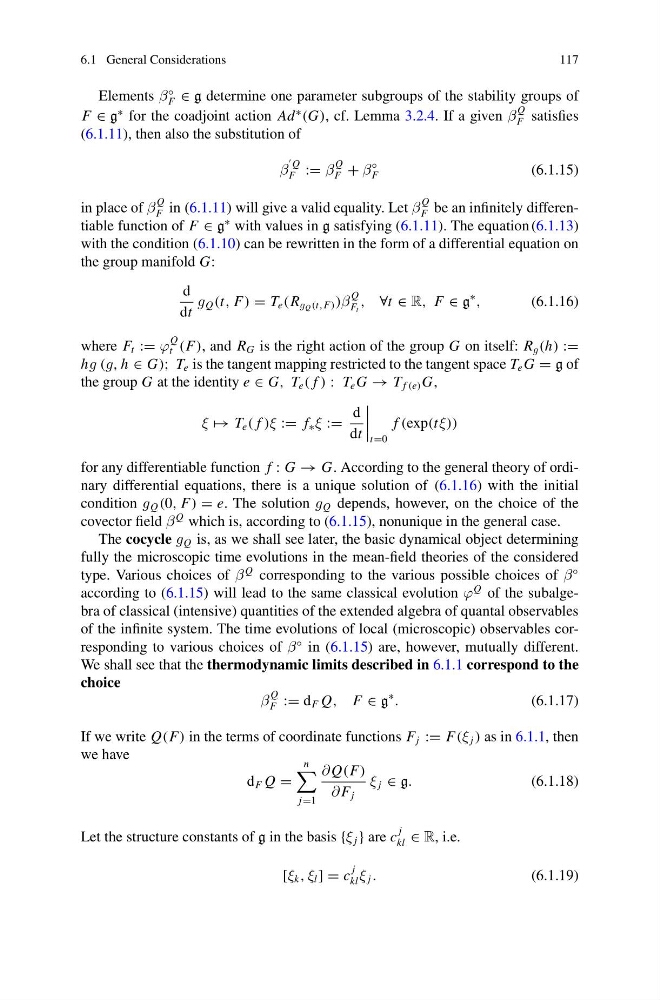
Elements β
◦
F ∈ g determine one parameter subgroups of the stability groups of
F ∈ g
∗ for the coadjoint action Ad
∗
(G), cf. Lemma 3.2.4. If a given β
Q
F satisfies
(6.1.11), then also the substitution of
β
Q
F := β
Q
F + β
◦
F
(6.1.15)
in place of β
Q
F in (6.1.11) will give a valid equality. Let β
Q
F be an infinitely differentiable function of F ∈ g
∗ with values in g satisfying (6.1.11). The equation (6.1.13)
with the condition (6.1.10) can be rewritten in the form of a differential equation on
the group manifold G:
d
dt
g Q (t, F) = T e (R g Q (t,F) )β
Q
F t
, ∀t ∈ R, F ∈ g
∗
,
(6.1.16)
where F t := ϕ
Q
t (F), and R G is the right action of the group G on itself: R g (h) :=
hg (g, h ∈ G); T e is the tangent mapping restricted to the tangent space T e G = g of
the group G at the identity e ∈ G, T e ( f ) : T e G → T f (e) G,
ξ → T e ( f )ξ := f ∗ ξ :=
d
dt
t=0
f (exp(tξ))
for any differentiable function f : G → G. According to the general theory of ordinary differential equations, there is a unique solution of (6.1.16) with the initial
condition g Q (0, F) = e. The solution g Q depends, however, on the choice of the
covector field β
Q which is, according to (6.1.15), nonunique in the general case.
The cocycle g Q is, as we shall see later, the basic dynamical object determining
fully the microscopic time evolutions in the mean-field theories of the considered
type. Various choices of β
Q corresponding to the various possible choices of β
◦
according to (6.1.15) will lead to the same classical evolution ϕ
Q of the subalgebra of classical (intensive) quantities of the extended algebra of quantal observables
of the infinite system. The time evolutions of local (microscopic) observables corresponding to various choices of β
◦ in (6.1.15) are, however, mutually different.
We shall see that the thermodynamic limits described in 6.1.1 correspond to the
choice
β
Q
F := d F Q, F ∈ g
∗
.
(6.1.17)
If we write Q(F) in the terms of coordinate functions F j := F(ξ j ) as in 6.1.1, then
we have
d F Q =
n
j=1
∂ Q(F)
∂ F j
ξ j ∈ g.
(6.1.18)
Let the structure constants of g in the basis {ξ j } are c
j
kl ∈ R, i.e.
[ξ k , ξ l ] = c
j
kl ξ j .
(6.1.19)
117
Elements β
◦
F ∈ g determine one parameter subgroups of the stability groups of
F ∈ g
∗ for the coadjoint action Ad
∗
(G), cf. Lemma 3.2.4. If a given β
Q
F satisfies
(6.1.11), then also the substitution of
β
Q
F := β
Q
F + β
◦
F
(6.1.15)
in place of β
Q
F in (6.1.11) will give a valid equality. Let β
Q
F be an infinitely differentiable function of F ∈ g
∗ with values in g satisfying (6.1.11). The equation (6.1.13)
with the condition (6.1.10) can be rewritten in the form of a differential equation on
the group manifold G:
d
dt
g Q (t, F) = T e (R g Q (t,F) )β
Q
F t
, ∀t ∈ R, F ∈ g
∗
,
(6.1.16)
where F t := ϕ
Q
t (F), and R G is the right action of the group G on itself: R g (h) :=
hg (g, h ∈ G); T e is the tangent mapping restricted to the tangent space T e G = g of
the group G at the identity e ∈ G, T e ( f ) : T e G → T f (e) G,
ξ → T e ( f )ξ := f ∗ ξ :=
d
dt
t=0
f (exp(tξ))
for any differentiable function f : G → G. According to the general theory of ordinary differential equations, there is a unique solution of (6.1.16) with the initial
condition g Q (0, F) = e. The solution g Q depends, however, on the choice of the
covector field β
Q which is, according to (6.1.15), nonunique in the general case.
The cocycle g Q is, as we shall see later, the basic dynamical object determining
fully the microscopic time evolutions in the mean-field theories of the considered
type. Various choices of β
Q corresponding to the various possible choices of β
◦
according to (6.1.15) will lead to the same classical evolution ϕ
Q of the subalgebra of classical (intensive) quantities of the extended algebra of quantal observables
of the infinite system. The time evolutions of local (microscopic) observables corresponding to various choices of β
◦ in (6.1.15) are, however, mutually different.
We shall see that the thermodynamic limits described in 6.1.1 correspond to the
choice
β
Q
F := d F Q, F ∈ g
∗
.
(6.1.17)
If we write Q(F) in the terms of coordinate functions F j := F(ξ j ) as in 6.1.1, then
we have
d F Q =
n
j=1
∂ Q(F)
∂ F j
ξ j ∈ g.
(6.1.18)
Let the structure constants of g in the basis {ξ j } are c
j
kl ∈ R, i.e.
[ξ k , ξ l ] = c
j
kl ξ j .
(6.1.19)