

116
6 Dynamics of Quantum Mechanical Macroscopic Systems
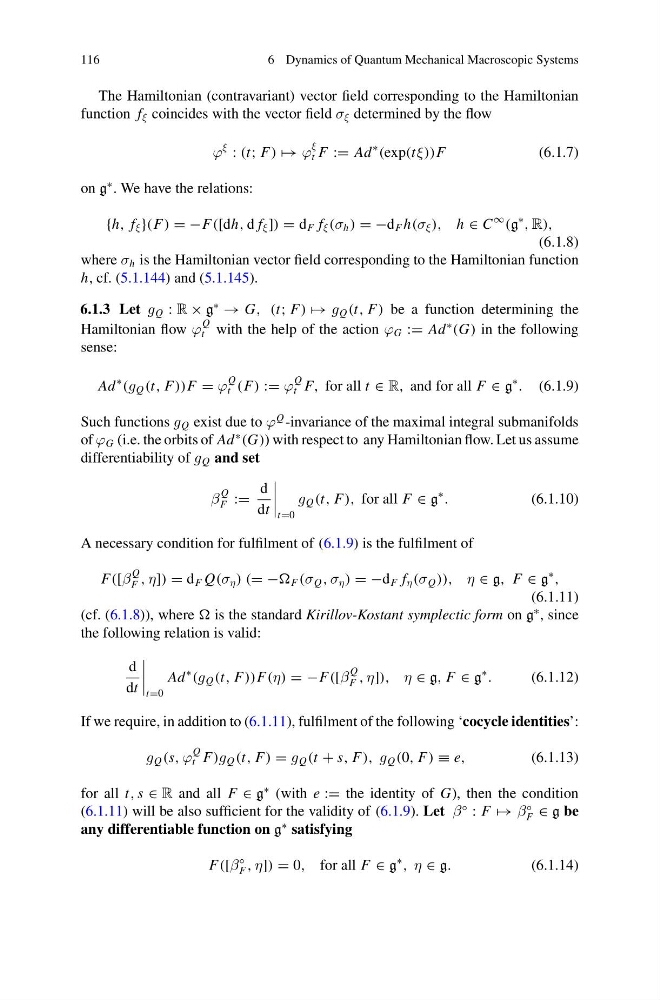
The Hamiltonian (contravariant) vector field corresponding to the Hamiltonian
function f ξ coincides with the vector field σ ξ determined by the flow
ϕ
ξ
: (t; F) → ϕ
ξ
t F := Ad
∗
(exp(tξ))F
(6.1.7)
on g
∗ . We have the relations:
{h, f ξ }(F) = −F([dh, d f ξ ]) = d F f ξ (σ h ) = −d F h(σ ξ ), h ∈ C
∞
(g
∗
, R),
(6.1.8)
where σ h is the Hamiltonian vector field corresponding to the Hamiltonian function
h, cf. (5.1.144) and (5.1.145).
6.1.3 Let g Q : R × g
∗
→ G, (t; F) → g Q (t, F) be a function determining the
Hamiltonian flow ϕ
Q
t with the help of the action ϕ G := Ad
∗
(G) in the following
sense:
Ad
∗
(g Q (t, F))F = ϕ
Q
t (F) := ϕ
Q
t F, for all t ∈ R, and for all F ∈ g
∗
. (6.1.9)
Such functions g Q exist due to ϕ
Q -invariance of the maximal integral submanifolds
of ϕ G (i.e. the orbits of Ad
∗
(G)) with respect to any Hamiltonian flow. Let us assume
differentiability of g Q and set
β
Q
F :=
d
dt
t=0
g Q (t, F), for all F ∈ g
∗
.
(6.1.10)
A necessary condition for fulfilment of (6.1.9) is the fulfilment of
F([β
Q
F , η]) = d F Q(σ η ) (= − F (σ Q , σ η ) = −d F f η (σ Q )), η ∈ g, F ∈ g
∗
,
(6.1.11)
(cf. (6.1.8)), where is the standard Kirillov-Kostant symplectic form on g
∗ , since
the following relation is valid:
d
dt
t=0
Ad
∗
(g Q (t, F))F(η) = −F([β
Q
F , η]), η ∈ g, F ∈ g
∗
.
(6.1.12)
If we require, in addition to (6.1.11), fulfilment of the following ‘cocycle identities’:
g Q (s, ϕ
Q
t F)g Q (t, F) = g Q (t + s, F), g Q (0, F) ≡ e,
(6.1.13)
for all t, s ∈ R and all F ∈ g
∗ (with e := the identity of G), then the condition
(6.1.11) will be also sufficient for the validity of (6.1.9). Let β
◦
: F → β
◦
F ∈ g be
any differentiable function on g
∗ satisfying
F([β
◦
F , η]) = 0, for all F ∈ g
∗
, η ∈ g.
(6.1.14)
6 Dynamics of Quantum Mechanical Macroscopic Systems
The Hamiltonian (contravariant) vector field corresponding to the Hamiltonian
function f ξ coincides with the vector field σ ξ determined by the flow
ϕ
ξ
: (t; F) → ϕ
ξ
t F := Ad
∗
(exp(tξ))F
(6.1.7)
on g
∗ . We have the relations:
{h, f ξ }(F) = −F([dh, d f ξ ]) = d F f ξ (σ h ) = −d F h(σ ξ ), h ∈ C
∞
(g
∗
, R),
(6.1.8)
where σ h is the Hamiltonian vector field corresponding to the Hamiltonian function
h, cf. (5.1.144) and (5.1.145).
6.1.3 Let g Q : R × g
∗
→ G, (t; F) → g Q (t, F) be a function determining the
Hamiltonian flow ϕ
Q
t with the help of the action ϕ G := Ad
∗
(G) in the following
sense:
Ad
∗
(g Q (t, F))F = ϕ
Q
t (F) := ϕ
Q
t F, for all t ∈ R, and for all F ∈ g
∗
. (6.1.9)
Such functions g Q exist due to ϕ
Q -invariance of the maximal integral submanifolds
of ϕ G (i.e. the orbits of Ad
∗
(G)) with respect to any Hamiltonian flow. Let us assume
differentiability of g Q and set
β
Q
F :=
d
dt
t=0
g Q (t, F), for all F ∈ g
∗
.
(6.1.10)
A necessary condition for fulfilment of (6.1.9) is the fulfilment of
F([β
Q
F , η]) = d F Q(σ η ) (= − F (σ Q , σ η ) = −d F f η (σ Q )), η ∈ g, F ∈ g
∗
,
(6.1.11)
(cf. (6.1.8)), where is the standard Kirillov-Kostant symplectic form on g
∗ , since
the following relation is valid:
d
dt
t=0
Ad
∗
(g Q (t, F))F(η) = −F([β
Q
F , η]), η ∈ g, F ∈ g
∗
.
(6.1.12)
If we require, in addition to (6.1.11), fulfilment of the following ‘cocycle identities’:
g Q (s, ϕ
Q
t F)g Q (t, F) = g Q (t + s, F), g Q (0, F) ≡ e,
(6.1.13)
for all t, s ∈ R and all F ∈ g
∗ (with e := the identity of G), then the condition
(6.1.11) will be also sufficient for the validity of (6.1.9). Let β
◦
: F → β
◦
F ∈ g be
any differentiable function on g
∗ satisfying
F([β
◦
F , η]) = 0, for all F ∈ g
∗
, η ∈ g.
(6.1.14)