

2.14 Microencapsulation
45
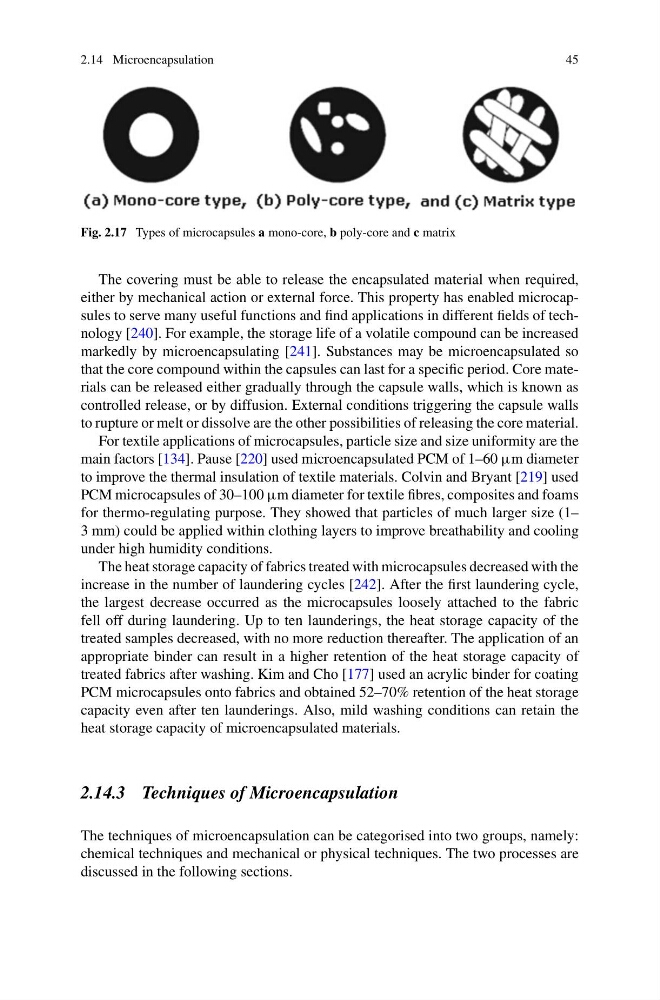
Fig. 2.17 Types of microcapsules a mono-core, b poly-core and c matrix
The covering must be able to release the encapsulated material when required,
either by mechanical action or external force. This property has enabled microcapsules to serve many useful functions and find applications in different fields of technology [240]. For example, the storage life of a volatile compound can be increased
markedly by microencapsulating [241]. Substances may be microencapsulated so
that the core compound within the capsules can last for a specific period. Core materials can be released either gradually through the capsule walls, which is known as
controlled release, or by diffusion. External conditions triggering the capsule walls
to rupture or melt or dissolve are the other possibilities of releasing the core material.
For textile applications of microcapsules, particle size and size uniformity are the
main factors [134]. Pause [220] used microencapsulated PCM of 1–60 µm diameter
to improve the thermal insulation of textile materials. Colvin and Bryant [219] used
PCM microcapsules of 30–100 µm diameter for textile fibres, composites and foams
for thermo-regulating purpose. They showed that particles of much larger size (1–
3 mm) could be applied within clothing layers to improve breathability and cooling
under high humidity conditions.
The heat storage capacity of fabrics treated with microcapsules decreased with the
increase in the number of laundering cycles [242]. After the first laundering cycle,
the largest decrease occurred as the microcapsules loosely attached to the fabric
fell off during laundering. Up to ten launderings, the heat storage capacity of the
treated samples decreased, with no more reduction thereafter. The application of an
appropriate binder can result in a higher retention of the heat storage capacity of
treated fabrics after washing. Kim and Cho [177] used an acrylic binder for coating
PCM microcapsules onto fabrics and obtained 52–70% retention of the heat storage
capacity even after ten launderings. Also, mild washing conditions can retain the
heat storage capacity of microencapsulated materials.
2.14.3 Techniques of Microencapsulation
The techniques of microencapsulation can be categorised into two groups, namely:
chemical techniques and mechanical or physical techniques. The two processes are
discussed in the following sections.
45
Fig. 2.17 Types of microcapsules a mono-core, b poly-core and c matrix
The covering must be able to release the encapsulated material when required,
either by mechanical action or external force. This property has enabled microcapsules to serve many useful functions and find applications in different fields of technology [240]. For example, the storage life of a volatile compound can be increased
markedly by microencapsulating [241]. Substances may be microencapsulated so
that the core compound within the capsules can last for a specific period. Core materials can be released either gradually through the capsule walls, which is known as
controlled release, or by diffusion. External conditions triggering the capsule walls
to rupture or melt or dissolve are the other possibilities of releasing the core material.
For textile applications of microcapsules, particle size and size uniformity are the
main factors [134]. Pause [220] used microencapsulated PCM of 1–60 µm diameter
to improve the thermal insulation of textile materials. Colvin and Bryant [219] used
PCM microcapsules of 30–100 µm diameter for textile fibres, composites and foams
for thermo-regulating purpose. They showed that particles of much larger size (1–
3 mm) could be applied within clothing layers to improve breathability and cooling
under high humidity conditions.
The heat storage capacity of fabrics treated with microcapsules decreased with the
increase in the number of laundering cycles [242]. After the first laundering cycle,
the largest decrease occurred as the microcapsules loosely attached to the fabric
fell off during laundering. Up to ten launderings, the heat storage capacity of the
treated samples decreased, with no more reduction thereafter. The application of an
appropriate binder can result in a higher retention of the heat storage capacity of
treated fabrics after washing. Kim and Cho [177] used an acrylic binder for coating
PCM microcapsules onto fabrics and obtained 52–70% retention of the heat storage
capacity even after ten launderings. Also, mild washing conditions can retain the
heat storage capacity of microencapsulated materials.
2.14.3 Techniques of Microencapsulation
The techniques of microencapsulation can be categorised into two groups, namely:
chemical techniques and mechanical or physical techniques. The two processes are
discussed in the following sections.