

44
2 Review of Literature: Motorcycle helmet
2.14.1.5 Grinding
In this process, a mixture of a core material and a coating material is plasticised, either
by adding a solvent to form a solution or by heating the mixture to form a melt. Then,
the solvent is removed from the solution to form a solid mass. Mechanical shearing
is used to break the solid mass into small particles in which the core material is
encapsulated. This is a very simple process and for many years has been used for
manufacturing toners [231].
Apart from the five basic techniques described above, microencapsulation can
be carried out by several other processes such as desolvation [232], vapour deposition [233], biliquid column process [234], fluidised-bed coating [235], electrostatic
encapsulation [236], centrifugal encapsulation [237] and gelation encapsulation
[238].
2.14.2 Features of Microcapsules
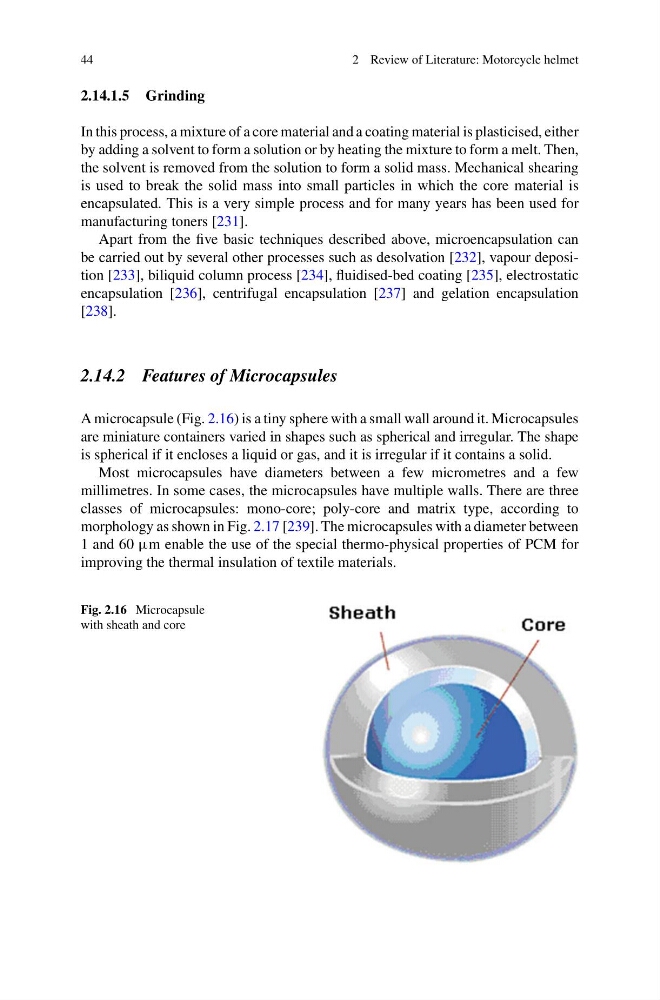
A microcapsule (Fig. 2.16) is a tiny sphere with a small wall around it. Microcapsules
are miniature containers varied in shapes such as spherical and irregular. The shape
is spherical if it encloses a liquid or gas, and it is irregular if it contains a solid.
Most microcapsules have diameters between a few micrometres and a few
millimetres. In some cases, the microcapsules have multiple walls. There are three
classes of microcapsules: mono-core; poly-core and matrix type, according to
morphology as shown in Fig. 2.17 [239]. The microcapsules with a diameter between
1 and 60 µm enable the use of the special thermo-physical properties of PCM for
improving the thermal insulation of textile materials.
Fig. 2.16 Microcapsule
with sheath and core
2 Review of Literature: Motorcycle helmet
2.14.1.5 Grinding
In this process, a mixture of a core material and a coating material is plasticised, either
by adding a solvent to form a solution or by heating the mixture to form a melt. Then,
the solvent is removed from the solution to form a solid mass. Mechanical shearing
is used to break the solid mass into small particles in which the core material is
encapsulated. This is a very simple process and for many years has been used for
manufacturing toners [231].
Apart from the five basic techniques described above, microencapsulation can
be carried out by several other processes such as desolvation [232], vapour deposition [233], biliquid column process [234], fluidised-bed coating [235], electrostatic
encapsulation [236], centrifugal encapsulation [237] and gelation encapsulation
[238].
2.14.2 Features of Microcapsules
A microcapsule (Fig. 2.16) is a tiny sphere with a small wall around it. Microcapsules
are miniature containers varied in shapes such as spherical and irregular. The shape
is spherical if it encloses a liquid or gas, and it is irregular if it contains a solid.
Most microcapsules have diameters between a few micrometres and a few
millimetres. In some cases, the microcapsules have multiple walls. There are three
classes of microcapsules: mono-core; poly-core and matrix type, according to
morphology as shown in Fig. 2.17 [239]. The microcapsules with a diameter between
1 and 60 µm enable the use of the special thermo-physical properties of PCM for
improving the thermal insulation of textile materials.
Fig. 2.16 Microcapsule
with sheath and core