

114
4 Results and Discussion
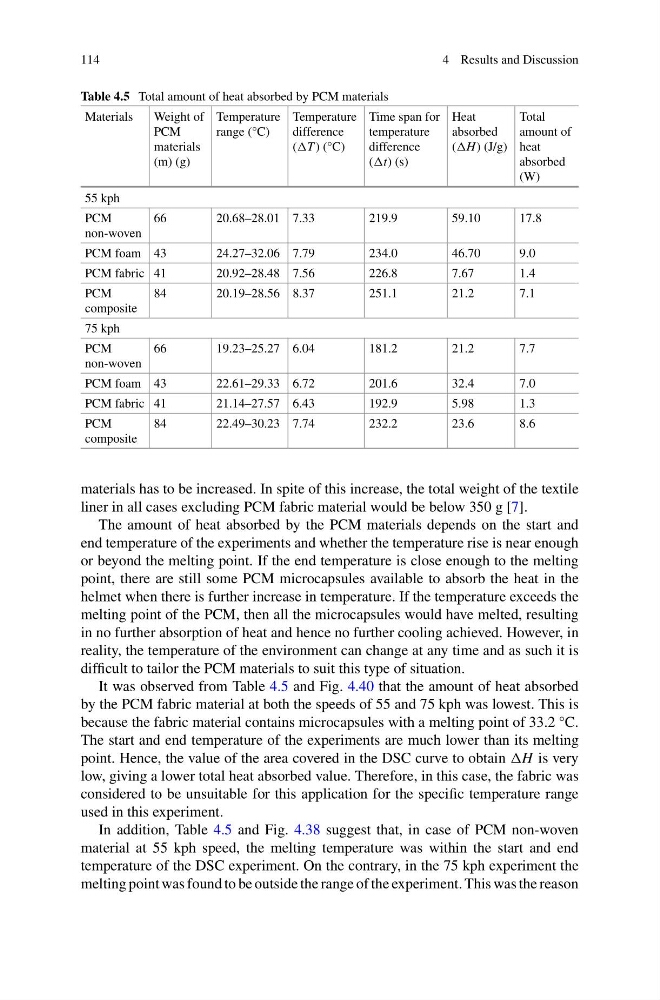
Table 4.5 Total amount of heat absorbed by PCM materials
Materials
Weight of
PCM
materials
(m) (g)
Temperature
range (°C)
Temperature
difference
(T ) (°C)
Time span for
temperature
difference
(t) (s)
Heat
absorbed
(H) (J/g)
Total
amount of
heat
absorbed
(W)
55 kph
PCM
non-woven
66
20.68–28.01 7.33
219.9
59.10
17.8
PCM foam 43
24.27–32.06 7.79
234.0
46.70
9.0
PCM fabric 41
20.92–28.48 7.56
226.8
7.67
1.4
PCM
composite
84
20.19–28.56 8.37
251.1
21.2
7.1
75 kph
PCM
non-woven
66
19.23–25.27 6.04
181.2
21.2
7.7
PCM foam 43
22.61–29.33 6.72
201.6
32.4
7.0
PCM fabric 41
21.14–27.57 6.43
192.9
5.98
1.3
PCM
composite
84
22.49–30.23 7.74
232.2
23.6
8.6
materials has to be increased. In spite of this increase, the total weight of the textile
liner in all cases excluding PCM fabric material would be below 350 g [7].
The amount of heat absorbed by the PCM materials depends on the start and
end temperature of the experiments and whether the temperature rise is near enough
or beyond the melting point. If the end temperature is close enough to the melting
point, there are still some PCM microcapsules available to absorb the heat in the
helmet when there is further increase in temperature. If the temperature exceeds the
melting point of the PCM, then all the microcapsules would have melted, resulting
in no further absorption of heat and hence no further cooling achieved. However, in
reality, the temperature of the environment can change at any time and as such it is
difficult to tailor the PCM materials to suit this type of situation.
It was observed from Table 4.5 and Fig. 4.40 that the amount of heat absorbed
by the PCM fabric material at both the speeds of 55 and 75 kph was lowest. This is
because the fabric material contains microcapsules with a melting point of 33.2 °C.
The start and end temperature of the experiments are much lower than its melting
point. Hence, the value of the area covered in the DSC curve to obtain H is very
low, giving a lower total heat absorbed value. Therefore, in this case, the fabric was
considered to be unsuitable for this application for the specific temperature range
used in this experiment.
In addition, Table 4.5 and Fig. 4.38 suggest that, in case of PCM non-woven
material at 55 kph speed, the melting temperature was within the start and end
temperature of the DSC experiment. On the contrary, in the 75 kph experiment the
melting point was found to be outside the range of the experiment. This was the reason
4 Results and Discussion
Table 4.5 Total amount of heat absorbed by PCM materials
Materials
Weight of
PCM
materials
(m) (g)
Temperature
range (°C)
Temperature
difference
(T ) (°C)
Time span for
temperature
difference
(t) (s)
Heat
absorbed
(H) (J/g)
Total
amount of
heat
absorbed
(W)
55 kph
PCM
non-woven
66
20.68–28.01 7.33
219.9
59.10
17.8
PCM foam 43
24.27–32.06 7.79
234.0
46.70
9.0
PCM fabric 41
20.92–28.48 7.56
226.8
7.67
1.4
PCM
composite
84
20.19–28.56 8.37
251.1
21.2
7.1
75 kph
PCM
non-woven
66
19.23–25.27 6.04
181.2
21.2
7.7
PCM foam 43
22.61–29.33 6.72
201.6
32.4
7.0
PCM fabric 41
21.14–27.57 6.43
192.9
5.98
1.3
PCM
composite
84
22.49–30.23 7.74
232.2
23.6
8.6
materials has to be increased. In spite of this increase, the total weight of the textile
liner in all cases excluding PCM fabric material would be below 350 g [7].
The amount of heat absorbed by the PCM materials depends on the start and
end temperature of the experiments and whether the temperature rise is near enough
or beyond the melting point. If the end temperature is close enough to the melting
point, there are still some PCM microcapsules available to absorb the heat in the
helmet when there is further increase in temperature. If the temperature exceeds the
melting point of the PCM, then all the microcapsules would have melted, resulting
in no further absorption of heat and hence no further cooling achieved. However, in
reality, the temperature of the environment can change at any time and as such it is
difficult to tailor the PCM materials to suit this type of situation.
It was observed from Table 4.5 and Fig. 4.40 that the amount of heat absorbed
by the PCM fabric material at both the speeds of 55 and 75 kph was lowest. This is
because the fabric material contains microcapsules with a melting point of 33.2 °C.
The start and end temperature of the experiments are much lower than its melting
point. Hence, the value of the area covered in the DSC curve to obtain H is very
low, giving a lower total heat absorbed value. Therefore, in this case, the fabric was
considered to be unsuitable for this application for the specific temperature range
used in this experiment.
In addition, Table 4.5 and Fig. 4.38 suggest that, in case of PCM non-woven
material at 55 kph speed, the melting temperature was within the start and end
temperature of the DSC experiment. On the contrary, in the 75 kph experiment the
melting point was found to be outside the range of the experiment. This was the reason