

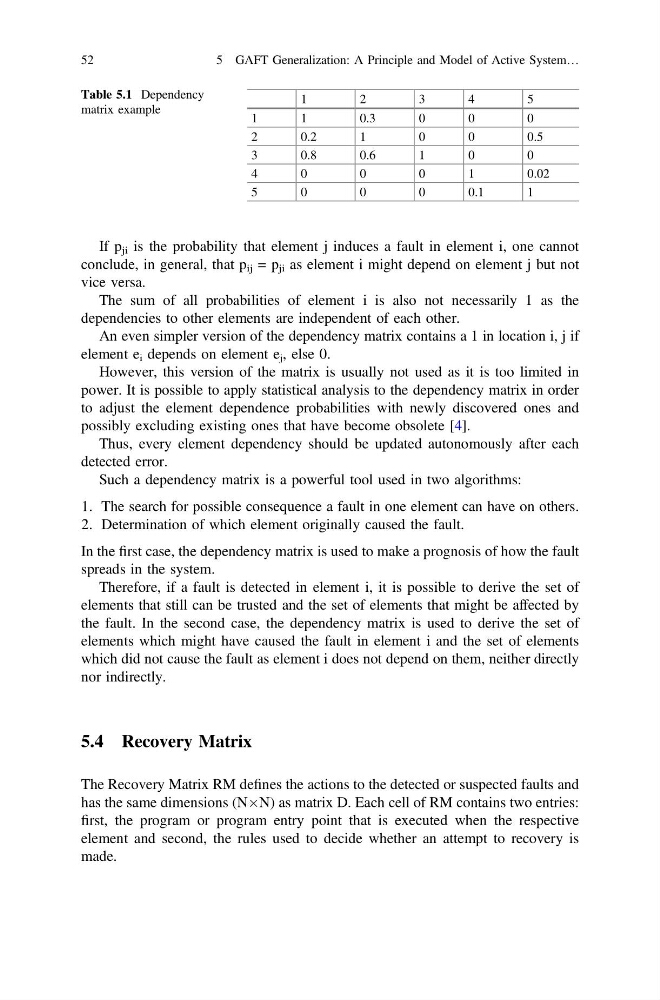
If p ji is the probability that element j induces a fault in element i, one cannot
conclude, in general, that p ij = p ji as element i might depend on element j but not
vice versa.
The sum of all probabilities of element i is also not necessarily 1 as the
dependencies to other elements are independent of each other.
An even simpler version of the dependency matrix contains a 1 in location i, j if
element e i depends on element e j , else 0.
However, this version of the matrix is usually not used as it is too limited in
power. It is possible to apply statistical analysis to the dependency matrix in order
to adjust the element dependence probabilities with newly discovered ones and
possibly excluding existing ones that have become obsolete [4].
Thus, every element dependency should be updated autonomously after each
detected error.
Such a dependency matrix is a powerful tool used in two algorithms:
1. The search for possible consequence a fault in one element can have on others.
2. Determination of which element originally caused the fault.
In the first case, the dependency matrix is used to make a prognosis of how the fault
spreads in the system.
Therefore, if a fault is detected in element i, it is possible to derive the set of
elements that still can be trusted and the set of elements that might be affected by
the fault. In the second case, the dependency matrix is used to derive the set of
elements which might have caused the fault in element i and the set of elements
which did not cause the fault as element i does not depend on them, neither directly
nor indirectly.
5.4 Recovery Matrix
The Recovery Matrix RM defines the actions to the detected or suspected faults and
has the same dimensions (NÂN) as matrix D. Each cell of RM contains two entries:
first, the program or program entry point that is executed when the respective
element and second, the rules used to decide whether an attempt to recovery is
made.
Table 5.1 Dependency
matrix example
1
2
3
4
5
1
1
0 . 3
0
0
0
2
0.2
1
0
0
0.5
3
0.8
0.6
1
0
0
4
0
0
0
1
0.02
5
0
0
0
0.1
1
52
5 GAFT Generalization: A Principle and Model of Active System…
conclude, in general, that p ij = p ji as element i might depend on element j but not
vice versa.
The sum of all probabilities of element i is also not necessarily 1 as the
dependencies to other elements are independent of each other.
An even simpler version of the dependency matrix contains a 1 in location i, j if
element e i depends on element e j , else 0.
However, this version of the matrix is usually not used as it is too limited in
power. It is possible to apply statistical analysis to the dependency matrix in order
to adjust the element dependence probabilities with newly discovered ones and
possibly excluding existing ones that have become obsolete [4].
Thus, every element dependency should be updated autonomously after each
detected error.
Such a dependency matrix is a powerful tool used in two algorithms:
1. The search for possible consequence a fault in one element can have on others.
2. Determination of which element originally caused the fault.
In the first case, the dependency matrix is used to make a prognosis of how the fault
spreads in the system.
Therefore, if a fault is detected in element i, it is possible to derive the set of
elements that still can be trusted and the set of elements that might be affected by
the fault. In the second case, the dependency matrix is used to derive the set of
elements which might have caused the fault in element i and the set of elements
which did not cause the fault as element i does not depend on them, neither directly
nor indirectly.
5.4 Recovery Matrix
The Recovery Matrix RM defines the actions to the detected or suspected faults and
has the same dimensions (NÂN) as matrix D. Each cell of RM contains two entries:
first, the program or program entry point that is executed when the respective
element and second, the rules used to decide whether an attempt to recovery is
made.
Table 5.1 Dependency
matrix example
1
2
3
4
5
1
1
0 . 3
0
0
0
2
0.2
1
0
0
0.5
3
0.8
0.6
1
0
0
4
0
0
0
1
0.02
5
0
0
0
0.1
1
52
5 GAFT Generalization: A Principle and Model of Active System…