

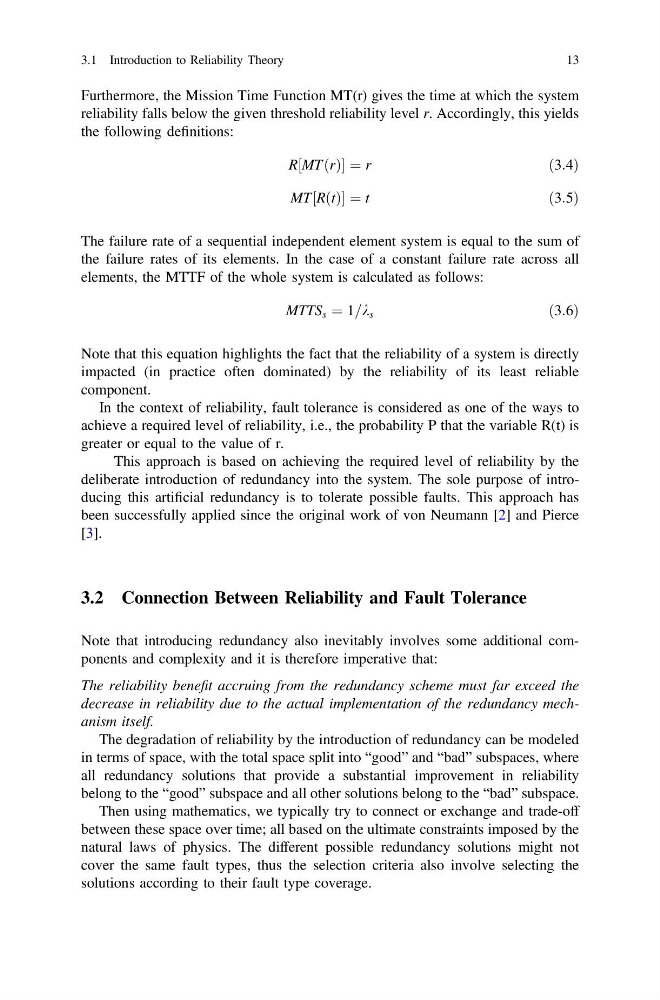
Furthermore, the Mission Time Function MT(r) gives the time at which the system
reliability falls below the given threshold reliability level r. Accordingly, this yields
the following definitions:
R MTðrÞ
½
¼r
ð3:4Þ
MT RðtÞ
½
¼ t
ð3:5Þ
The failure rate of a sequential independent element system is equal to the sum of
the failure rates of its elements. In the case of a constant failure rate across all
elements, the MTTF of the whole system is calculated as follows:
MTTS s ¼ 1=k s
ð3:6Þ
Note that this equation highlights the fact that the reliability of a system is directly
impacted (in practice often dominated) by the reliability of its least reliable
component.
In the context of reliability, fault tolerance is considered as one of the ways to
achieve a required level of reliability, i.e., the probability P that the variable R(t) is
greater or equal to the value of r.
This approach is based on achieving the required level of reliability by the
deliberate introduction of redundancy into the system. The sole purpose of introducing this artificial redundancy is to tolerate possible faults. This approach has
been successfully applied since the original work of von Neumann [2] and Pierce
[3].
3.2 Connection Between Reliability and Fault Tolerance
Note that introducing redundancy also inevitably involves some additional components and complexity and it is therefore imperative that:
The reliability benefit accruing from the redundancy scheme must far exceed the
decrease in reliability due to the actual implementation of the redundancy mechanism itself.
The degradation of reliability by the introduction of redundancy can be modeled
in terms of space, with the total space split into “good” and “bad” subspaces, where
all redundancy solutions that provide a substantial improvement in reliability
belong to the “good” subspace and all other solutions belong to the “bad” subspace.
Then using mathematics, we typically try to connect or exchange and trade-off
between these space over time; all based on the ultimate constraints imposed by the
natural laws of physics. The different possible redundancy solutions might not
cover the same fault types, thus the selection criteria also involve selecting the
solutions according to their fault type coverage.
3.1 Introduction to Reliability Theory
13
reliability falls below the given threshold reliability level r. Accordingly, this yields
the following definitions:
R MTðrÞ
½
¼r
ð3:4Þ
MT RðtÞ
½
¼ t
ð3:5Þ
The failure rate of a sequential independent element system is equal to the sum of
the failure rates of its elements. In the case of a constant failure rate across all
elements, the MTTF of the whole system is calculated as follows:
MTTS s ¼ 1=k s
ð3:6Þ
Note that this equation highlights the fact that the reliability of a system is directly
impacted (in practice often dominated) by the reliability of its least reliable
component.
In the context of reliability, fault tolerance is considered as one of the ways to
achieve a required level of reliability, i.e., the probability P that the variable R(t) is
greater or equal to the value of r.
This approach is based on achieving the required level of reliability by the
deliberate introduction of redundancy into the system. The sole purpose of introducing this artificial redundancy is to tolerate possible faults. This approach has
been successfully applied since the original work of von Neumann [2] and Pierce
[3].
3.2 Connection Between Reliability and Fault Tolerance
Note that introducing redundancy also inevitably involves some additional components and complexity and it is therefore imperative that:
The reliability benefit accruing from the redundancy scheme must far exceed the
decrease in reliability due to the actual implementation of the redundancy mechanism itself.
The degradation of reliability by the introduction of redundancy can be modeled
in terms of space, with the total space split into “good” and “bad” subspaces, where
all redundancy solutions that provide a substantial improvement in reliability
belong to the “good” subspace and all other solutions belong to the “bad” subspace.
Then using mathematics, we typically try to connect or exchange and trade-off
between these space over time; all based on the ultimate constraints imposed by the
natural laws of physics. The different possible redundancy solutions might not
cover the same fault types, thus the selection criteria also involve selecting the
solutions according to their fault type coverage.
3.1 Introduction to Reliability Theory
13