

based on the application of reliability engineering throughout the system to
reach this goal.
2. By the design of fault-tolerant computer systems, with deliberate introduction of
redundancy in the system along with active mechanisms for fault detection and
reconfiguration to achieve continuous operation (in the sense of the application).
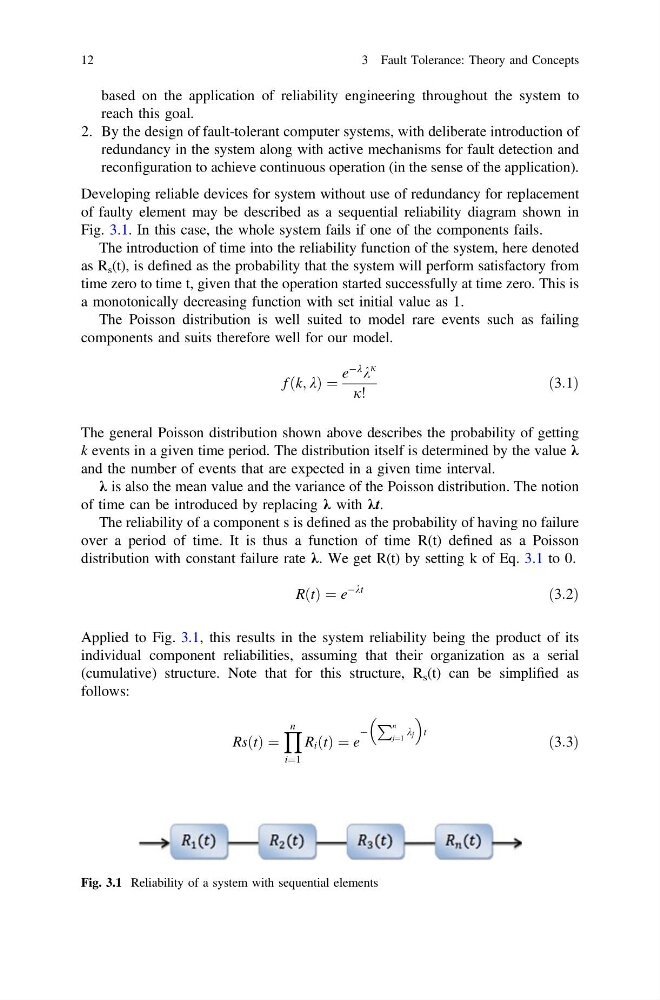
Developing reliable devices for system without use of redundancy for replacement
of faulty element may be described as a sequential reliability diagram shown in
Fig. 3.1. In this case, the whole system fails if one of the components fails.
The introduction of time into the reliability function of the system, here denoted
as R s (t), is defined as the probability that the system will perform satisfactory from
time zero to time t, given that the operation started successfully at time zero. This is
a monotonically decreasing function with set initial value as 1.
The Poisson distribution is well suited to model rare events such as failing
components and suits therefore well for our model.
f ðk; kÞ ¼
e
Àk k
j
j!
ð3:1Þ
The general Poisson distribution shown above describes the probability of getting
k events in a given time period. The distribution itself is determined by the value k
and the number of events that are expected in a given time interval.
k is also the mean value and the variance of the Poisson distribution. The notion
of time can be introduced by replacing k with kt.
The reliability of a component s is defined as the probability of having no failure
over a period of time. It is thus a function of time R(t) defined as a Poisson
distribution with constant failure rate k. We get R(t) by setting k of Eq. 3.1 to 0.
RðtÞ ¼ e
Àkt
ð3:2Þ
Applied to Fig. 3.1, this results in the system reliability being the product of its
individual component reliabilities, assuming that their organization as a serial
(cumulative) structure. Note that for this structure, R s (t) can be simplified as
follows:
RsðtÞ ¼
Y n
i¼1
R i ðtÞ ¼ e
À
P n
j¼1
k j
t
ð3:3Þ
Fig. 3.1 Reliability of a system with sequential elements
12
3 Fault Tolerance: Theory and Concepts
reach this goal.
2. By the design of fault-tolerant computer systems, with deliberate introduction of
redundancy in the system along with active mechanisms for fault detection and
reconfiguration to achieve continuous operation (in the sense of the application).
Developing reliable devices for system without use of redundancy for replacement
of faulty element may be described as a sequential reliability diagram shown in
Fig. 3.1. In this case, the whole system fails if one of the components fails.
The introduction of time into the reliability function of the system, here denoted
as R s (t), is defined as the probability that the system will perform satisfactory from
time zero to time t, given that the operation started successfully at time zero. This is
a monotonically decreasing function with set initial value as 1.
The Poisson distribution is well suited to model rare events such as failing
components and suits therefore well for our model.
f ðk; kÞ ¼
e
Àk k
j
j!
ð3:1Þ
The general Poisson distribution shown above describes the probability of getting
k events in a given time period. The distribution itself is determined by the value k
and the number of events that are expected in a given time interval.
k is also the mean value and the variance of the Poisson distribution. The notion
of time can be introduced by replacing k with kt.
The reliability of a component s is defined as the probability of having no failure
over a period of time. It is thus a function of time R(t) defined as a Poisson
distribution with constant failure rate k. We get R(t) by setting k of Eq. 3.1 to 0.
RðtÞ ¼ e
Àkt
ð3:2Þ
Applied to Fig. 3.1, this results in the system reliability being the product of its
individual component reliabilities, assuming that their organization as a serial
(cumulative) structure. Note that for this structure, R s (t) can be simplified as
follows:
RsðtÞ ¼
Y n
i¼1
R i ðtÞ ¼ e
À
P n
j¼1
k j
t
ð3:3Þ
Fig. 3.1 Reliability of a system with sequential elements
12
3 Fault Tolerance: Theory and Concepts