

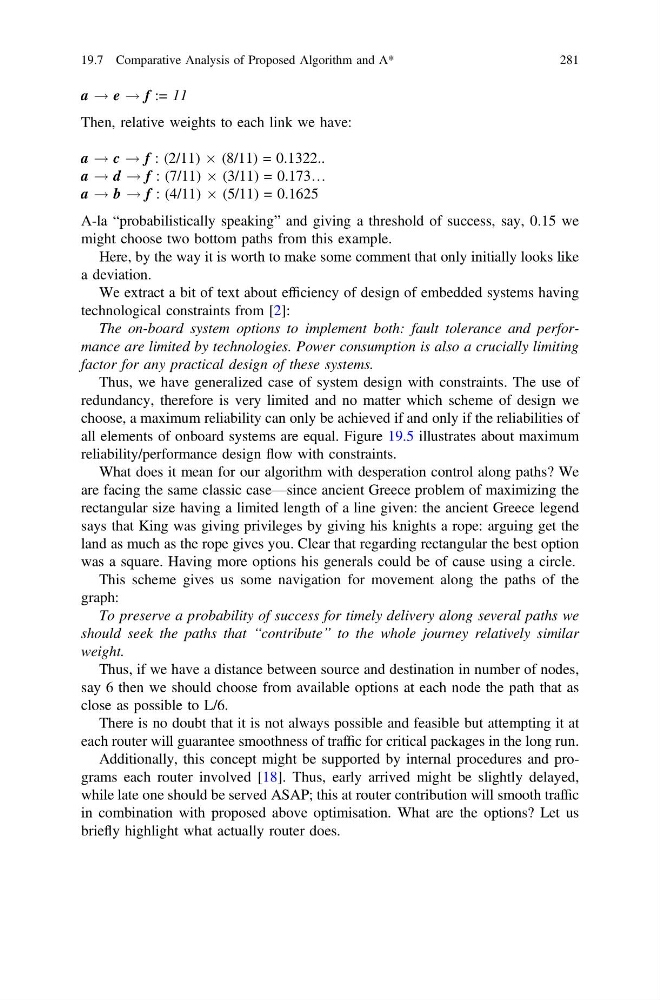
a ! e ! f := 11
Then, relative weights to each link we have:
a ! c ! f : (2/11) Â (8/11) = 0.1322..
a ! d ! f : (7/11) Â (3/11) = 0.173…
a ! b ! f : (4/11) Â (5/11) = 0.1625
A-la “probabilistically speaking” and giving a threshold of success, say, 0.15 we
might choose two bottom paths from this example.
Here, by the way it is worth to make some comment that only initially looks like
a deviation.
We extract a bit of text about efficiency of design of embedded systems having
technological constraints from [2]:
The on-board system options to implement both: fault tolerance and performance are limited by technologies. Power consumption is also a crucially limiting
factor for any practical design of these systems.
Thus, we have generalized case of system design with constraints. The use of
redundancy, therefore is very limited and no matter which scheme of design we
choose, a maximum reliability can only be achieved if and only if the reliabilities of
all elements of onboard systems are equal. Figure 19.5 illustrates about maximum
reliability/performance design flow with constraints.
What does it mean for our algorithm with desperation control along paths? We
are facing the same classic case—since ancient Greece problem of maximizing the
rectangular size having a limited length of a line given: the ancient Greece legend
says that King was giving privileges by giving his knights a rope: arguing get the
land as much as the rope gives you. Clear that regarding rectangular the best option
was a square. Having more options his generals could be of cause using a circle.
This scheme gives us some navigation for movement along the paths of the
graph:
To preserve a probability of success for timely delivery along several paths we
should seek the paths that “contribute” to the whole journey relatively similar
weight.
Thus, if we have a distance between source and destination in number of nodes,
say 6 then we should choose from available options at each node the path that as
close as possible to L/6.
There is no doubt that it is not always possible and feasible but attempting it at
each router will guarantee smoothness of traffic for critical packages in the long run.
Additionally, this concept might be supported by internal procedures and programs each router involved [18]. Thus, early arrived might be slightly delayed,
while late one should be served ASAP; this at router contribution will smooth traffic
in combination with proposed above optimisation. What are the options? Let us
briefly highlight what actually router does.
19.7 Comparative Analysis of Proposed Algorithm and A*
281
Then, relative weights to each link we have:
a ! c ! f : (2/11) Â (8/11) = 0.1322..
a ! d ! f : (7/11) Â (3/11) = 0.173…
a ! b ! f : (4/11) Â (5/11) = 0.1625
A-la “probabilistically speaking” and giving a threshold of success, say, 0.15 we
might choose two bottom paths from this example.
Here, by the way it is worth to make some comment that only initially looks like
a deviation.
We extract a bit of text about efficiency of design of embedded systems having
technological constraints from [2]:
The on-board system options to implement both: fault tolerance and performance are limited by technologies. Power consumption is also a crucially limiting
factor for any practical design of these systems.
Thus, we have generalized case of system design with constraints. The use of
redundancy, therefore is very limited and no matter which scheme of design we
choose, a maximum reliability can only be achieved if and only if the reliabilities of
all elements of onboard systems are equal. Figure 19.5 illustrates about maximum
reliability/performance design flow with constraints.
What does it mean for our algorithm with desperation control along paths? We
are facing the same classic case—since ancient Greece problem of maximizing the
rectangular size having a limited length of a line given: the ancient Greece legend
says that King was giving privileges by giving his knights a rope: arguing get the
land as much as the rope gives you. Clear that regarding rectangular the best option
was a square. Having more options his generals could be of cause using a circle.
This scheme gives us some navigation for movement along the paths of the
graph:
To preserve a probability of success for timely delivery along several paths we
should seek the paths that “contribute” to the whole journey relatively similar
weight.
Thus, if we have a distance between source and destination in number of nodes,
say 6 then we should choose from available options at each node the path that as
close as possible to L/6.
There is no doubt that it is not always possible and feasible but attempting it at
each router will guarantee smoothness of traffic for critical packages in the long run.
Additionally, this concept might be supported by internal procedures and programs each router involved [18]. Thus, early arrived might be slightly delayed,
while late one should be served ASAP; this at router contribution will smooth traffic
in combination with proposed above optimisation. What are the options? Let us
briefly highlight what actually router does.
19.7 Comparative Analysis of Proposed Algorithm and A*
281