

19.6 Desperation—Proposed Algorithms for Handling
In the algorithms of forward tracing and backward tracing (see for more details UK
patent [15], papers [5–7] books [1–3] we have introduced on-going probabilistic
reasoning to justify next step forward and next step backward. This enables us:
• to choose most likely further flow of events, predicting the future
• discover the most likely reason what went wrong (through backward tracing)
Both actions made possible preventing of unpleasant consequences and finding the
way to change the structure and element(s) of the system.
In our books [1–3] and patent [15] we were considering an idea of introduction a
realistic engineering constraints (with e f and e b ) of possible further propagations of
fault in the system.
Note here that an anomaly detected at one node (element) might cause serious
consequences for other nodes adjacent to the first we start considering. Equations
along the paths were based on multiplication of probabilities along the lists of
adjacent nodes:
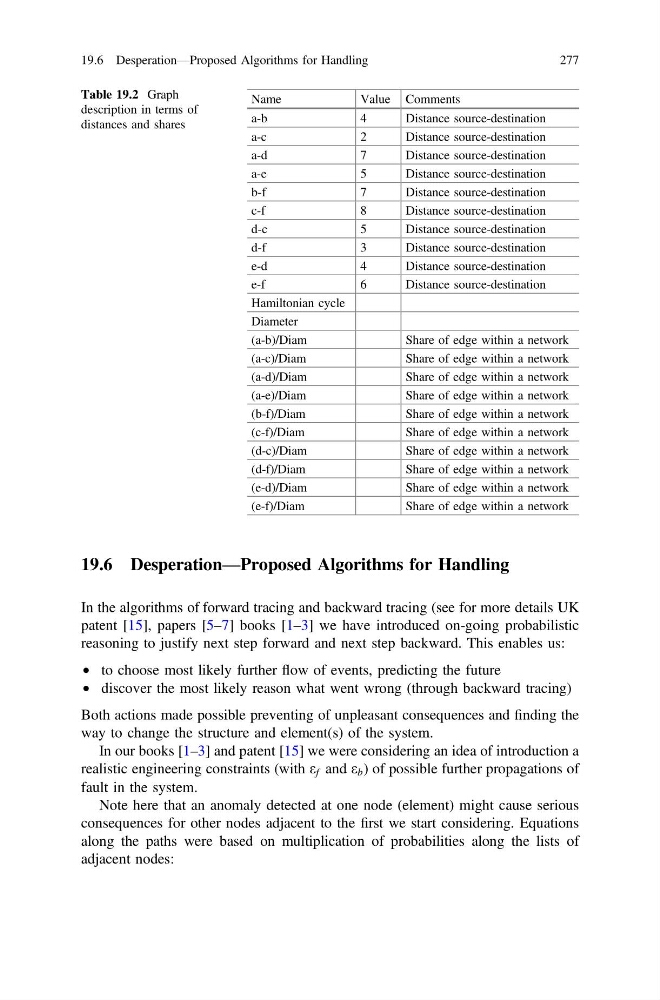
Table 19.2 Graph
description in terms of
distances and shares
Name
Value Comments
a-b
4
Distance source-destination
a-c
2
Distance source-destination
a-d
7
Distance source-destination
a-e
5
Distance source-destination
b-f
7
Distance source-destination
c-f
8
Distance source-destination
d-c
5
Distance source-destination
d-f
3
Distance source-destination
e-d
4
Distance source-destination
e-f
6
Distance source-destination
Hamiltonian cycle
Diameter
(a-b)/Diam
Share of edge within a network
(a-c)/Diam
Share of edge within a network
(a-d)/Diam
Share of edge within a network
(a-e)/Diam
Share of edge within a network
(b-f)/Diam
Share of edge within a network
(c-f)/Diam
Share of edge within a network
(d-c)/Diam
Share of edge within a network
(d-f)/Diam
Share of edge within a network
(e-d)/Diam
Share of edge within a network
(e-f)/Diam
Share of edge within a network
19.6 Desperation—Proposed Algorithms for Handling
277
In the algorithms of forward tracing and backward tracing (see for more details UK
patent [15], papers [5–7] books [1–3] we have introduced on-going probabilistic
reasoning to justify next step forward and next step backward. This enables us:
• to choose most likely further flow of events, predicting the future
• discover the most likely reason what went wrong (through backward tracing)
Both actions made possible preventing of unpleasant consequences and finding the
way to change the structure and element(s) of the system.
In our books [1–3] and patent [15] we were considering an idea of introduction a
realistic engineering constraints (with e f and e b ) of possible further propagations of
fault in the system.
Note here that an anomaly detected at one node (element) might cause serious
consequences for other nodes adjacent to the first we start considering. Equations
along the paths were based on multiplication of probabilities along the lists of
adjacent nodes:
Table 19.2 Graph
description in terms of
distances and shares
Name
Value Comments
a-b
4
Distance source-destination
a-c
2
Distance source-destination
a-d
7
Distance source-destination
a-e
5
Distance source-destination
b-f
7
Distance source-destination
c-f
8
Distance source-destination
d-c
5
Distance source-destination
d-f
3
Distance source-destination
e-d
4
Distance source-destination
e-f
6
Distance source-destination
Hamiltonian cycle
Diameter
(a-b)/Diam
Share of edge within a network
(a-c)/Diam
Share of edge within a network
(a-d)/Diam
Share of edge within a network
(a-e)/Diam
Share of edge within a network
(b-f)/Diam
Share of edge within a network
(c-f)/Diam
Share of edge within a network
(d-c)/Diam
Share of edge within a network
(d-f)/Diam
Share of edge within a network
(e-d)/Diam
Share of edge within a network
(e-f)/Diam
Share of edge within a network
19.6 Desperation—Proposed Algorithms for Handling
277