

Saying this all gives us some argumentation that cardinal number and diameter
of graph are good terms to discuss the role of number of nodes and cost (or weight)
of path when we introduce different type of packages. Any estimation in particular,
pre-estimation (before sending a package) provide information for evaluation of
package travel success in presence of time constraints.
When we speak about directed and weighted graph The diameter of a graph G, is
the maximum distance between two vertices or nodes. It usually denoted as Diam
(G) [14].
Also, it is worth to consider how far a source node distant from any other
vertices. For this, in graph theory a term eccentricity is used. The eccentricity of a
vertex is the maximum distance from it to any other vertex.
Note here that packages are treated by routing algorithms and routers in terms of
pursuing Hamiltonian property of the journey. Hamiltonian property of any path in
graph also known when implemented as Hamiltonian path.
Tracing of the path in the graph for routing assumes that package is not repeating
any of path and visits each vertex exactly once. Thus, for any node we can think
about Hamiltonian cycle any of two nodes—sender receiver we A Hamiltonian
cycle (or Hamiltonian circuit) is a Hamiltonian path that is a cycle. This is convenient to analyze when we seek a maximum length of routing for corporate
networks which have known structure and costs of the links.
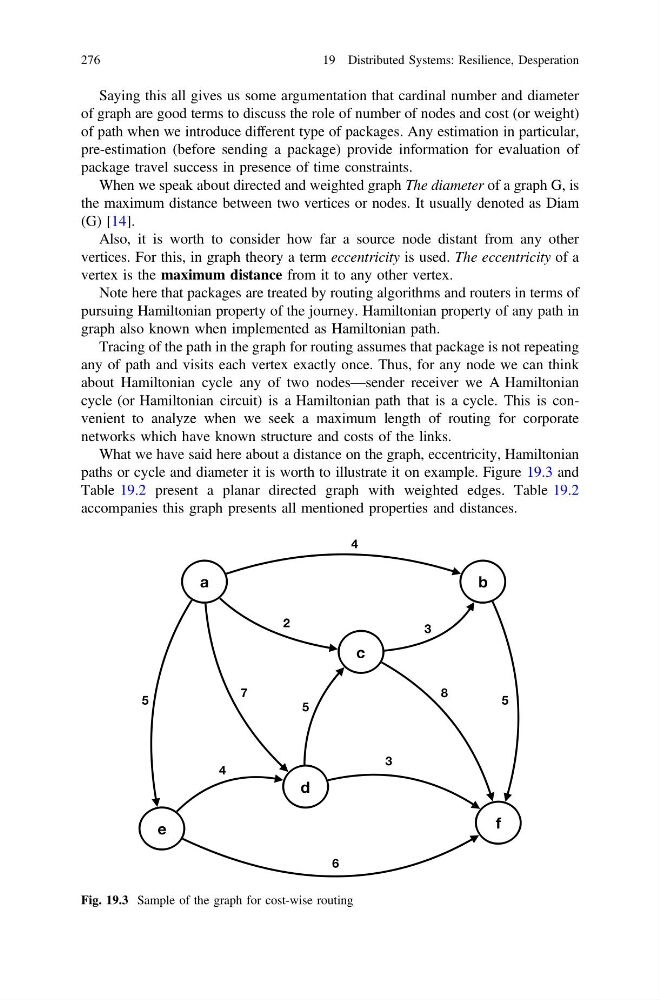
What we have said here about a distance on the graph, eccentricity, Hamiltonian
paths or cycle and diameter it is worth to illustrate it on example. Figure 19.3 and
Table 19.2 present a planar directed graph with weighted edges. Table 19.2
accompanies this graph presents all mentioned properties and distances.
Fig. 19.3 Sample of the graph for cost-wise routing
276
19 Distributed Systems: Resilience, Desperation
of graph are good terms to discuss the role of number of nodes and cost (or weight)
of path when we introduce different type of packages. Any estimation in particular,
pre-estimation (before sending a package) provide information for evaluation of
package travel success in presence of time constraints.
When we speak about directed and weighted graph The diameter of a graph G, is
the maximum distance between two vertices or nodes. It usually denoted as Diam
(G) [14].
Also, it is worth to consider how far a source node distant from any other
vertices. For this, in graph theory a term eccentricity is used. The eccentricity of a
vertex is the maximum distance from it to any other vertex.
Note here that packages are treated by routing algorithms and routers in terms of
pursuing Hamiltonian property of the journey. Hamiltonian property of any path in
graph also known when implemented as Hamiltonian path.
Tracing of the path in the graph for routing assumes that package is not repeating
any of path and visits each vertex exactly once. Thus, for any node we can think
about Hamiltonian cycle any of two nodes—sender receiver we A Hamiltonian
cycle (or Hamiltonian circuit) is a Hamiltonian path that is a cycle. This is convenient to analyze when we seek a maximum length of routing for corporate
networks which have known structure and costs of the links.
What we have said here about a distance on the graph, eccentricity, Hamiltonian
paths or cycle and diameter it is worth to illustrate it on example. Figure 19.3 and
Table 19.2 present a planar directed graph with weighted edges. Table 19.2
accompanies this graph presents all mentioned properties and distances.
Fig. 19.3 Sample of the graph for cost-wise routing
276
19 Distributed Systems: Resilience, Desperation