

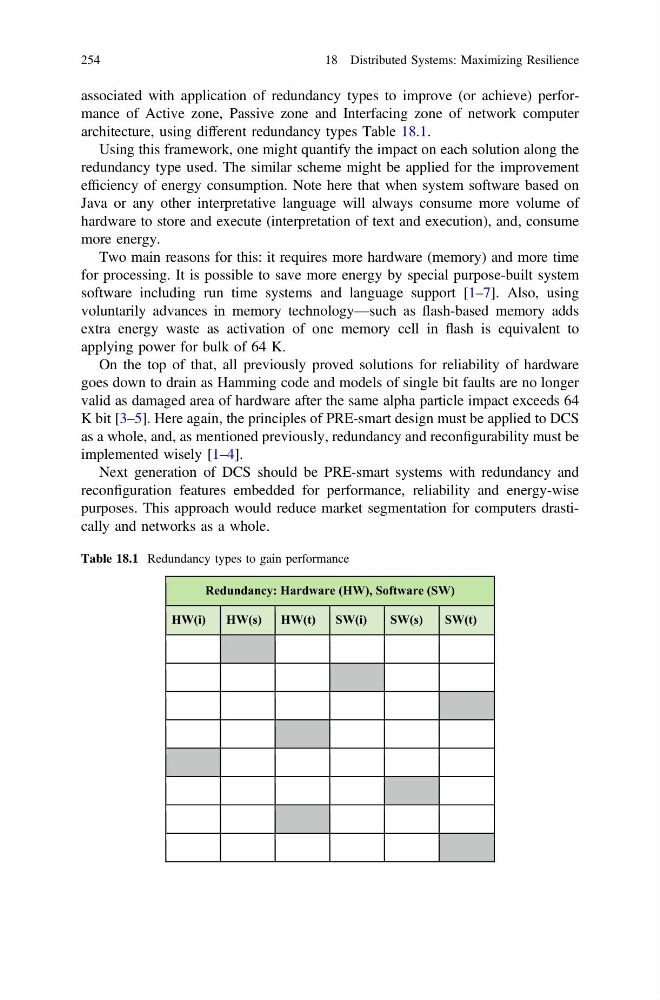
associated with application of redundancy types to improve (or achieve) performance of Active zone, Passive zone and Interfacing zone of network computer
architecture, using different redundancy types Table 18.1.
Using this framework, one might quantify the impact on each solution along the
redundancy type used. The similar scheme might be applied for the improvement
efficiency of energy consumption. Note here that when system software based on
Java or any other interpretative language will always consume more volume of
hardware to store and execute (interpretation of text and execution), and, consume
more energy.
Two main reasons for this: it requires more hardware (memory) and more time
for processing. It is possible to save more energy by special purpose-built system
software including run time systems and language support [1–7]. Also, using
voluntarily advances in memory technology—such as flash-based memory adds
extra energy waste as activation of one memory cell in flash is equivalent to
applying power for bulk of 64 K.
On the top of that, all previously proved solutions for reliability of hardware
goes down to drain as Hamming code and models of single bit faults are no longer
valid as damaged area of hardware after the same alpha particle impact exceeds 64
K bit [3–5]. Here again, the principles of PRE-smart design must be applied to DCS
as a whole, and, as mentioned previously, redundancy and reconfigurability must be
implemented wisely [1–4].
Next generation of DCS should be PRE-smart systems with redundancy and
reconfiguration features embedded for performance, reliability and energy-wise
purposes. This approach would reduce market segmentation for computers drastically and networks as a whole.
Table 18.1 Redundancy types to gain performance
Redundancy: Hardware (HW), Software (SW)
HW(i)
HW(s)
HW(t)
SW(i)
SW(s)
SW(t)
254
18 Distributed Systems: Maximizing Resilience
architecture, using different redundancy types Table 18.1.
Using this framework, one might quantify the impact on each solution along the
redundancy type used. The similar scheme might be applied for the improvement
efficiency of energy consumption. Note here that when system software based on
Java or any other interpretative language will always consume more volume of
hardware to store and execute (interpretation of text and execution), and, consume
more energy.
Two main reasons for this: it requires more hardware (memory) and more time
for processing. It is possible to save more energy by special purpose-built system
software including run time systems and language support [1–7]. Also, using
voluntarily advances in memory technology—such as flash-based memory adds
extra energy waste as activation of one memory cell in flash is equivalent to
applying power for bulk of 64 K.
On the top of that, all previously proved solutions for reliability of hardware
goes down to drain as Hamming code and models of single bit faults are no longer
valid as damaged area of hardware after the same alpha particle impact exceeds 64
K bit [3–5]. Here again, the principles of PRE-smart design must be applied to DCS
as a whole, and, as mentioned previously, redundancy and reconfigurability must be
implemented wisely [1–4].
Next generation of DCS should be PRE-smart systems with redundancy and
reconfiguration features embedded for performance, reliability and energy-wise
purposes. This approach would reduce market segmentation for computers drastically and networks as a whole.
Table 18.1 Redundancy types to gain performance
Redundancy: Hardware (HW), Software (SW)
HW(i)
HW(s)
HW(t)
SW(i)
SW(s)
SW(t)
254
18 Distributed Systems: Maximizing Resilience