

18.2.1 Redundancy of Distributed System: A Description
Important categories to describe redundancy are: structure, information and time
[11]. According to [5], a structural redundancy can be measured using graph or
graph-logic notation, as represented below:
dS : dV; dE
h
i:
ð18:1Þ
where dS represent structural redundancy, whereas dV and dE represents extra
vertices and edges added in the structure to aid in the implementation of reconfigurability. Therefore, PRE-goal can measure quantitatively as redundancy using
the following expression:
dR ¼ dT; dS; dI
h
i
ð18:2Þ
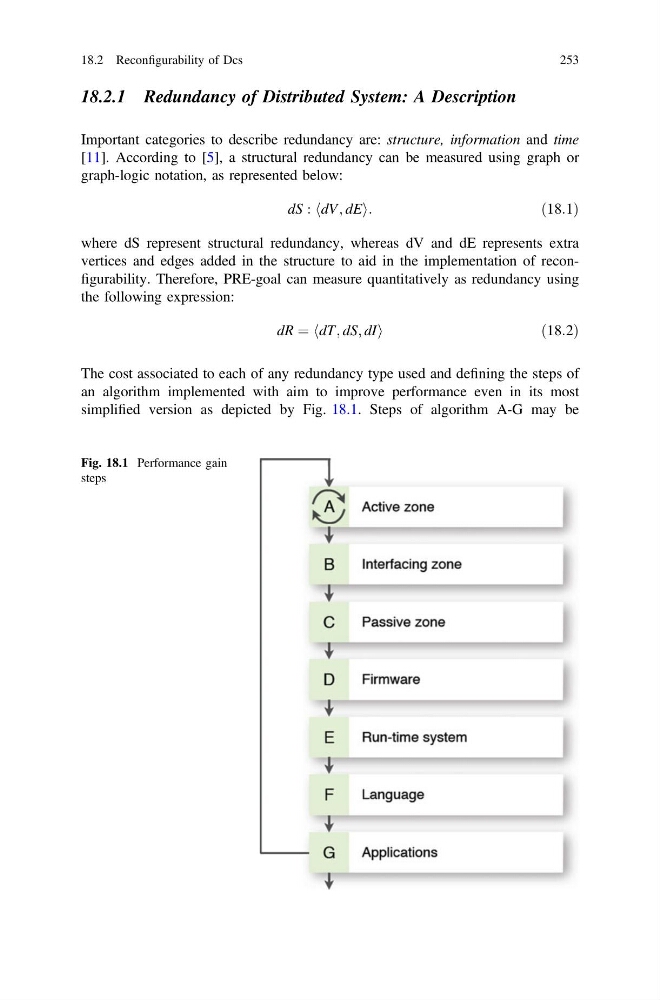
The cost associated to each of any redundancy type used and defining the steps of
an algorithm implemented with aim to improve performance even in its most
simplified version as depicted by Fig. 18.1. Steps of algorithm A-G may be
Fig. 18.1 Performance gain
steps
18.2 Reconfigurability of Dcs
253
Important categories to describe redundancy are: structure, information and time
[11]. According to [5], a structural redundancy can be measured using graph or
graph-logic notation, as represented below:
dS : dV; dE
h
i:
ð18:1Þ
where dS represent structural redundancy, whereas dV and dE represents extra
vertices and edges added in the structure to aid in the implementation of reconfigurability. Therefore, PRE-goal can measure quantitatively as redundancy using
the following expression:
dR ¼ dT; dS; dI
h
i
ð18:2Þ
The cost associated to each of any redundancy type used and defining the steps of
an algorithm implemented with aim to improve performance even in its most
simplified version as depicted by Fig. 18.1. Steps of algorithm A-G may be
Fig. 18.1 Performance gain
steps
18.2 Reconfigurability of Dcs
253