

additional serial time (Tis) plays an extremely important role in defining the
speedup scaling of a given calculation.
Most computer systems process information sequentially. Lines of code in a
computer program get translated into assembly language by the compiler, and the
latter gets decoded into microcode in the processor. Everything and every step
along the way is done sequentially. For example, a flowchart processing usually
includes multiplication or comparison of two digits; it starts with the first digit, and
then the second digit is introduced and the working register is set to 0.
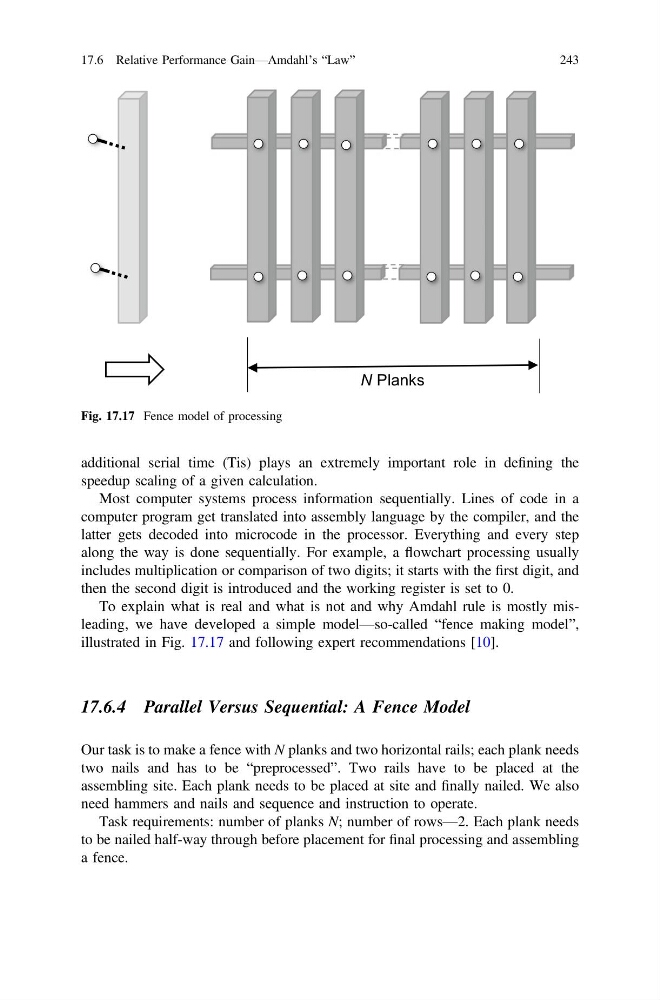
To explain what is real and what is not and why Amdahl rule is mostly misleading, we have developed a simple model—so-called “fence making model”,
illustrated in Fig. 17.17 and following expert recommendations [10].
17.6.4 Parallel Versus Sequential: A Fence Model
Our task is to make a fence with N planks and two horizontal rails; each plank needs
two nails and has to be “preprocessed”. Two rails have to be placed at the
assembling site. Each plank needs to be placed at site and finally nailed. We also
need hammers and nails and sequence and instruction to operate.
Task requirements: number of planks N; number of rows—2. Each plank needs
to be nailed half-way through before placement for final processing and assembling
a fence.
N Planks
Fig. 17.17 Fence model of processing
17.6 Relative Performance Gain—Amdahl’s “Law”
243
speedup scaling of a given calculation.
Most computer systems process information sequentially. Lines of code in a
computer program get translated into assembly language by the compiler, and the
latter gets decoded into microcode in the processor. Everything and every step
along the way is done sequentially. For example, a flowchart processing usually
includes multiplication or comparison of two digits; it starts with the first digit, and
then the second digit is introduced and the working register is set to 0.
To explain what is real and what is not and why Amdahl rule is mostly misleading, we have developed a simple model—so-called “fence making model”,
illustrated in Fig. 17.17 and following expert recommendations [10].
17.6.4 Parallel Versus Sequential: A Fence Model
Our task is to make a fence with N planks and two horizontal rails; each plank needs
two nails and has to be “preprocessed”. Two rails have to be placed at the
assembling site. Each plank needs to be placed at site and finally nailed. We also
need hammers and nails and sequence and instruction to operate.
Task requirements: number of planks N; number of rows—2. Each plank needs
to be nailed half-way through before placement for final processing and assembling
a fence.
N Planks
Fig. 17.17 Fence model of processing
17.6 Relative Performance Gain—Amdahl’s “Law”
243