

The recovery depth is small, and thus, the linear algorithm is better. For
Fig. 10.1, we used the following values:
malfunction rate [1/sec] k 1 = 0.0000027, k 2 = 0.0000003, k = 0.000003; permanent
fault/malfunction ratio S = 0.1; segment execution time [sec] T = 3; Time
parameters [sec] d = 0.5; d 1 = 1.0, d′ = 0.5; number of program segments from the
start [segments] k = 10.
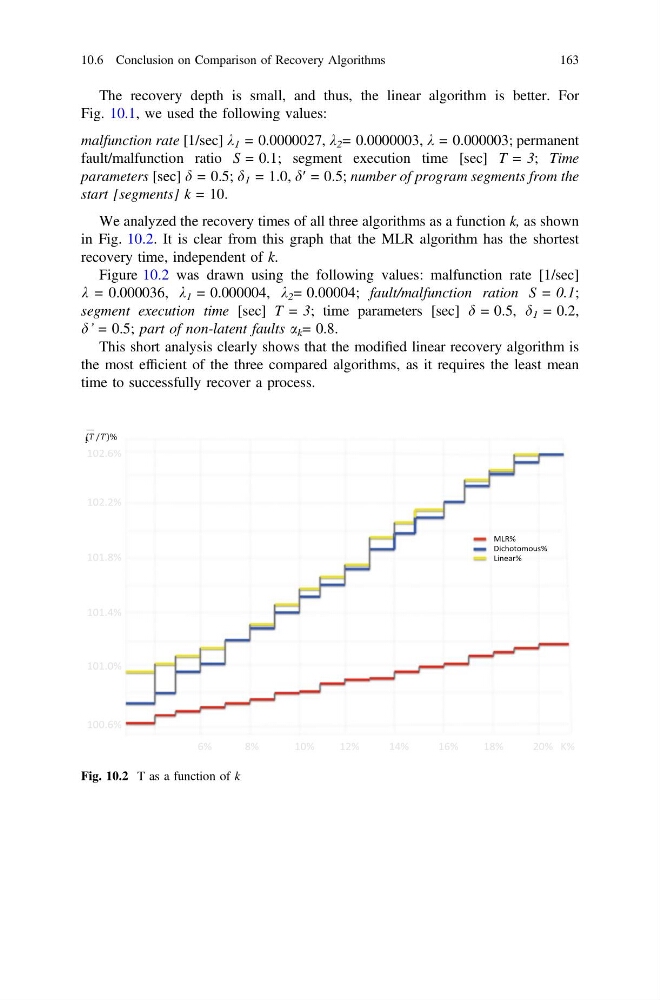
We analyzed the recovery times of all three algorithms as a function k, as shown
in Fig. 10.2. It is clear from this graph that the MLR algorithm has the shortest
recovery time, independent of k.
Figure 10.2 was drawn using the following values: malfunction rate [1/sec]
k = 0.000036, k 1 = 0.000004, k 2 = 0.00004; fault/malfunction ration S = 0.1;
segment execution time [sec] T = 3; time parameters [sec] d = 0.5, d 1 = 0.2,
d’ = 0.5; part of non-latent faults a k = 0.8.
This short analysis clearly shows that the modified linear recovery algorithm is
the most efficient of the three compared algorithms, as it requires the least mean
time to successfully recover a process.
100.6%
101.0%
101.4%
101.8%
102.2%
102.6%
6%
8%
10%
12%
14%
16%
18%
20% K%
MLR%
Dichotomous%
Linear%
Fig. 10.2 T as a function of k
10.6 Conclusion on Comparison of Recovery Algorithms
163
Fig. 10.1, we used the following values:
malfunction rate [1/sec] k 1 = 0.0000027, k 2 = 0.0000003, k = 0.000003; permanent
fault/malfunction ratio S = 0.1; segment execution time [sec] T = 3; Time
parameters [sec] d = 0.5; d 1 = 1.0, d′ = 0.5; number of program segments from the
start [segments] k = 10.
We analyzed the recovery times of all three algorithms as a function k, as shown
in Fig. 10.2. It is clear from this graph that the MLR algorithm has the shortest
recovery time, independent of k.
Figure 10.2 was drawn using the following values: malfunction rate [1/sec]
k = 0.000036, k 1 = 0.000004, k 2 = 0.00004; fault/malfunction ration S = 0.1;
segment execution time [sec] T = 3; time parameters [sec] d = 0.5, d 1 = 0.2,
d’ = 0.5; part of non-latent faults a k = 0.8.
This short analysis clearly shows that the modified linear recovery algorithm is
the most efficient of the three compared algorithms, as it requires the least mean
time to successfully recover a process.
100.6%
101.0%
101.4%
101.8%
102.2%
102.6%
6%
8%
10%
12%
14%
16%
18%
20% K%
MLR%
Dichotomous%
Linear%
Fig. 10.2 T as a function of k
10.6 Conclusion on Comparison of Recovery Algorithms
163