

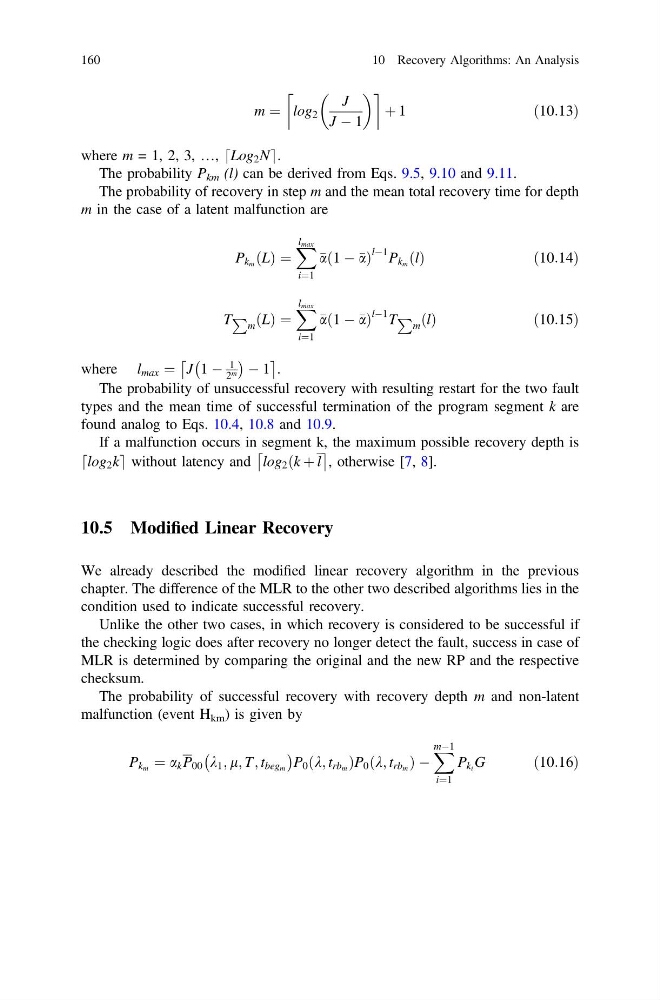
m ¼ log 2
J
J À 1
$
%
þ 1
ð10:13Þ
where m = 1, 2, 3, …, Log 2 N
d
e.
The probability P km (l) can be derived from Eqs. 9.5, 9.10 and 9.11.
The probability of recovery in step m and the mean total recovery time for depth
m in the case of a latent malfunction are
P k m ðLÞ ¼
X l max
i¼1
a 1 À a
ð
Þ
lÀ1 P k m ðlÞ
ð 10:14Þ
T P
m ðLÞ ¼
X l max
i¼1
a 1 À a
ð
Þ
lÀ1 T P
m ðlÞ
ð 10:15Þ
where l max ¼ J 1 À
1
2 m
À
Á
À 1
Æ
Ç
.
The probability of unsuccessful recovery with resulting restart for the two fault
types and the mean time of successful termination of the program segment k are
found analog to Eqs. 10.4, 10.8 and 10.9.
If a malfunction occurs in segment k, the maximum possible recovery depth is
log 2 k
d
e without latency and log 2 ðk þ l
Æ
Ç
, otherwise [7, 8].
10.5 Modified Linear Recovery
We already described the modified linear recovery algorithm in the previous
chapter. The difference of the MLR to the other two described algorithms lies in the
condition used to indicate successful recovery.
Unlike the other two cases, in which recovery is considered to be successful if
the checking logic does after recovery no longer detect the fault, success in case of
MLR is determined by comparing the original and the new RP and the respective
checksum.
The probability of successful recovery with recovery depth m and non-latent
malfunction (event H km ) is given by
P k m ¼ a k P 00 k 1 ; l; T; t beg m
À
Á
P 0 k; t rb m
ð
ÞP 0 k; t rb m
ð
ÞÀ
X mÀ1
i¼1
P k i G
ð10:16Þ
160
10 Recovery Algorithms: An Analysis
J
J À 1
$
%
þ 1
ð10:13Þ
where m = 1, 2, 3, …, Log 2 N
d
e.
The probability P km (l) can be derived from Eqs. 9.5, 9.10 and 9.11.
The probability of recovery in step m and the mean total recovery time for depth
m in the case of a latent malfunction are
P k m ðLÞ ¼
X l max
i¼1
a 1 À a
ð
Þ
lÀ1 P k m ðlÞ
ð 10:14Þ
T P
m ðLÞ ¼
X l max
i¼1
a 1 À a
ð
Þ
lÀ1 T P
m ðlÞ
ð 10:15Þ
where l max ¼ J 1 À
1
2 m
À
Á
À 1
Æ
Ç
.
The probability of unsuccessful recovery with resulting restart for the two fault
types and the mean time of successful termination of the program segment k are
found analog to Eqs. 10.4, 10.8 and 10.9.
If a malfunction occurs in segment k, the maximum possible recovery depth is
log 2 k
d
e without latency and log 2 ðk þ l
Æ
Ç
, otherwise [7, 8].
10.5 Modified Linear Recovery
We already described the modified linear recovery algorithm in the previous
chapter. The difference of the MLR to the other two described algorithms lies in the
condition used to indicate successful recovery.
Unlike the other two cases, in which recovery is considered to be successful if
the checking logic does after recovery no longer detect the fault, success in case of
MLR is determined by comparing the original and the new RP and the respective
checksum.
The probability of successful recovery with recovery depth m and non-latent
malfunction (event H km ) is given by
P k m ¼ a k P 00 k 1 ; l; T; t beg m
À
Á
P 0 k; t rb m
ð
ÞP 0 k; t rb m
ð
ÞÀ
X mÀ1
i¼1
P k i G
ð10:16Þ
160
10 Recovery Algorithms: An Analysis