

testing code or code, which has to be relocatable, could indeed use the second
approach.
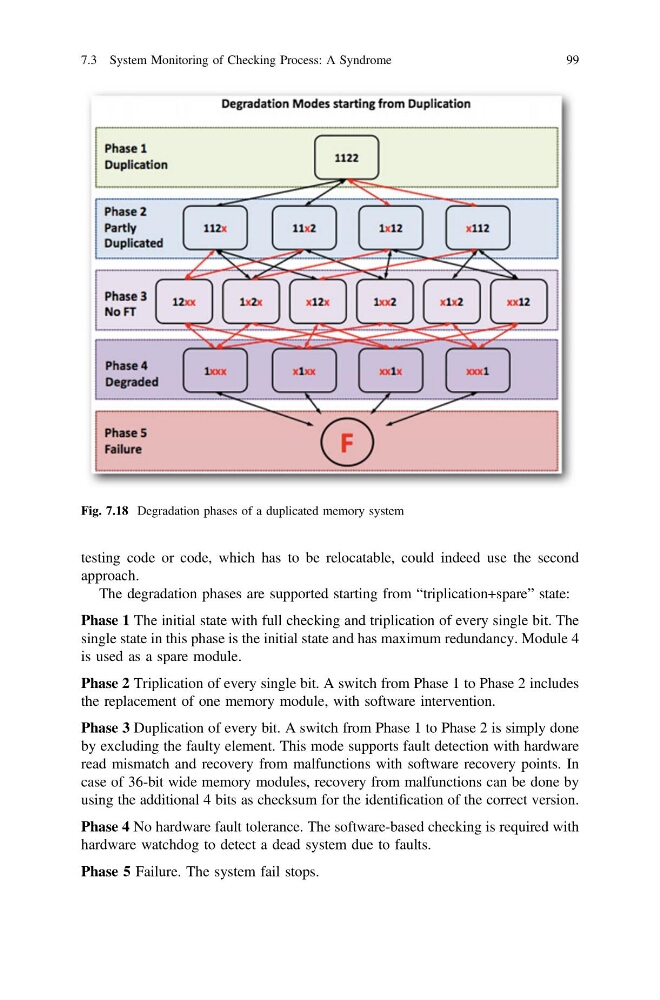
The degradation phases are supported starting from “triplication+spare” state:
Phase 1 The initial state with full checking and triplication of every single bit. The
single state in this phase is the initial state and has maximum redundancy. Module 4
is used as a spare module.
Phase 2 Triplication of every single bit. A switch from Phase 1 to Phase 2 includes
the replacement of one memory module, with software intervention.
Phase 3 Duplication of every bit. A switch from Phase 1 to Phase 2 is simply done
by excluding the faulty element. This mode supports fault detection with hardware
read mismatch and recovery from malfunctions with software recovery points. In
case of 36-bit wide memory modules, recovery from malfunctions can be done by
using the additional 4 bits as checksum for the identification of the correct version.
Phase 4 No hardware fault tolerance. The software-based checking is required with
hardware watchdog to detect a dead system due to faults.
Phase 5 Failure. The system fail stops.
Fig. 7.18 Degradation phases of a duplicated memory system
7.3 System Monitoring of Checking Process: A Syndrome
99
approach.
The degradation phases are supported starting from “triplication+spare” state:
Phase 1 The initial state with full checking and triplication of every single bit. The
single state in this phase is the initial state and has maximum redundancy. Module 4
is used as a spare module.
Phase 2 Triplication of every single bit. A switch from Phase 1 to Phase 2 includes
the replacement of one memory module, with software intervention.
Phase 3 Duplication of every bit. A switch from Phase 1 to Phase 2 is simply done
by excluding the faulty element. This mode supports fault detection with hardware
read mismatch and recovery from malfunctions with software recovery points. In
case of 36-bit wide memory modules, recovery from malfunctions can be done by
using the additional 4 bits as checksum for the identification of the correct version.
Phase 4 No hardware fault tolerance. The software-based checking is required with
hardware watchdog to detect a dead system due to faults.
Phase 5 Failure. The system fail stops.
Fig. 7.18 Degradation phases of a duplicated memory system
7.3 System Monitoring of Checking Process: A Syndrome
99