

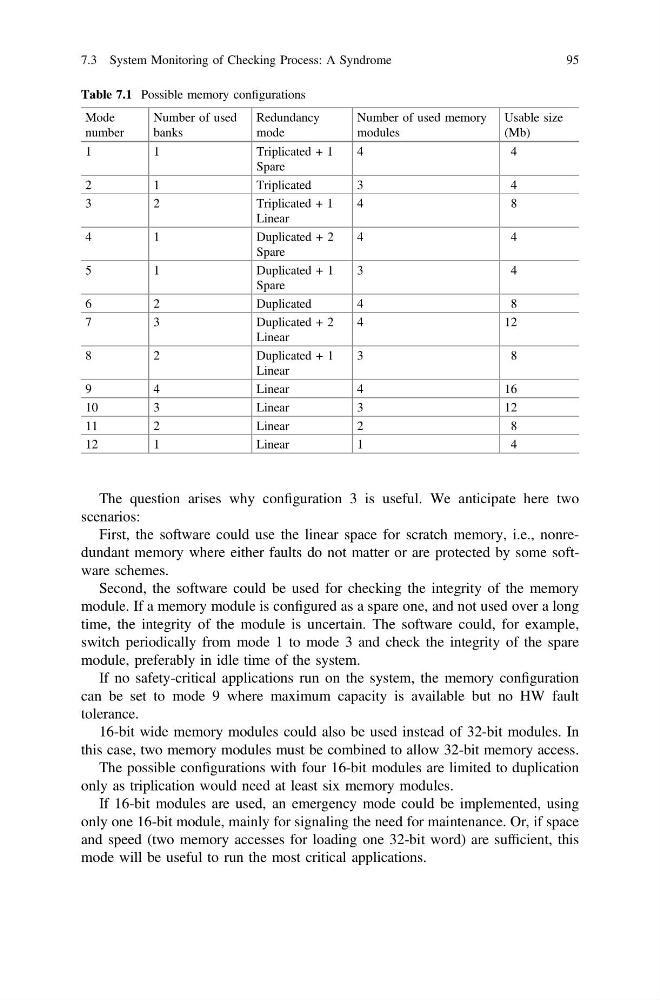
The question arises why configuration 3 is useful. We anticipate here two
scenarios:
First, the software could use the linear space for scratch memory, i.e., nonredundant memory where either faults do not matter or are protected by some software schemes.
Second, the software could be used for checking the integrity of the memory
module. If a memory module is configured as a spare one, and not used over a long
time, the integrity of the module is uncertain. The software could, for example,
switch periodically from mode 1 to mode 3 and check the integrity of the spare
module, preferably in idle time of the system.
If no safety-critical applications run on the system, the memory configuration
can be set to mode 9 where maximum capacity is available but no HW fault
tolerance.
16-bit wide memory modules could also be used instead of 32-bit modules. In
this case, two memory modules must be combined to allow 32-bit memory access.
The possible configurations with four 16-bit modules are limited to duplication
only as triplication would need at least six memory modules.
If 16-bit modules are used, an emergency mode could be implemented, using
only one 16-bit module, mainly for signaling the need for maintenance. Or, if space
and speed (two memory accesses for loading one 32-bit word) are sufficient, this
mode will be useful to run the most critical applications.
Table 7.1 Possible memory configurations
Mode
number
Number of used
banks
Redundancy
mode
Number of used memory
modules
Usable size
(Mb)
1
1
Triplicated + 1
Spare
4
4
2
1
Triplicated
3
4
3
2
Triplicated + 1
Linear
4
8
4
1
Duplicated + 2
Spare
4
4
5
1
Duplicated + 1
Spare
3
4
6
2
Duplicated
4
8
7
3
Duplicated + 2
Linear
4
1 2
8
2
Duplicated + 1
Linear
3
8
9
4
Linear
4
16
10
3
Linear
3
12
11
2
Linear
2
8
12
1
Linear
1
4
7.3 System Monitoring of Checking Process: A Syndrome
95
scenarios:
First, the software could use the linear space for scratch memory, i.e., nonredundant memory where either faults do not matter or are protected by some software schemes.
Second, the software could be used for checking the integrity of the memory
module. If a memory module is configured as a spare one, and not used over a long
time, the integrity of the module is uncertain. The software could, for example,
switch periodically from mode 1 to mode 3 and check the integrity of the spare
module, preferably in idle time of the system.
If no safety-critical applications run on the system, the memory configuration
can be set to mode 9 where maximum capacity is available but no HW fault
tolerance.
16-bit wide memory modules could also be used instead of 32-bit modules. In
this case, two memory modules must be combined to allow 32-bit memory access.
The possible configurations with four 16-bit modules are limited to duplication
only as triplication would need at least six memory modules.
If 16-bit modules are used, an emergency mode could be implemented, using
only one 16-bit module, mainly for signaling the need for maintenance. Or, if space
and speed (two memory accesses for loading one 32-bit word) are sufficient, this
mode will be useful to run the most critical applications.
Table 7.1 Possible memory configurations
Mode
number
Number of used
banks
Redundancy
mode
Number of used memory
modules
Usable size
(Mb)
1
1
Triplicated + 1
Spare
4
4
2
1
Triplicated
3
4
3
2
Triplicated + 1
Linear
4
8
4
1
Duplicated + 2
Spare
4
4
5
1
Duplicated + 1
Spare
3
4
6
2
Duplicated
4
8
7
3
Duplicated + 2
Linear
4
1 2
8
2
Duplicated + 1
Linear
3
8
9
4
Linear
4
16
10
3
Linear
3
12
11
2
Linear
2
8
12
1
Linear
1
4
7.3 System Monitoring of Checking Process: A Syndrome
95