

A separation of the functions of processing (of data operation) and storing
(memory) enables to apply various checking, recovery, and reconfiguration solutions and making system more flexible. The Syndrome acts as a control center for
three main functions including fault monitoring, reconfigurability, and recovery.
A syndrome is conceptually speaking can be considered as a real-time status for
every element of the system. However, its function is not only passive, presenting a
“snapshot-status”, but also active, serving as a control manager of the system.
In the following, we present how the concept of syndrome is implemented using
Embedded Reconfigurable Architecture (ERA) [11] as an example. From the
software point of view, the syndrome is represented as a set of special hardware
registers that shows the current hardware state (current configuration, detected
faults, power) and can, in case of detected faults, signal them to the software via
interrupts.
NB. Pictures of syndrome (Figs. 7.12, 7.13 and 7.14) for our proposed architecture
ERA [10] were prepared by Dr. Victor Castano and with his kind permission are
introduced here.
As an example platform to illustrate the syndrome, we use here the simulator of
the same processor architecture ERA with all its devices as it is implemented. See
Appendix A for more details about the simulator. The syndrome implementation in
hardware is currently ongoing but we still give in this section some implementation
guidelines.
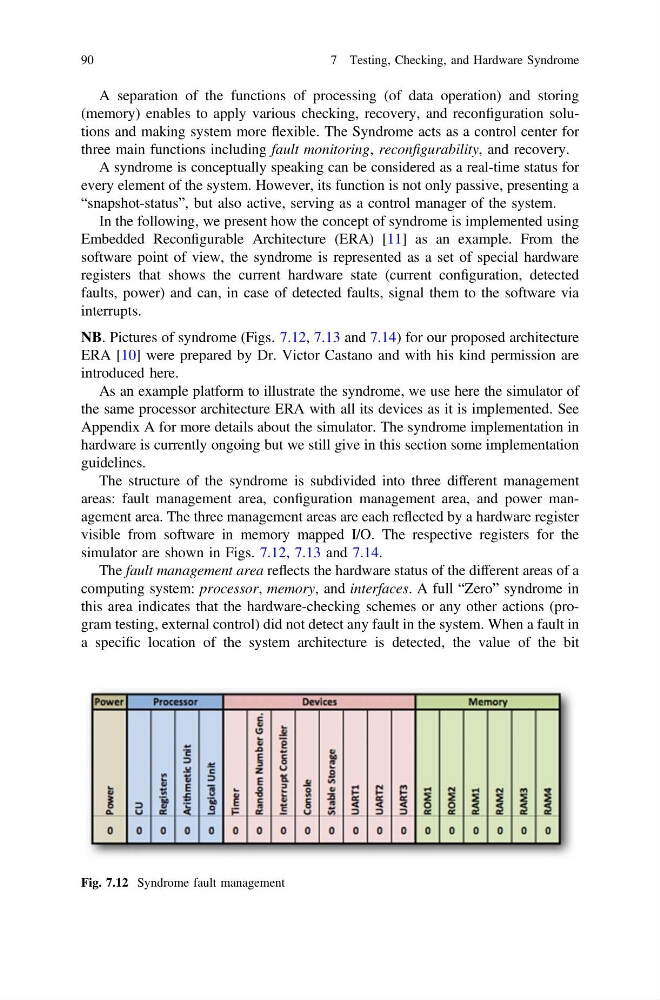
The structure of the syndrome is subdivided into three different management
areas: fault management area, configuration management area, and power management area. The three management areas are each reflected by a hardware register
visible from software in memory mapped I/O. The respective registers for the
simulator are shown in Figs. 7.12, 7.13 and 7.14.
The fault management area reflects the hardware status of the different areas of a
computing system: processor, memory, and interfaces. A full “Zero” syndrome in
this area indicates that the hardware-checking schemes or any other actions (program testing, external control) did not detect any fault in the system. When a fault in
a specific location of the system architecture is detected, the value of the bit
Fig. 7.12 Syndrome fault management
90
7 Testing, Checking, and Hardware Syndrome
(memory) enables to apply various checking, recovery, and reconfiguration solutions and making system more flexible. The Syndrome acts as a control center for
three main functions including fault monitoring, reconfigurability, and recovery.
A syndrome is conceptually speaking can be considered as a real-time status for
every element of the system. However, its function is not only passive, presenting a
“snapshot-status”, but also active, serving as a control manager of the system.
In the following, we present how the concept of syndrome is implemented using
Embedded Reconfigurable Architecture (ERA) [11] as an example. From the
software point of view, the syndrome is represented as a set of special hardware
registers that shows the current hardware state (current configuration, detected
faults, power) and can, in case of detected faults, signal them to the software via
interrupts.
NB. Pictures of syndrome (Figs. 7.12, 7.13 and 7.14) for our proposed architecture
ERA [10] were prepared by Dr. Victor Castano and with his kind permission are
introduced here.
As an example platform to illustrate the syndrome, we use here the simulator of
the same processor architecture ERA with all its devices as it is implemented. See
Appendix A for more details about the simulator. The syndrome implementation in
hardware is currently ongoing but we still give in this section some implementation
guidelines.
The structure of the syndrome is subdivided into three different management
areas: fault management area, configuration management area, and power management area. The three management areas are each reflected by a hardware register
visible from software in memory mapped I/O. The respective registers for the
simulator are shown in Figs. 7.12, 7.13 and 7.14.
The fault management area reflects the hardware status of the different areas of a
computing system: processor, memory, and interfaces. A full “Zero” syndrome in
this area indicates that the hardware-checking schemes or any other actions (program testing, external control) did not detect any fault in the system. When a fault in
a specific location of the system architecture is detected, the value of the bit
Fig. 7.12 Syndrome fault management
90
7 Testing, Checking, and Hardware Syndrome