

6.3 Signals and Patterns
91
that such a profile could be established in a reasonable time, within a few hours,
in a millimeter-sized embryo, but would take a full day in a centimeter-sized animal. This estimate does not change in the more realistic case of an exponentially
decreasing profile of a morphogen decaying within a tissue, and is not limited to
diffusional transport. Morphogen proteins are not sufficiently stable to travel far,
and the essential body organization must already take place in the embryo. The signaling scenario was transformed from hypothetical to proven after the first protein
morphogen, Bicoid, was identified, forming a gradient along the antero-posterior
axis in the Drosophila embryo (N¨ usslein-Volhard and Frohnh¨ ofer, 1986) 4 .
Hans Meinhardt (1982) devised several pattern-forming mechanisms bringing
Turing’s scheme closer to biological reality. The important points were attention
to the polarity of the body plan and the influence of boundaries. Polarity is always
present in the body plan of animals with either bilateral or central symmetry, as long
as their head and tail ends are different and morphogen gradients have a definite
direction. In this way, patterning is tied to the idea of positional information put
forward by Wolpert (1969). An additional organizer may be incapacitated by lateral
inhibition; thus, implanting such an organizer to incite a hydra to grow another head
fails if it is placed close to the existing head. Meinhardt observed that hydra, that
belovedly simple animal, has separate organizers at both ends, and their realignment
could have naturally produced the dorsal–ventral axis supplementing the anteroposterior axis in bilaterians.
Early work concentrated on one-dimensional patterning along the principal direction of a signal – but far more possibilities exist when there are two organizing
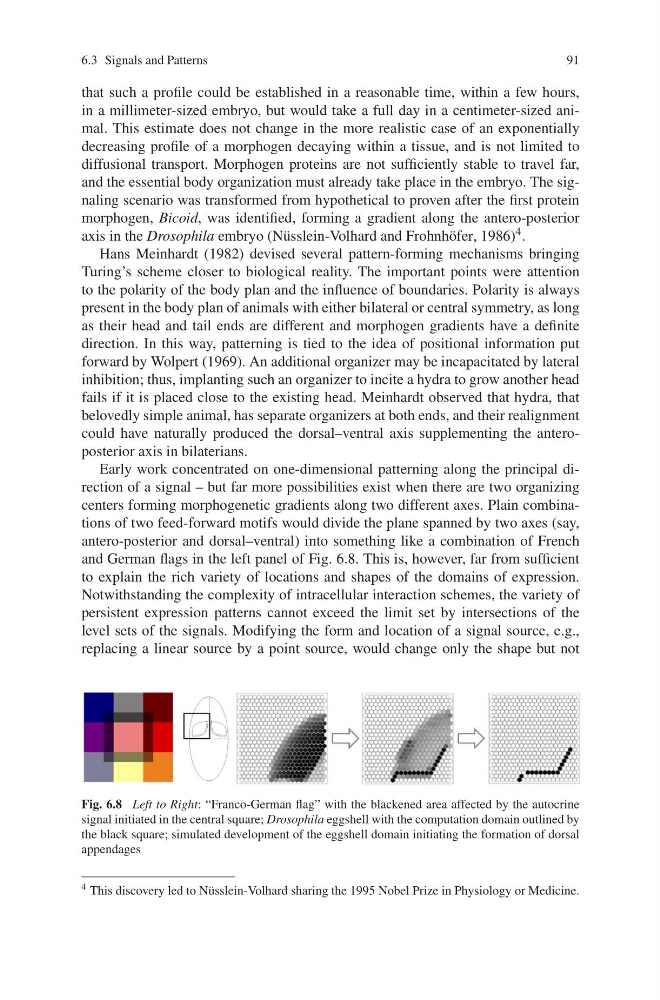
centers forming morphogenetic gradients along two different axes. Plain combinations of two feed-forward motifs would divide the plane spanned by two axes (say,
antero-posterior and dorsal–ventral) into something like a combination of French
and German flags in the left panel of Fig. 6.8. This is, however, far from sufficient
to explain the rich variety of locations and shapes of the domains of expression.
Notwithstanding the complexity of intracellular interaction schemes, the variety of
persistent expression patterns cannot exceed the limit set by intersections of the
level sets of the signals. Modifying the form and location of a signal source, e.g.,
replacing a linear source by a point source, would change only the shape but not
Fig. 6.8 Left to Right: “Franco-German flag” with the blackened area affected by the autocrine
signal initiated in the central square; Drosophila eggshell with the computation domain outlined by
the black square; simulated development of the eggshell domain initiating the formation of dorsal
appendages
4 This discovery led to N¨ usslein-Volhard sharing the 1995 Nobel Prize in Physiology or Medicine.
91
that such a profile could be established in a reasonable time, within a few hours,
in a millimeter-sized embryo, but would take a full day in a centimeter-sized animal. This estimate does not change in the more realistic case of an exponentially
decreasing profile of a morphogen decaying within a tissue, and is not limited to
diffusional transport. Morphogen proteins are not sufficiently stable to travel far,
and the essential body organization must already take place in the embryo. The signaling scenario was transformed from hypothetical to proven after the first protein
morphogen, Bicoid, was identified, forming a gradient along the antero-posterior
axis in the Drosophila embryo (N¨ usslein-Volhard and Frohnh¨ ofer, 1986) 4 .
Hans Meinhardt (1982) devised several pattern-forming mechanisms bringing
Turing’s scheme closer to biological reality. The important points were attention
to the polarity of the body plan and the influence of boundaries. Polarity is always
present in the body plan of animals with either bilateral or central symmetry, as long
as their head and tail ends are different and morphogen gradients have a definite
direction. In this way, patterning is tied to the idea of positional information put
forward by Wolpert (1969). An additional organizer may be incapacitated by lateral
inhibition; thus, implanting such an organizer to incite a hydra to grow another head
fails if it is placed close to the existing head. Meinhardt observed that hydra, that
belovedly simple animal, has separate organizers at both ends, and their realignment
could have naturally produced the dorsal–ventral axis supplementing the anteroposterior axis in bilaterians.
Early work concentrated on one-dimensional patterning along the principal direction of a signal – but far more possibilities exist when there are two organizing
centers forming morphogenetic gradients along two different axes. Plain combinations of two feed-forward motifs would divide the plane spanned by two axes (say,
antero-posterior and dorsal–ventral) into something like a combination of French
and German flags in the left panel of Fig. 6.8. This is, however, far from sufficient
to explain the rich variety of locations and shapes of the domains of expression.
Notwithstanding the complexity of intracellular interaction schemes, the variety of
persistent expression patterns cannot exceed the limit set by intersections of the
level sets of the signals. Modifying the form and location of a signal source, e.g.,
replacing a linear source by a point source, would change only the shape but not
Fig. 6.8 Left to Right: “Franco-German flag” with the blackened area affected by the autocrine
signal initiated in the central square; Drosophila eggshell with the computation domain outlined by
the black square; simulated development of the eggshell domain initiating the formation of dorsal
appendages
4 This discovery led to N¨ usslein-Volhard sharing the 1995 Nobel Prize in Physiology or Medicine.